ChatGPT 5.6 represents a major shift from a general-purpose conversational assistant toward a more capable system for complex professional work. The new generation is designed to handle demanding tasks in coding, research, science, cybersecurity, computer use, document creation, and visual design with greater accuracy and efficiency.
Modern antivirus protection is no longer limited to searching for traditional computer viruses. It is designed to identify a much wider range of threats, including ransomware, spyware, password stealers, banking Trojans, malicious scripts, rootkits, worms, and potentially unwanted applications.
Artificial intelligence has become an essential tool in modern software development. AI coding assistants can generate code, explain complex algorithms, detect bugs, write documentation, create tests, and even suggest architectural improvements. As these tools continue to evolve, developers are discovering that AI is most effective not as a replacement for programming skills but as a powerful productivity partner. From individual developers to enterprise engineering teams, AI coding assistants are helping accelerate development cycles while improving code quality. However, achieving the best results requires understanding how to collaborate effectively with AI rather than relying on it blindly. The most successful developers use AI to enhance their expertise, automate repetitive work, and focus on solving complex engineering problems.
Artificial intelligence has fundamentally transformed social media. Today, AI can generate realistic images, videos, voices, articles, influencers, and even entire online personalities within minutes. While these technologies unlock exciting creative opportunities, they also introduce one of the biggest challenges the digital world has ever faced: the explosion of synthetic content. Every day, millions of AI-generated posts are uploaded to platforms such as Instagram, TikTok, Facebook, X, and YouTube. In many cases, users cannot distinguish between authentic human-created content and material produced entirely by artificial intelligence. As generative AI becomes more accessible, the internet is entering an era where authenticity is increasingly difficult to verify.
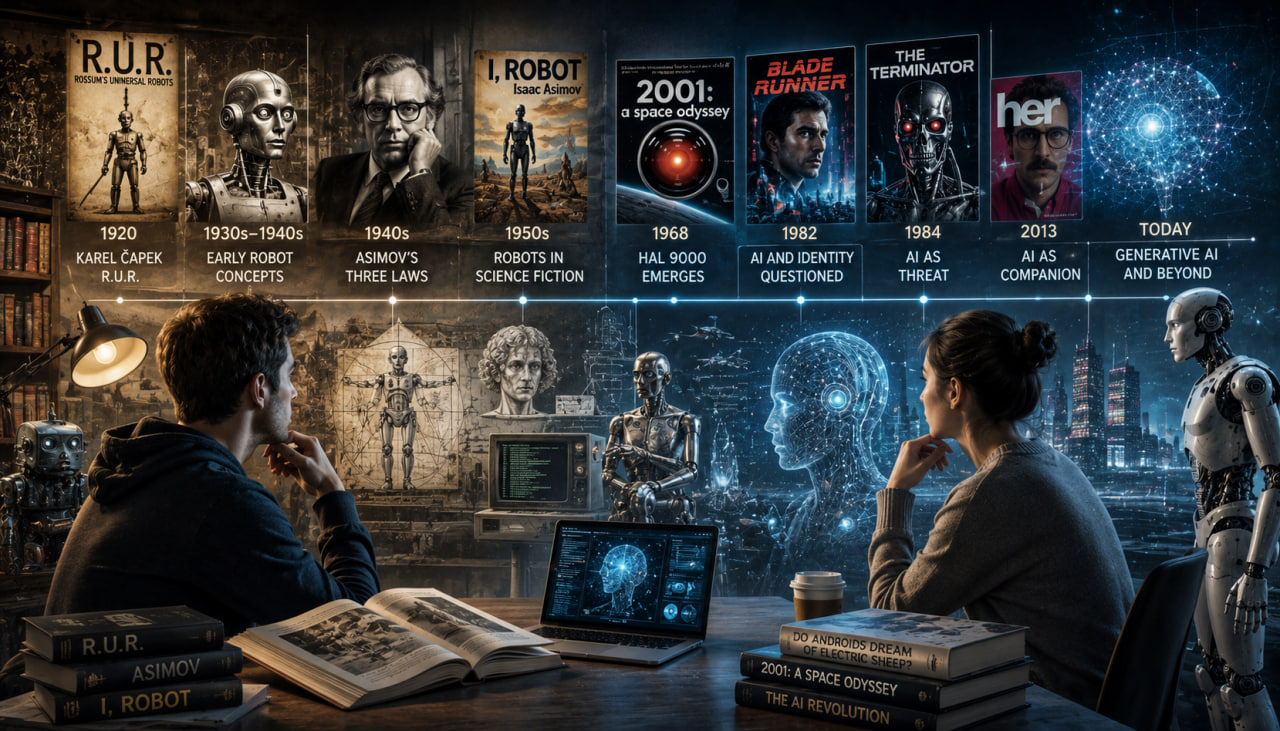
Long before artificial intelligence became a reality, science fiction imagined intelligent machines capable of thinking, learning, and even surpassing humanity. Writers, filmmakers, and visionaries explored the possibilities of synthetic intelligence decades before modern computers could perform even the simplest calculations. Today, many ideas once confined to novels and films have become part of everyday life. AI assistants, autonomous robots, machine learning systems, and generative AI all have roots in fictional worlds that inspired generations of scientists and engineers. The history of artificial intelligence in science fiction is not only a story of imagination—it is also a story of how fiction has influenced real technological innovation.
Artificial intelligence is rapidly transforming the music industry. What once required years of musical training, expensive studio equipment, and collaboration with professional producers can now be partially achieved through advanced AI systems capable of generating melodies, harmonies, vocals, and complete songs within minutes. One of the most fascinating and controversial applications of this technology is the ability to create music that resembles the style of famous artists. While AI cannot truly replicate human creativity, modern models can analyze vast amounts of musical data and generate compositions that capture recognizable characteristics of particular genres, eras, and performers. As AI-generated music becomes increasingly sophisticated, it is raising important questions about creativity, copyright, and the future of the music business.
Artificial intelligence has become one of the most important technologies for modern businesses. Organizations across industries are integrating AI into customer service, marketing, analytics, automation, software development, and decision-making processes. As AI adoption accelerates, companies often face a critical strategic question: Should we build our own AI system or use existing AI APIs? At first glance, creating a proprietary AI solution may seem attractive. It offers greater control, customization, and potential competitive advantages. However, developing AI from scratch requires significant investments in talent, infrastructure, data, and ongoing maintenance. On the other hand, AI APIs provide immediate access to powerful capabilities with minimal development effort, but they may introduce limitations related to cost, customization, and vendor dependence. Choosing the right approach depends on business objectives, resources, technical requirements, and long-term strategy.
Artificial intelligence is no longer an experimental technology reserved for large corporations. Businesses of all sizes are investing in AI to automate processes, improve customer experiences, reduce costs, and create new revenue opportunities. However, one critical question remains at the center of every AI initiative: How do you measure the return on investment (ROI) of an AI project? Unlike traditional software implementations, AI projects often generate value in multiple ways. Some benefits are directly measurable through cost reductions or increased revenue, while others involve productivity gains, improved decision-making, risk reduction, or enhanced customer satisfaction. As a result, calculating AI ROI can be more complex than evaluating conventional technology investments. Organizations that accurately measure ROI are far more likely to secure executive support, justify future investments, and maximize long-term value from artificial intelligence.
Artificial intelligence has become one of the most influential business technologies of the modern era. Organizations across virtually every industry are investing in AI to improve productivity, automate routine tasks, reduce costs, enhance customer experiences, and gain competitive advantages. According to numerous industry studies, AI adoption continues to accelerate globally. However, despite growing investment, many projects fail to deliver the expected results. The reason is rarely the technology itself. More often, failures occur because organizations approach AI implementation incorrectly. Unrealistic expectations, poor planning, inadequate data management, and insufficient employee involvement frequently undermine otherwise promising initiatives. Understanding the most common mistakes can help businesses avoid costly setbacks and maximize the value of their AI investments. Successful AI implementation is as much about people, processes, and strategy as it is about technology.
Artificial intelligence is no longer a technology reserved for large corporations with billion-dollar budgets. Over the past few years, AI tools have become more affordable, accessible, and practical for small and medium-sized businesses (SMBs). Today, companies with just a few employees can leverage AI to improve productivity, automate routine tasks, enhance customer service, and make better business decisions. Despite growing interest, many business owners remain uncertain about where to begin. The challenge is not whether AI can create value, but how to implement it effectively without unnecessary complexity or expense. The most successful AI adoption strategies usually start small, focus on measurable business outcomes, and expand gradually as organizations gain experience. For most SMBs, the goal is not replacing employees with AI—it is enabling employees to work more efficiently and focus on higher-value activities.