Artificial intelligence can write essays, solve equations, analyze images, generate software code, summarize complex documents, and hold conversations that sometimes feel remarkably human. Modern AI systems can also plan multi-step tasks, compare alternatives, identify mistakes, and explain how they reached a conclusion.
Artificial intelligence often appears almost magical from the outside. Show a neural network enough photographs and it can learn to recognize cars. Feed it millions of sentences and it can learn patterns of language. Give it sensor data from vehicles and it may learn to detect pedestrians, estimate battery health, predict component failures, or recognize dangerous road situations.
Artificial intelligence has become an essential tool in modern software development. AI coding assistants can generate code, explain complex algorithms, detect bugs, write documentation, create tests, and even suggest architectural improvements. As these tools continue to evolve, developers are discovering that AI is most effective not as a replacement for programming skills but as a powerful productivity partner. From individual developers to enterprise engineering teams, AI coding assistants are helping accelerate development cycles while improving code quality. However, achieving the best results requires understanding how to collaborate effectively with AI rather than relying on it blindly. The most successful developers use AI to enhance their expertise, automate repetitive work, and focus on solving complex engineering problems.
Artificial intelligence is revolutionizing language learning by making education more personalized, interactive, and accessible than ever before. Instead of relying solely on textbooks or traditional classroom instruction, learners can now practice conversations, receive instant grammar corrections, improve pronunciation, and generate customized exercises using AI-powered tools. Whether you are learning English, Spanish, French, German, Japanese, or any other language, artificial intelligence can accelerate your progress by adapting lessons to your skill level and learning style. AI is not replacing teachers—it is becoming one of the most powerful learning assistants available today.
Artificial intelligence has evolved from an experimental technology into a practical business tool that entrepreneurs can use every day. What once required large teams, significant budgets, and specialized expertise can now be accomplished with AI-powered solutions available to businesses of any size. From marketing and customer support to sales and product development, AI is helping entrepreneurs work faster, make better decisions, and scale their companies more efficiently. As competition intensifies across industries, understanding how to leverage AI is becoming a critical skill for modern business leaders.
Over the past decade, Data Science and Machine Learning have become two of the most sought-after fields in the global technology industry. As organizations increasingly rely on data-driven decision-making and artificial intelligence, the demand for professionals capable of analyzing data, building predictive models, and developing AI systems continues to grow. From startups and e-commerce companies to banks, healthcare providers, and technology giants, businesses are competing aggressively for skilled talent. This strong demand has made Data Scientists and Machine Learning Engineers some of the highest-paid professionals in the modern labor market. However, salaries vary significantly depending on experience, location, industry, education, and specialization. Understanding the compensation landscape can help aspiring professionals make informed career decisions and identify the skills most valued by employers. The combination of data expertise, programming skills, and AI knowledge has created one of the most lucrative career paths in technology.
Artificial intelligence has dramatically lowered the barrier to launching new products and businesses. Just a few years ago, building an AI-powered application required large engineering teams, expensive infrastructure, and significant funding. Today, entrepreneurs can create functional AI-powered MVPs (Minimum Viable Products) in weeks—or even days—using existing AI platforms and no-code tools. This shift has fundamentally changed startup development. Instead of spending months or years building a complete product, founders can now test demand quickly, collect user feedback, and validate business ideas before making major investments. The most successful AI startups increasingly follow a simple principle: validate first, scale later. For entrepreneurs, understanding how to build an AI MVP efficiently may be one of the most valuable skills in the modern innovation economy.
As artificial intelligence systems become more capable, one of the key challenges remains reliability and accuracy of information. Large language models (LLMs) are powerful, but they have a well-known limitation: they generate responses based on patterns learned during training, not from real-time or verified data sources. This can lead to outdated information or so-called “hallucinations.” To address this, a new architectural approach has gained rapid popularity: Retrieval-Augmented Generation (RAG). It is now considered one of the most important trends in modern AI, especially for enterprise applications.
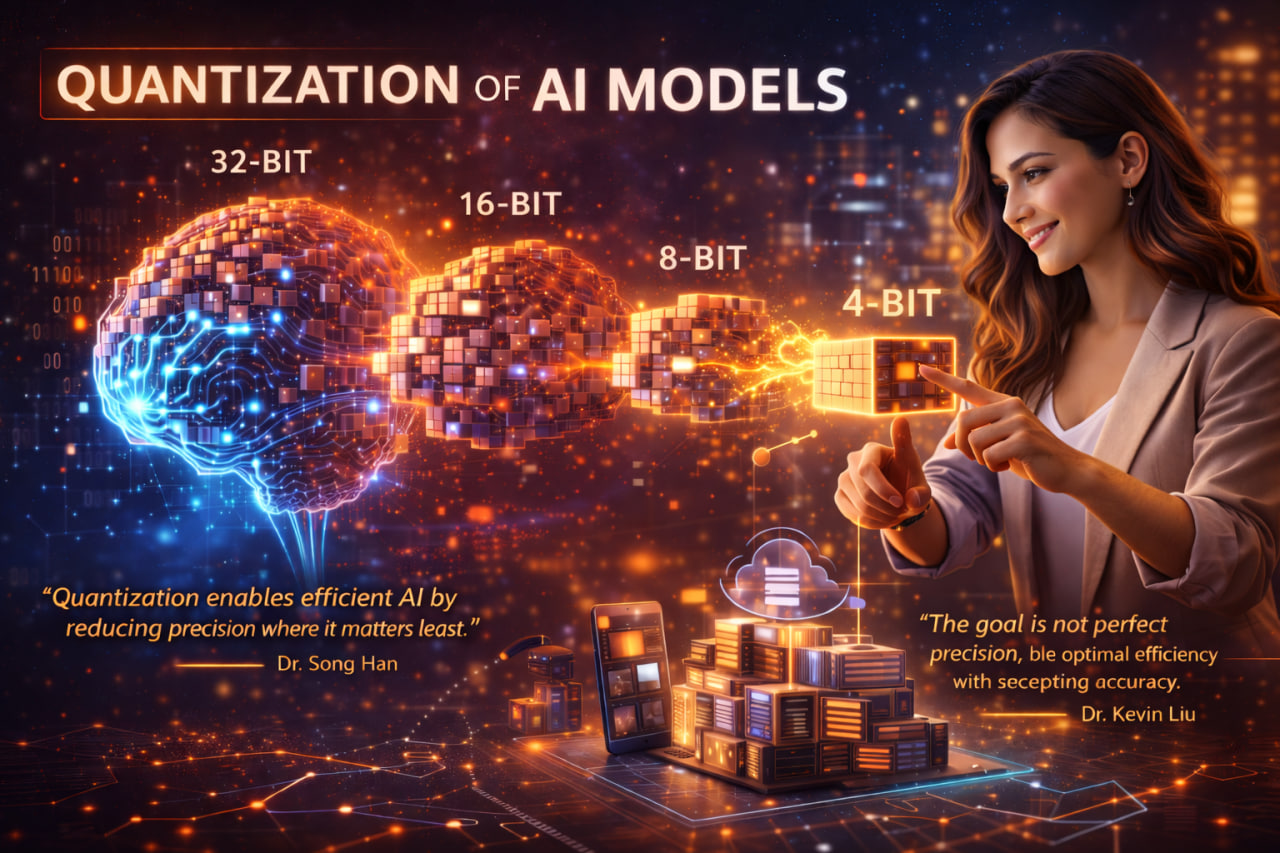
As artificial intelligence models grow in size and complexity, they become more powerful—but also more demanding in terms of memory, computation, and energy consumption. Large language models, computer vision systems, and multimodal AI often require massive hardware resources to run efficiently. This creates a challenge: how can we make these models faster, cheaper, and more accessible without sacrificing too much performance? One of the most effective solutions is quantization — a technique that reduces the precision of model parameters to improve efficiency.
Artificial intelligence is fundamentally reshaping the global education system by introducing personalized instruction models, automated performance evaluation, and intelligent digital support tools. Traditional education has long relied on standardized curricula, fixed pacing, and classroom-wide instruction, which often fail to accommodate individual learning differences. Today, artificial intelligence (AI) enables adaptive systems that respond dynamically to each learner’s progress, strengths, and weaknesses. Rather than replacing teachers, AI enhances their effectiveness by providing data-driven insights and scalable support mechanisms. As educational institutions increasingly adopt digital infrastructure, AI is becoming a strategic pillar in improving engagement, performance, and long-term academic outcomes.