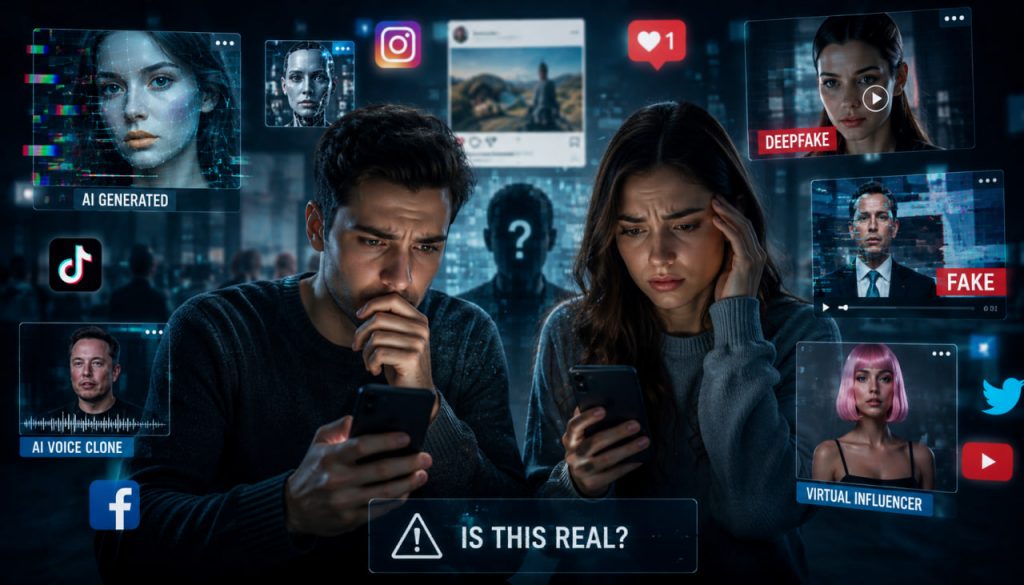
Artificial intelligence has fundamentally transformed social media. Today, AI can generate realistic images, videos, voices, articles, influencers, and even entire online personalities within minutes. While these technologies unlock exciting creative opportunities, they also introduce one of the biggest challenges the digital world has ever faced: the explosion of synthetic content.
Every day, millions of AI-generated posts are uploaded to platforms such as Instagram, TikTok, Facebook, X, and YouTube. In many cases, users cannot distinguish between authentic human-created content and material produced entirely by artificial intelligence.
As generative AI becomes more accessible, the internet is entering an era where authenticity is increasingly difficult to verify.
What Is Virtual Content?
Virtual content refers to digital media that is created entirely or partially by artificial intelligence rather than captured or produced by humans.
Examples include:
- AI-generated photos
- Synthetic videos
- Deepfake videos
- AI-generated voices
- Virtual influencers
- AI-written articles
- AI-generated music
- Computer-generated product reviews
Modern AI systems are now capable of producing content so realistic that even experienced users often struggle to identify it.
Why AI-Generated Content Is Growing So Rapidly
Several technological advances have accelerated the spread of synthetic media.
Today’s AI models can generate:
- High-resolution images
- Photorealistic videos
- Human-like conversations
- Natural voice clones
- Personalized marketing campaigns
At the same time, cloud computing has dramatically lowered production costs.
Content that once required expensive equipment, actors, designers, and video editors can now be produced by a single creator using AI-powered tools.
This has fundamentally changed the economics of online content creation.
The Rise of Virtual Influencers
One of the most visible trends is the emergence of AI-generated influencers.
Unlike traditional creators, virtual personalities:
- Never age
- Never become tired
- Can publish content continuously
- Can speak multiple languages
- Can be customized for different audiences
Many brands now collaborate with digital avatars for advertising campaigns because they offer complete creative control and predictable brand representation.
However, audiences are not always informed that these personalities are entirely artificial.
Deepfakes and Digital Manipulation
Perhaps the greatest concern surrounding AI-generated content is the rapid improvement of deepfake technology.
Modern AI can convincingly recreate:
- Faces
- Facial expressions
- Voices
- Lip movements
- Body language
These capabilities make it possible to produce videos that appear authentic even though they depict events that never occurred.
Deepfakes have become a growing concern for journalism, politics, business, and public trust.
How AI Is Changing Social Media Algorithms
Social media platforms reward engagement, and AI enables creators to produce content at unprecedented speed.
Some accounts now publish:
- Hundreds of AI-generated images
- Multiple short videos daily
- Automated comments
- AI-written captions
- Personalized responses
As synthetic content floods recommendation systems, genuinely original human content may become harder to discover.
This shift is changing how algorithms prioritize visibility and audience engagement.
The Business Impact
AI-generated content offers enormous benefits for businesses.
Companies use AI to create:
- Marketing campaigns
- Product photography
- Promotional videos
- Customer support content
- Educational materials
For many organizations, AI significantly reduces production costs while increasing publishing frequency.
However, businesses also face new risks if audiences lose trust in digital media.
Maintaining transparency is becoming increasingly important for protecting brand credibility.
Risks for Society
The rapid spread of virtual content creates several significant challenges.
Declining Trust
As synthetic media becomes more realistic, users may begin questioning the authenticity of everything they see online.
This erosion of trust affects:
- News reporting
- Scientific communication
- Corporate messaging
- Personal relationships
Misinformation
AI allows false information to spread faster than ever.
Fake videos, fabricated interviews, and manipulated images can influence public opinion before fact-checkers have time to respond.
Identity Theft
Voice cloning and facial synthesis make it easier for criminals to impersonate individuals.
These technologies have already been used in financial fraud, phishing attacks, and identity scams.
Can AI Also Be Part of the Solution?
Ironically, artificial intelligence is becoming one of the best tools for detecting synthetic content.
Researchers are developing systems capable of identifying:
- AI-generated images
- Deepfake videos
- Voice cloning
- Image manipulation
- Digital watermarks
Several technology companies are also introducing content authenticity standards that help verify the origin of digital media.
Although detection technology continues to improve, experts acknowledge that the race between generation and detection remains ongoing.
Expert Perspective: The Challenge of AI-Generated Media
According to Sam Gregory, the growing accessibility of generative AI makes it increasingly important to strengthen media literacy and develop systems that help verify authentic content before it spreads widely.
Similarly, researchers at Partnership on AI have emphasized that transparency, responsible deployment, and clear disclosure of AI-generated media are essential for maintaining public trust in the digital ecosystem.
Their work reflects a broad consensus among experts: the challenge is not AI itself, but ensuring that synthetic media is used responsibly and transparently.
The Future of Social Media
Artificial intelligence will continue to reshape social platforms over the coming years.
Future developments are likely to include:
- AI-generated live streaming
- Fully virtual influencers
- Personalized AI entertainment
- Automatic content localization
- Stronger authenticity verification systems
- More comprehensive AI labeling policies
As governments, technology companies, and creators adapt to these changes, balancing innovation with transparency will become increasingly important.
Conclusion
Artificial intelligence has transformed content creation, making it possible to generate realistic images, videos, voices, and entire online personalities at unprecedented speed. While these technologies offer remarkable opportunities for creativity and business, they also present serious challenges related to misinformation, trust, and digital authenticity.
The future of social media will depend not only on advances in AI generation but also on the development of reliable detection tools, transparent labeling practices, and greater public awareness.
In the age of generative AI, learning to question, verify, and critically evaluate digital content has become an essential skill for every internet user.