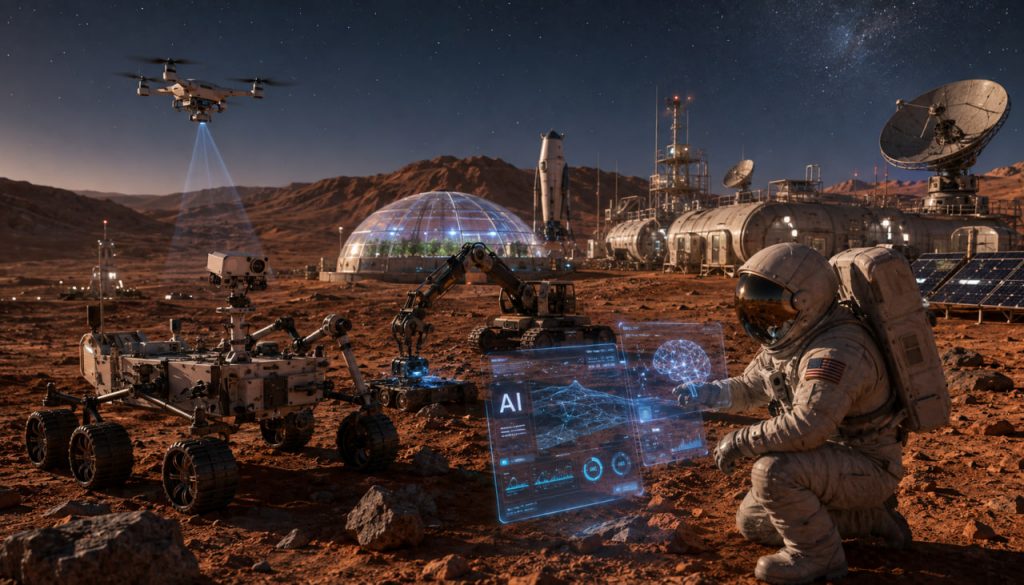
Artificial intelligence is becoming one of the most important technologies in the future of space exploration. As missions travel farther from Earth, spacecraft, robots, and astronauts will face long communication delays, dangerous environments, limited resources, and situations that cannot be managed instantly by mission control.
On the Moon, communication with Earth takes only a few seconds. On Mars, a one-way radio signal can take roughly three to 22 minutes, depending on the planets’ positions. For missions to the outer solar system, communication delays can extend to hours. Direct control from Earth therefore becomes increasingly impractical as distance grows.
AI can help spacecraft navigate independently, select scientific targets, diagnose technical failures, manage energy, support astronauts, and coordinate robotic construction. It may eventually allow distant planetary bases to operate even when communication with Earth is interrupted.
AI will not replace astronauts, scientists, or mission controllers. Its primary role will be to give them the autonomy required to explore environments where immediate human assistance is impossible.
Why Deep-Space Missions Need Artificial Intelligence
Most spacecraft operating near Earth remain closely connected to ground-control teams. Engineers monitor telemetry, prepare commands, analyze risks, and respond to technical problems.
That operating model becomes difficult beyond Earth orbit. A Mars rover cannot be driven with a joystick in real time because every command and response must cross millions of miles of space. Human controllers currently send planned instructions, wait for the rover to execute them, and later receive the results.
Future missions will be more complex. Several rovers, drones, construction machines, scientific instruments, and crewed vehicles may need to work together across large planetary regions. Ground teams will not be able to supervise every movement or decision.
AI can provide the onboard decision-making needed to:
- Navigate unfamiliar terrain
- Replan missions after unexpected events
- Identify scientifically valuable targets
- Detect equipment failures
- Allocate power and communications
- Coordinate multiple robots
- Support astronaut health and safety
- Reduce unnecessary data transmissions
NASA states that future onboard autonomy will include fault management, planning, scheduling, scientific target selection, execution, and data summarization. These capabilities are essential when a spacecraft cannot depend on continuous guidance from Earth.
Autonomous Navigation Across Alien Terrain
Navigation is one of the clearest applications of AI in planetary exploration.
A planetary rover must recognize rocks, steep slopes, loose soil, trenches, and other hazards. Traditional systems can follow routes designed by engineers, but advanced autonomous navigation allows the rover to analyze its surroundings and choose a safe path as it moves.
NASA’s Perseverance rover already uses autonomous navigation software to examine terrain, identify obstacles, and select routes. Its AutoNav system enabled the rover to cross a difficult Martian boulder field more quickly than earlier rovers could have managed.
In December 2025, Perseverance completed the first drives on another planet whose waypoints had been created with generative AI. The demonstration used orbital imagery and terrain data to develop a route that avoided potential hazards, reducing part of the manual planning normally performed by human specialists.
Autonomous navigation can allow a rover to travel farther between communications sessions, increasing the amount of science completed during a limited mission.
Future vehicles may combine cameras, radar, lidar, inertial sensors, terrain maps, and machine learning. They will need to navigate without satellite navigation networks and remain reliable in dust, darkness, extreme temperatures, and unfamiliar geological environments.
AI Can Choose What Is Worth Studying
Planetary missions collect more data than they can always transmit to Earth. Communication bandwidth is limited, and a spacecraft may have only short windows in which to send information.
AI can analyze scientific observations onboard and prioritize the most valuable results.
NASA’s Autonomous Exploration for Gathering Increased Science system, known as AEGIS, has already been used on Mars. Perseverance employed AEGIS to select rocks for examination with its SuperCam instrument without waiting for scientists on Earth to specify every target.
In another Mars demonstration, AI analyzed rock-composition data in real time and autonomously decided whether additional observations were justified. NASA described this as the first use of AI on Mars to make autonomous decisions based on immediate compositional analysis.
This type of onboard science can help future missions:
- Recognize unusual minerals
- Search for possible signs of past life
- Identify water-bearing materials
- Detect geological changes
- Select samples for collection
- Prioritize images for transmission
- Avoid wasting energy on low-value targets
Instead of returning every observation indiscriminately, an intelligent spacecraft can act as a preliminary field scientist.
Human researchers would still make the final scientific interpretations, but AI could ensure that rare discoveries are not overlooked between communication opportunities.
Safer Landings on the Moon, Mars, and Asteroids
Landing on another world is one of the most dangerous stages of any mission. The spacecraft must reduce enormous speed, understand its position, identify hazards, and reach the surface with limited or no intervention from Earth.
AI-enhanced terrain-relative navigation can compare camera images with stored maps while the spacecraft descends. It can estimate location, detect unsafe terrain, and redirect the vehicle toward a better landing zone.
This capability is particularly important for future missions targeting scientifically valuable but hazardous areas, including:
- Lunar polar regions
- Martian crater walls
- Ancient river deltas
- Icy moons
- Small asteroids
- Uneven or poorly mapped surfaces
The European Space Agency has investigated AI-based navigation that could help spacecraft travel independently through unknown environments, including terrain around small asteroids.
A more accurate autonomous landing system could reduce the size of landing zones and allow spacecraft to reach locations that older missions would have considered too dangerous.
Robots Could Build Bases Before Astronauts Arrive
Permanent exploration of the Moon or Mars will require landing pads, power systems, communication equipment, roads, radiation shielding, storage facilities, and habitats.
Transporting every completed structure from Earth would be extremely expensive. A more practical approach is to send robotic equipment ahead of astronauts and use local materials where possible.
AI-guided robots could:
- Survey construction sites
- Excavate lunar or Martian soil
- Level terrain
- Build protective walls
- Assemble modular habitats
- Deploy solar arrays
- Install antennas
- Inspect completed structures
- Repair damaged equipment
NASA is developing autonomous assembly concepts in which modular robots could construct habitats, antennas, and other structures in locations where continuous human supervision is impossible.
Research has also explored autonomous excavation of lunar regolith. This loose surface material could potentially be used to create roads, landing pads, building materials, and radiation shielding.
The first builders on another planet may be autonomous machines rather than humans.
Robotic preparation could make crewed missions safer by ensuring that power, shelter, and communication systems are already operating when astronauts arrive.
AI and the Search for Local Resources
Long-term settlements cannot depend entirely on supplies delivered from Earth. Future explorers will need to locate and use resources available on the Moon, Mars, or other destinations.
This concept is known as in-situ resource utilization. Potential resources include:
- Water ice
- Oxygen-containing minerals
- Metals
- Carbon dioxide
- Regolith for construction
- Materials suitable for fuel production
AI could combine orbital imagery, ground-penetrating radar, spectrometer readings, drilling results, and geological models to identify promising deposits.
Autonomous prospecting robots could map large regions before sending excavation equipment. Machine-learning systems could then estimate the quantity, accessibility, and quality of available resources.
On the Moon, water ice may support drinking-water production, oxygen generation, and rocket fuel manufacturing. On Mars, atmospheric carbon dioxide and subsurface ice could contribute to life support, agriculture, and fuel production.
AI-assisted resource discovery could determine whether a planetary settlement becomes self-sustaining or remains dependent on expensive deliveries from Earth.
Managing Energy in Harsh Environments
Energy will be one of the most limited resources on another world.
Solar panels may produce less power during dust storms, long nights, or seasonal changes. Nuclear systems may provide steady output but still require careful management. Batteries must support habitats, vehicles, scientific instruments, communications, heating, and life-support equipment.
AI could continually balance supply and demand by:
- Forecasting solar generation
- Scheduling high-energy activities
- Prioritizing critical systems
- Managing battery charging
- Detecting unusual consumption
- Shutting down nonessential equipment
- Coordinating several power sources
- Predicting maintenance requirements
On Mars, an intelligent energy-management system might delay a drilling operation when a dust storm is approaching. On the Moon, it could prepare vehicles and habitats for the extreme cold of the lunar night.
AI could also improve route planning by calculating how terrain, temperature, payload, and speed will affect a rover’s energy consumption.
Detecting Failures Before They Become Emergencies
A technical fault that would be inconvenient on Earth could become fatal on Mars.
Future spacecraft and habitats will contain thousands of interacting components. These may include oxygen generators, carbon-dioxide scrubbers, pumps, batteries, computers, thermal-control systems, pressure seals, and radiation monitors.
AI could analyze sensor data continuously and detect subtle changes before a component fails. Predictive-maintenance systems could recognize patterns such as:
- Increasing vibration
- Abnormal temperature
- Declining electrical efficiency
- Pressure changes
- Unusual power consumption
- Sensor disagreement
- Gradual loss of mechanical performance
The system could recommend maintenance, isolate a malfunctioning component, activate a backup, or reorganize operations around the failure.
ESA has studied AI methods intended to improve the reliability of space missions, reduce the need for constant human oversight, and enable faster responses when conditions change.
An intelligent diagnostic system could act as a permanent engineering team that never sleeps.
However, critical decisions would require carefully validated software, transparent reasoning, and reliable fallback modes. A false diagnosis in space could be almost as dangerous as an undetected failure.
Supporting Astronaut Health
Astronauts on long missions will face isolation, radiation exposure, reduced gravity, confined living conditions, disrupted sleep, and limited access to medical specialists.
An AI medical assistant could monitor physiological data, detect health changes, and help crews respond to emergencies when doctors on Earth cannot provide immediate guidance.
Potential applications include:
- Monitoring heart rate and blood oxygen
- Analyzing sleep quality
- Detecting infection or injury
- Interpreting medical images
- Supporting medication decisions
- Guiding emergency procedures
- Tracking mental-health indicators
- Personalizing exercise programs
- Predicting the effects of radiation exposure
AI could also help manage food, water, air quality, and environmental conditions inside a habitat.
The system would not replace a trained physician, but it could provide structured decision support during a communication delay. It might compare symptoms with medical records, suggest diagnostic steps, and guide a crew member through a procedure.
Medical AI for space would require exceptionally high standards of privacy, reliability, and validation. It would also need to function without access to cloud computing or constant software updates.
AI Assistants for Daily Life on Another Planet
A Mars crew will have to perform many roles. Astronauts may need to act as engineers, scientists, mechanics, doctors, farmers, and construction supervisors during the same mission.
An onboard AI assistant could provide rapid access to procedures and mission knowledge. It might:
- Explain repair instructions
- Locate technical documentation
- Translate scientific data
- Prepare daily schedules
- Track supplies
- Monitor mission objectives
- Summarize communications from Earth
- Warn crews about conflicting tasks
- Help operate unfamiliar equipment
NASA has studied AI-based decision-support tools for future astronauts, particularly for missions where repeated communication with ground control would be inefficient.
Unlike a consumer chatbot, a spaceflight assistant would need to work from verified mission data and clearly distinguish facts from uncertain recommendations.
A confident but incorrect answer could be dangerous, so reliability will matter more than conversational fluency.
Coordinating Fleets of Robots
Exploring an entire planet with one rover is slow and vulnerable. Future missions may use groups of smaller robots with different capabilities.
A robotic team could include:
- Mapping drones
- Geological rovers
- Excavation machines
- Cargo transporters
- Maintenance robots
- Sample-collection vehicles
- Communication relays
AI could assign tasks, share maps, prevent collisions, and reorganize the group if one machine fails. Aerial vehicles might identify promising locations, while ground robots conduct detailed inspections.
Rather than waiting for instructions from Earth, the fleet could decide how to divide its workload. One robot could act as a communication relay while others travel beyond direct contact with a base.
This distributed approach could increase coverage and reduce the risk of losing an entire mission because of one mechanical failure.
Agriculture and Closed-Loop Life Support
Human settlements will need efficient systems for growing food and recycling water, oxygen, and waste.
AI could manage controlled agricultural environments by monitoring:
- Plant growth
- Nutrient levels
- Water use
- Light exposure
- Temperature
- Humidity
- Carbon dioxide
- Disease indicators
Computer vision could detect stressed plants before symptoms become obvious to the crew. Automated systems could adjust lighting, irrigation, and nutrient delivery for each crop.
AI could also improve closed-loop life support by predicting water demand, monitoring air quality, and coordinating biological and mechanical recycling processes.
Because resources will be extremely limited, even small efficiency improvements could significantly increase the duration and safety of a mission.
Designing Better Spacecraft and Habitats
Artificial intelligence can contribute before a mission leaves Earth.
Engineers can use AI-assisted optimization to evaluate large numbers of possible designs for spacecraft structures, heat shields, propulsion systems, landing gear, habitats, and power networks.
Generative design systems may identify lightweight structures that would be difficult for humans to create manually. Machine learning can also accelerate simulations of fluid flow, material stress, thermal behavior, and aerodynamics.
AI may help determine:
- The safest habitat layout
- The most efficient structural geometry
- Optimal equipment placement
- Effective radiation-shielding strategies
- Lower-mass components
- More reliable mission schedules
Every kilogram removed from a spacecraft can reduce launch cost or create room for additional scientific equipment and supplies.
However, AI-generated designs must still be tested through conventional engineering analysis, laboratory experiments, and physical validation.
Mapping Planets from Orbit
Orbiters generate enormous volumes of imagery and sensor data. Manually examining every image is time-consuming and may delay important discoveries.
Machine-learning systems can classify terrain and identify:
- Craters
- Rockfalls
- Lava tubes
- Ice deposits
- Dust storms
- Seasonal changes
- Potential landing sites
- Signs of recent geological activity
AI can compare images taken at different times to detect changes that might otherwise be missed.
Onboard processing can also reduce communication demands. Instead of transmitting every raw image, a spacecraft could identify the most important regions, compress relevant data, and discard unusable observations such as images obscured by clouds or dust.
This would allow scientists to receive useful findings more quickly while conserving bandwidth.
Protecting Missions from Space Weather
Solar flares and coronal mass ejections can expose astronauts and spacecraft to dangerous radiation.
AI could analyze observations of the Sun, recognize developing activity, and improve forecasts of incoming space weather. An early warning could give astronauts time to enter a shielded area, protect sensitive electronics, or postpone activities outside the habitat.
An autonomous system on Mars might react before a warning from Earth arrives. It could suspend surface operations, recall robotic vehicles, and move the crew into a protected shelter.
Accurate prediction remains scientifically difficult, but AI may help discover patterns across large solar datasets and improve the speed of alerts.
Communication Networks Between Worlds
Future lunar and Martian operations will require networks connecting habitats, rovers, orbiters, relay satellites, and Earth.
AI could manage these networks by:
- Selecting the best communication route
- Prioritizing emergency messages
- Compressing data
- Correcting transmission errors
- Scheduling high-bandwidth transfers
- Rerouting traffic around failed equipment
- Protecting networks from cyberattacks
A planetary network may experience frequent interruptions caused by terrain, orbital movement, equipment limitations, and solar activity.
Intelligent networking software could store information temporarily and transmit it when a suitable connection becomes available. This would make the system more resilient than one dependent on continuous links.
The Limits and Risks of AI in Space
AI can increase autonomy, but it also introduces significant risks.
Machine-learning systems may make incorrect decisions when they encounter conditions that were not represented in their training data. Sensors may provide incomplete information, radiation may damage computing hardware, and software updates may be difficult to install.
Major concerns include:
- Unpredictable behavior
- Incorrect scientific classifications
- Cybersecurity vulnerabilities
- Excessive dependence on automation
- Difficulty explaining decisions
- Limited onboard computing power
- Biased or incomplete training data
- Failure under unfamiliar conditions
Space agencies cannot treat a planetary mission as an uncontrolled experiment. AI systems must undergo extensive simulation, hardware testing, fault injection, and validation.
Critical functions should include redundant sensors, conservative safety boundaries, and non-AI backup procedures.
The safest approach is supervised autonomy: AI handles routine and time-sensitive decisions while humans retain authority over major mission objectives.
Why Onboard Computing Is a Major Challenge
Powerful AI systems on Earth often depend on large data centers. Spacecraft cannot carry that level of infrastructure.
Onboard computers must operate with limited energy, restricted cooling, and radiation-resistant components. These processors are often less powerful than the latest commercial hardware because reliability is more important than peak performance.
Space AI must therefore be:
- Energy efficient
- Compact
- Resistant to radiation
- Able to operate offline
- Capable of detecting corrupted data
- Reliable for many years
- Updatable without creating new risks
Future processors designed specifically for autonomous spacecraft may allow more complex machine-learning models to run directly onboard.
The most effective systems may combine conventional rule-based software with machine learning rather than relying entirely on one approach.
Expert Perspective: Autonomy Is Essential for Deep Space
NASA’s Platform for Autonomous Systems project states that autonomous operations are critical to the success, safety, and survival of crews on deep-space missions. Future spacecraft will travel beyond low Earth orbit for extended periods while operating with limited or unavailable communication with Earth.
This assessment reflects a fundamental constraint of interplanetary travel: distance makes real-time control impossible, so meaningful exploration requires machines and crews that can make safe decisions locally.
ESA similarly identifies autonomous navigation as a key application of AI for spacecraft operating around Earth and other planetary bodies.
The expert consensus is not that AI should independently control every aspect of a mission. It is that future exploration cannot scale without dependable onboard autonomy.
How AI Could Change the First Human Mission to Mars
During an early human mission to Mars, AI could operate across nearly every stage.
Before launch, it could optimize mission schedules and spacecraft designs. During the journey, it could monitor systems, support medical decisions, and manage power. Before landing, autonomous navigation could identify a safe touchdown zone.
On the surface, AI-guided robots could inspect equipment, transport cargo, map routes, search for water, and maintain communication networks. Inside the habitat, an intelligent assistant could organize tasks, monitor life support, and help diagnose technical problems.
When emergencies occur, the crew could receive immediate local decision support instead of waiting up to 44 minutes for a question and response to travel between Mars and Earth.
AI may become the invisible operational layer connecting astronauts, robots, habitats, vehicles, and scientific instruments into one coordinated system.
Could AI Explore Planets Without Humans?
AI-powered robots will almost certainly reach some destinations before humans and may remain the only practical explorers in extremely hostile environments.
Robotic spacecraft can tolerate conditions that humans cannot, including intense radiation, crushing atmospheric pressure, extreme temperatures, and years of travel.
Potential destinations include:
- The subsurface oceans of icy moons
- The atmosphere of Venus
- Permanently shadowed lunar craters
- Asteroids with very low gravity
- The outer planets
- Distant dwarf planets
AI could allow these machines to conduct complex science without constant direction from Earth.
However, robotic and human exploration serve different purposes. Robots offer endurance, lower risk, and access to dangerous locations. Humans provide adaptable reasoning, creativity, physical versatility, and the ability to respond to entirely unexpected situations.
The most productive model is likely to be cooperation between people and intelligent machines.
Conclusion
Artificial intelligence will be a foundational technology for exploring and eventually settling other worlds. It can help spacecraft navigate, land safely, select scientific targets, manage energy, detect failures, construct habitats, locate resources, support astronauts, and coordinate fleets of robots.
Its importance will increase with distance. The farther a mission travels from Earth, the less practical continuous human control becomes.
AI must still be developed cautiously. Planetary exploration demands systems that are reliable, explainable, secure, energy efficient, and capable of operating for years in environments that cannot be fully reproduced on Earth.
Humanity will not reach other planets through AI alone, but sustainable exploration beyond Earth may be impossible without it. The future of space travel will depend on a partnership in which human beings define the goals and intelligent machines provide the autonomy, speed, and resilience needed to achieve them.