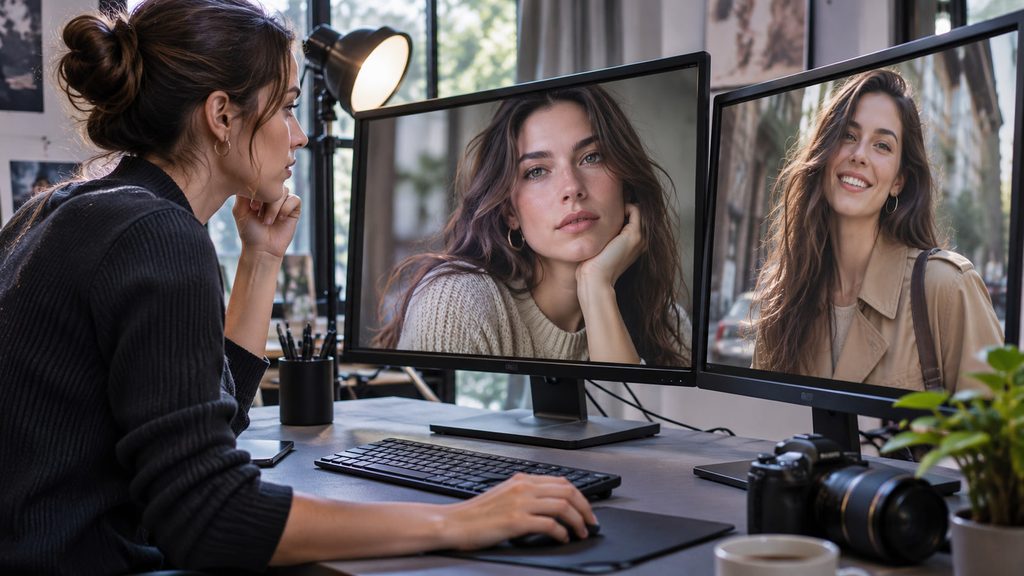
Social media is entering a new era in which the people appearing in photographs, videos, and advertising campaigns may never have existed. These digital personalities smile at cameras, visit restaurants, wear fashionable clothing, share personal stories, and interact with followers just like ordinary influencers. Their appearances can be remarkably convincing, even though their faces, bodies, voices, and surroundings are created or manipulated using artificial intelligence.
Known as synthetic avatars, AI-generated influencers, or virtual humans, these characters are becoming increasingly visible on Instagram, TikTok, YouTube, and other platforms. Some are openly presented as fictional digital personalities, while others are designed to resemble everyday people so closely that audiences may not immediately recognize their artificial origins.
The most significant development is not simply that AI can create realistic faces. It is that creators can now build consistent digital identities capable of appearing in hundreds of photographs, producing videos, and maintaining an ongoing social media presence.
Understanding how these synthetic people are created reveals both the commercial opportunities and the growing challenges surrounding authenticity, privacy, and trust online.
What Are Synthetic Avatars?
A synthetic avatar is a digitally created representation of a person that can appear in images, videos, interactive applications, or virtual environments. Unlike traditional cartoon characters, photorealistic avatars are designed to reproduce the visual characteristics of real human beings, including skin texture, facial expressions, hair, body proportions, and natural lighting.
Not all digital influencers use the same technology. Some are constructed using traditional three-dimensional computer graphics, while others rely primarily on generative AI models. More sophisticated productions combine AI-generated imagery, 3D animation, video processing, and human editing.
The distinction between a virtual influencer and an autonomous AI personality is equally important. Many seemingly independent digital characters are controlled by human teams responsible for their appearance, personality, messages, and commercial relationships.
A synthetic influencer can look and communicate like a real person without possessing human experiences, consciousness, or an independent personal life.
Why AI-Generated People Are Appearing Everywhere
Several technological developments have made realistic synthetic avatars more accessible. Modern generative image models can produce convincing human portraits from written descriptions, while image editing systems allow creators to modify clothing, expressions, locations, and camera angles.
Video generation has improved as well. Images that previously remained static can now be transformed into short clips featuring facial movements, walking, gestures, and simulated speech.
The economics of content creation are another major factor. A conventional influencer campaign may involve photographers, models, locations, travel, equipment, and scheduling. An AI-based production can reduce some of these requirements, particularly when producing large numbers of variations.
However, lower production costs do not guarantee better content. High-quality synthetic personalities still require creative direction, consistent visual design, editing, audience management, and careful quality control.
How AI Creates a Person Who Does Not Exist
Most contemporary AI-generated human images are produced using generative neural networks trained to recognize visual patterns across large image datasets. These systems learn statistical relationships between features such as facial structure, lighting, clothing, pose, and photographic composition.
Earlier generations of realistic synthetic faces were commonly created using generative adversarial networks, including technologies such as StyleGAN. More recent workflows frequently use diffusion-based image generation systems.
Diffusion models learn to reconstruct images from noisy representations. During generation, they progressively transform an initially noisy pattern into an image that corresponds to the requested description and other supplied conditions.
A creator might describe a fictional woman in her late twenties with brown hair, natural makeup, and casual clothing, photographed in a modern apartment with soft daylight. The model generates a new visual representation rather than photographing a real individual.
The result can contain convincing pores, shadows, reflections, and small facial imperfections. These details help synthetic portraits resemble ordinary photographs rather than obviously computer-generated illustrations.
How Creators Keep the Same Face Across Different Photos
Generating one believable face is relatively straightforward with modern AI tools. Maintaining exactly the same identity across dozens of images is considerably more difficult.
Without additional controls, an image generator may subtly change facial proportions, eye shape, hairline, or other recognizable features between generations. These inconsistencies become noticeable when an avatar appears repeatedly in the same social media account.
Professional creators address this problem by developing a consistent character design and using reference images, identity-preservation techniques, and controlled generation settings.
Some workflows employ specialized fine-tuning methods, including Low-Rank Adaptation, commonly called LoRA. Others rely on reference-image conditioning and editing systems that preserve essential facial features while changing clothing, backgrounds, and poses.
After generation, artists may manually correct irregularities and reject images that do not match the established character.
The illusion of a real person depends heavily on visual continuity. A convincing synthetic influencer must look recognizably identical across different situations.
From Still Images to Realistic AI Videos
Video introduces additional technical challenges because the avatar must remain consistent across many consecutive frames. Facial expressions, body movements, camera motion, lighting, and environmental details need to behave naturally over time.
Image-to-video systems can animate an existing portrait, while text-to-video models can generate scenes from detailed descriptions. Other tools use motion references to guide how a digital character moves.
For example, a creator might generate a photograph of an artificial lifestyle influencer sitting in a cafe and then animate the image into a short video showing the character smiling and turning toward the camera.
More advanced workflows combine generated footage with editing software, stabilization, color correction, and sound design.
Nevertheless, AI-generated videos can still exhibit inconsistent fingers, unusual blinking, changing background objects, or unrealistic physical interactions. Longer sequences and complex actions generally create greater opportunities for visible errors.
How Synthetic Avatars Speak and Interact
A realistic digital personality can also be given a synthetic voice. Modern text-to-speech systems generate spoken audio from written scripts, often allowing creators to select different accents, speaking styles, and emotional characteristics.
Lip-synchronization technology then matches mouth movements to the generated speech. Some systems also simulate facial expressions and head movements to create the impression of a natural conversation.
An avatar can therefore appear in a video explaining a product, telling a story, or delivering a prepared message without a human performer appearing on camera.
Interactive versions may incorporate large language models to generate responses to audience questions. However, these systems require moderation and clear boundaries because automatically generated replies can contain inaccurate or inappropriate information.
Using a real person’s voice or likeness without permission raises additional ethical and legal concerns. Creating an original fictional identity is fundamentally different from impersonating an identifiable individual.
Real Examples of Successful Virtual Influencers
One of the best-known early virtual influencers is Lil Miquela, a digital character introduced in 2016. Developed by the company Brud, she built a substantial social media presence through fashion content, fictional personal stories, and collaborations with major brands.
Lil Miquela is important historically, but she should not be confused with today’s entirely AI-generated personalities. Her original production relied extensively on computer-generated imagery and human creative teams.
A more recent example is Aitana Lopez, a fictional model developed by the Barcelona-based agency The Clueless. Her social media presence combines realistic AI-generated images with a carefully designed personality, interests, and fictional lifestyle.
In May 2026, Fast Company reported that Aitana’s social media accounts had attracted nearly 400,000 combined followers. Behind the apparent individual was a creative team responsible for developing her content and maintaining visual consistency.
These examples illustrate two generations of virtual influencer technology: traditional CGI-based personalities and newer characters increasingly produced through generative AI.
What Happens Behind a Synthetic Influencer Account?
A realistic AI influencer rarely operates without human involvement. Successful accounts typically begin with a defined character identity, including appearance, interests, communication style, target audience, and recurring content themes.
The production team then develops visual materials that support this fictional identity. A travel-oriented avatar might appear at beaches, hotels, and famous landmarks, while a fitness-oriented character could feature in sportswear campaigns and simulated exercise content.
Captions, publishing schedules, audience responses, and brand collaborations also require planning. Some interactions may be automated, but human oversight remains important for reputation management and factual accuracy.
The central task is maintaining the impression of a coherent personality over time. Synthetic influencers are not simply collections of generated photographs; they are ongoing media projects built around fictional identities.
Why Brands Are Interested in AI Influencers
For advertisers, virtual influencers offer several potential advantages. Their appearance can remain consistent, their content can be produced without conventional travel arrangements, and campaigns can be adapted for different audiences.
Brands may also have greater control over visual presentation and scheduling. A synthetic fashion model can appear in numerous outfits and locations without requiring a physical photoshoot for every variation.
Production flexibility is particularly valuable for businesses testing multiple advertising concepts. Instead of organizing separate campaigns, marketers can create alternative scenes and compare their effectiveness.
However, cost savings depend on production quality and workflow complexity. Maintaining a convincing character across sophisticated videos can require considerable technical expertise and editing time.
There is also a credibility problem. An artificial personality cannot genuinely experience a product, develop personal preferences through physical use, or provide authentic firsthand testimony.
Synthetic influencers may be effective advertising characters, but they should not be presented as independent consumers with experiences they never had.
Why People Can Struggle to Recognize AI Faces
The realism of synthetic people is not merely a marketing claim. Scientific research has demonstrated that identifying AI-generated faces can be extremely difficult.
In a 2022 study published in the Proceedings of the National Academy of Sciences, psychologists Sophie Nightingale of Lancaster University and Hany Farid of the University of California, Berkeley examined people’s ability to distinguish real faces from computer-generated ones.
In one experiment involving 315 participants, the average classification accuracy was only 48.2%, approximately equivalent to random guessing. The researchers also found that synthetic faces received slightly higher average trustworthiness ratings than real photographs.
This is a particularly important expert finding because it challenges the assumption that people can reliably identify artificial faces by looking carefully enough.
The experiment evaluated a particular generation of synthetic face technology, so its exact findings should not be generalized to every modern image or video. Nevertheless, it provides strong evidence that visual realism alone is an unreliable indicator of authenticity.
The Psychology of Following Someone Who Is Not Real
People can develop emotional connections with fictional characters, animated personalities, and virtual influencers. Social media strengthens these relationships through repeated exposure, personal storytelling, and interactive communication.
Researchers describe one-sided emotional connections with media personalities as parasocial relationships. Such relationships can develop even when the audience knows that the character is fictional.
A study published in the Journal of Business Research in 2025 examined virtual influencer relationships using survey data from 826 Instagram users. Researchers Fanjue Liu and Rang Wang found that perceived trustworthiness and identification helped explain how humanlike qualities influenced audience relationships.
This suggests that realistic appearance is only one component of an influential digital personality. Storytelling, perceived authenticity, and consistent behavior also contribute to audience engagement.
The ethical concern arises when followers believe that an artificial character is a real person or mistake automated attention for a genuine personal relationship.
How Social Media Platforms Are Responding
Major social media companies increasingly require disclosure of realistic AI-generated content. TikTok requires creators to label realistic synthetic images, audio, and video and can automatically identify certain files using Content Credentials.
Meta has introduced AI information labels on Facebook, Instagram, and Threads for content identified through supported technical indicators or creator disclosures.
YouTube similarly requires creators to disclose realistic altered or synthetic content, including scenes that did not actually occur and videos that make real people appear to say or do something they never said.
These policies do not necessarily prohibit virtual influencers. Instead, they attempt to provide audiences with information about the origin of the material they are viewing.
Enforcement remains challenging because automatically detecting synthetic content is imperfect. Files can be edited, reposted, or stripped of identifying metadata, while some legitimate photographs may also contain AI-assisted modifications.
Laws, Transparency, and Advertising Disclosure
Regulation is becoming increasingly relevant as synthetic personalities enter commercial advertising and public communication.
In the European Union, Article 50 of the AI Act began applying on August 2, 2026, introducing transparency obligations for certain AI interactions and artificially generated or manipulated content. The precise requirements depend on how the technology is used and whether particular legal definitions and exceptions apply.
In the United States, the Federal Trade Commission’s updated Endorsement Guides explicitly address virtual influencers and deceptive advertising practices.
Commercial relationships must be disclosed when they could affect how consumers evaluate an endorsement. An AI-generated personality should not be used to invent customer experiences or make unsupported product claims.
For businesses, a responsible approach involves clearly identifying fictional personas, disclosing sponsorships, and maintaining records of creative rights and permissions.
Transparency is becoming an essential part of synthetic influencer marketing rather than an optional detail.
Can AI Avatars Be Used for Scams and Manipulation?
The same technology that creates entertaining digital characters can also enable deceptive activities. Realistic fictional profiles may be used to fabricate romantic identities, promote fraudulent investments, circulate misinformation, or generate fake testimonials.
A synthetic profile can display numerous apparently convincing photographs without any of the depicted events having occurred. Automated messaging systems can then maintain conversations at a scale that would be difficult for individual human operators.
The risks are particularly serious when artificial images are combined with stolen identities, voice cloning, or fabricated claims of professional expertise.
However, not every virtual influencer is deceptive. Transparent fictional characters used for entertainment, education, or advertising can serve legitimate purposes.
The crucial distinction is whether the audience understands the nature of the content and whether its creators are attempting to mislead people about identity, evidence, or personal experience.
How to Recognize a Synthetic Social Media Profile
There is no universally reliable visual test for identifying AI-generated people. Modern systems can reproduce realistic skin texture, lighting, and facial expressions, while conventional photographs can also contain editing artifacts.
Instead of relying on a single unusual detail, viewers should examine the broader context of an account.
Potential indicators include unusually consistent facial appearance across many settings, inconsistent background details, implausible personal stories, missing independent information, and limited evidence of genuine real-world activity.
Users can also check for platform-generated AI labels, disclosure statements, and available content provenance information.
Content Credentials, based on the C2PA standard, can provide information about how certain digital files were created or modified. However, missing credentials do not prove that content is genuine, and valid credentials do not establish that every depicted event actually happened.
The safest approach is to verify identity and important claims independently rather than trusting a convincing photograph or video.
The Future of Synthetic People on Social Media
Synthetic avatars will likely become more sophisticated as image generation, video production, speech synthesis, and conversational AI continue improving.
Digital personalities may increasingly appear in advertising, virtual customer service, education, entertainment, and interactive online communities.
At the same time, competition could make generic AI-generated influencers less distinctive. If thousands of accounts feature similarly attractive fictional personalities, storytelling and creative originality may become more important than technical realism.
Regulatory expectations are also changing. Platforms, advertisers, and content creators will face growing pressure to distinguish genuine human experiences from artificially produced media.
The central question is no longer whether artificial people can look realistic. It is how society should manage digital identities that can imitate human appearance and communication without representing real individuals.
Conclusion
Synthetic avatars are transforming social media by making it possible to create convincing digital personalities that look, speak, and behave like real people. Advances in generative image models, character consistency, AI video, and voice synthesis have made these technologies increasingly accessible.
Virtual influencers such as Lil Miquela and Aitana Lopez demonstrate how fictional identities can attract audiences and participate in commercial campaigns. Scientific research also confirms that synthetic faces can be remarkably difficult to distinguish from genuine photographs.
However, greater realism introduces important challenges involving deception, consent, advertising transparency, privacy, and audience trust.
The future of AI-generated people will depend not only on technological progress but also on how responsibly these characters are created and presented.
Synthetic avatars can become valuable tools for creativity and communication, but their success should not depend on convincing audiences that fictional people are real.
Would you follow a realistic AI-generated influencer if you knew the person did not actually exist? Share your opinion in the comments.