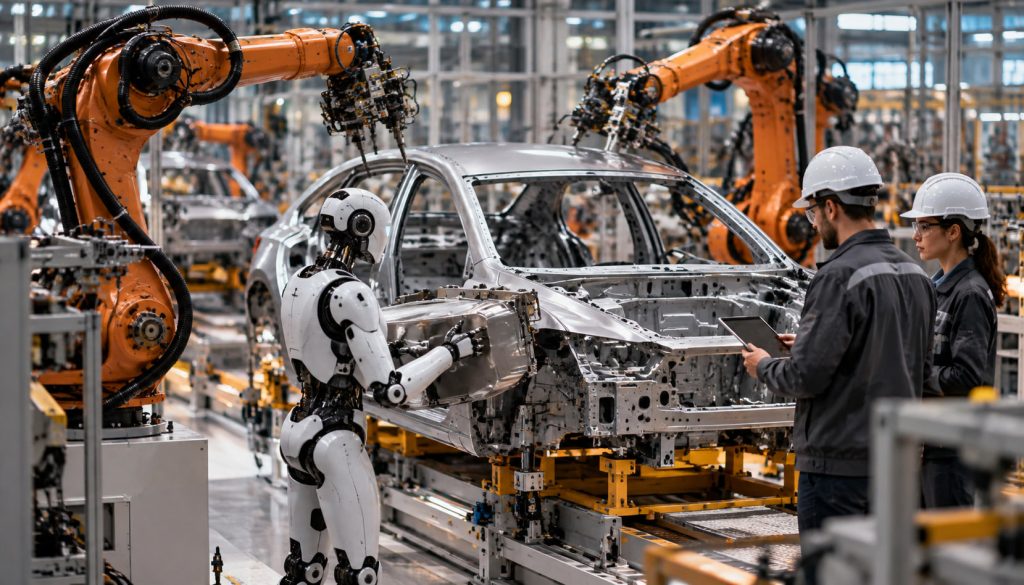
Artificial intelligence and robotics are entering a new stage of development. Machines that once followed strictly programmed movements are increasingly capable of recognizing objects, interpreting complex environments, learning from experience, and adapting their behavior to changing conditions.
This transformation is reshaping automotive manufacturing, logistics, healthcare, agriculture, construction, and numerous other industries. Robots are becoming more flexible, while artificial intelligence allows them to perform tasks that previously required extensive programming or constant human supervision.
The scale of this change is already significant. According to the International Federation of Robotics, approximately 5.08 million industrial robots were operating worldwide in 2025, while annual installations reached a record 603,000 units.
However, the most important development is not simply the growing number of robots. It is the emergence of systems that combine mechanical precision with increasingly sophisticated perception, reasoning, and decision-making.
Artificial intelligence is transforming robots from specialized machines into more adaptable tools capable of working in increasingly complex environments.
What Is the Difference Between Artificial Intelligence and Robotics?
Artificial intelligence and robotics are closely related, but they are not the same technology.
Robotics focuses on designing, building, and controlling physical machines that interact with their surroundings. These machines may use motors, mechanical arms, wheels, cameras, sensors, and specialized tools.
Artificial intelligence focuses on creating computational systems capable of performing tasks involving perception, pattern recognition, prediction, language understanding, planning, or learning.
A conventional industrial robot can repeat a welding operation thousands of times without needing modern machine learning. Its movements may be determined by predefined programs and control algorithms.
An AI-powered robot can potentially go further. It may recognize different components, adjust its movements when objects change position, or choose between alternative actions.
The distinction is important because not every robot uses AI, and not every AI system controls a robot.
Modern robotic systems often combine both technologies with conventional engineering, which remains essential for precise movement, stability, and safe operation.
How Artificial Intelligence Makes Robots Smarter
An intelligent robot needs to understand its environment before acting within it.
This process typically involves sensors, computer vision, machine learning, motion planning, and feedback control.
Cameras collect visual information, while depth sensors, radar, lidar, force sensors, and other instruments provide additional measurements.
AI software can analyze this information and identify objects, estimate distances, recognize obstacles, or determine whether a component has been positioned correctly.
The robot then uses planning and control systems to select and execute appropriate movements.
A simplified robotic operating cycle includes:
- Perception: Sensors collect information about the environment.
- Interpretation: Software identifies relevant objects, conditions, and potential hazards.
- Planning: The system selects an appropriate action or movement.
- Execution: Motors and actuators perform the operation.
- Feedback: Sensors measure the result and allow the system to make corrections.
These processes can operate continuously, allowing robots to respond to changing conditions rather than merely repeating fixed sequences.
Nevertheless, successful operation depends on much more than an AI model. Mechanical design, calibration, real-time control, reliable sensors, and safety systems remain fundamental.
The Rapid Growth of Industrial Robotics
Industrial robotics has become a major component of global manufacturing.
The International Federation of Robotics reported that factories installed approximately 603,000 industrial robots worldwide in 2025, an increase of 11 percent compared with the previous year.
The global operational stock reached approximately 5.08 million units.
China accounted for about 59 percent of worldwide installations in 2025, demonstrating the enormous scale of manufacturing automation in the country.
The United States, Japan, South Korea, and Germany also remain major industrial robotics markets.
These figures reveal a long-term transformation of manufacturing, but they do not mean every factory is becoming fully autonomous.
Industrial robots remain particularly valuable in environments where tasks are repetitive, measurable, and technically well defined.
AI is expanding those possibilities by making robotic systems more capable of handling variation, recognizing defects, and adapting to changing production requirements.
AI Robots in Automotive Manufacturing
The automotive industry has been one of the most important drivers of industrial robotics for decades.
Traditional assembly plants rely heavily on robotic systems for welding, painting, material handling, and component positioning.
Artificial intelligence is now extending automation into tasks that are difficult to manage with fixed programming.
Computer vision can inspect vehicle components, identify surface imperfections, check assembly quality, and detect manufacturing inconsistencies.
Machine-learning systems can also analyze equipment performance and identify patterns associated with potential failures.
In modern vehicle production, intelligent robotics can support:
- Body welding and structural assembly
- Precision adhesive application
- Paint inspection and finishing
- Battery module and pack assembly
- Component identification and sorting
- Automated quality inspection
- Material transportation between production stations
- Predictive maintenance
Electric-vehicle manufacturing creates additional opportunities because battery production requires accurate component positioning, controlled manufacturing processes, and extensive quality monitoring.
The greatest opportunity is not necessarily replacing traditional industrial robots, but making existing automated production systems more flexible and reliable.
However, automated inspections must be validated carefully. A system that performs well on familiar defects may still miss unusual manufacturing problems.
Autonomous Mobile Robots in Warehouses
Warehouses represent one of the clearest commercial applications of intelligent mobile robotics.
Instead of following only fixed routes, autonomous mobile robots can use sensors, navigation software, and environmental maps to move through facilities.
They transport goods, supply workstations, support order fulfillment, and reduce the need for employees to perform repetitive transportation tasks.
According to the International Federation of Robotics’ 2026 service robotics report, approximately 117,500 professional service robots were sold for transportation and logistics applications in 2025.
These systems can help warehouses improve material flow, use available space more efficiently, and coordinate operations across different departments.
AI can also support fleet management by assigning tasks, predicting congestion, and optimizing routes.
Nevertheless, autonomous robots still require suitable infrastructure, reliable communication, maintenance, and procedures for handling unexpected obstacles.
Humanoid Robots and the Race Toward General-Purpose Machines
Humanoid robots have attracted considerable attention because their physical structure resembles the human body.
The idea is appealing: a robot equipped with arms, hands, and human-like mobility could potentially operate machinery, move objects, and navigate workplaces originally designed for people.
Companies including Tesla, Figure AI, Boston Dynamics, and Apptronik have developed humanoid robotic platforms or demonstrated advanced prototypes.
Their work combines mechanical engineering, artificial intelligence, computer vision, and sophisticated motion control.
Potential applications include industrial material handling, warehouse operations, manufacturing support, and selected maintenance tasks.
Yet humanoid robotics remains an emerging market.
The International Federation of Robotics reported approximately 7,000 full-size humanoid robots sold globally in 2025 for commercial and professional applications. This remains small compared with conventional industrial robotics.
Many humanoid deployments are still pilots, while some tasks require human remote control or intervention.
Humanoid machines face difficult engineering challenges involving balance, manipulation, battery endurance, reliability, safety, and operating costs.
A humanoid robot that demonstrates an impressive task is not necessarily capable of performing that task reliably throughout an entire working shift.
The real commercial test will be whether these machines can deliver consistent productivity at an economically sustainable cost.
How Robots Learn New Skills
Traditional robotic programming often requires engineers to specify positions, movements, and operating conditions.
AI introduces alternative methods for teaching robots.
One approach is imitation learning, where systems learn from demonstrations performed by humans or other robots.
Another is reinforcement learning, where an algorithm improves behavior through repeated trials and feedback.
Simulation is particularly useful because robots can practice movements in virtual environments before attempting them on physical hardware.
Developers can simulate different objects, surfaces, lighting conditions, and mechanical interactions.
This approach can reduce development costs and limit some risks associated with experimentation on real machines.
However, simulated environments cannot perfectly reproduce every real-world condition.
Differences in friction, lighting, material properties, and sensor behavior can cause models trained in simulation to perform poorly in physical environments.
Engineers must therefore validate learned behaviors on actual hardware.
The Rise of AI Models for Physical Robots
One of the most significant developments in modern robotics is the emergence of vision-language-action models.
These systems combine visual observations and language instructions with the ability to generate robotic actions.
In 2025, Google DeepMind introduced its Gemini Robotics family, including models designed to connect multimodal understanding with physical manipulation.
The company subsequently demonstrated additional developments aimed at more capable robotic reasoning and task execution.
Such systems are intended to make robots easier to instruct and more adaptable across tasks.
Instead of programming every movement separately, an operator may eventually be able to describe a goal in ordinary language.
The robot would then need to interpret the instruction, identify objects, plan actions, and execute movements.
This approach is promising, but language understanding does not guarantee safe physical behavior.
A robot must satisfy real-world constraints involving force, speed, balance, collision avoidance, and human safety, regardless of how intelligently it interprets instructions.
Artificial Intelligence and Autonomous Vehicles
Self-driving vehicles represent another important intersection between AI and robotics.
Although cars do not resemble traditional robots, autonomous driving relies on many of the same principles: perception, localization, prediction, planning, and control.
Cameras, radar, lidar where fitted, and other sensors help automated driving systems monitor road conditions.
Machine-learning models can recognize road users, classify objects, predict movement, and support decisions about vehicle behavior.
Autonomous driving technology is being developed for passenger transportation, freight movement, delivery vehicles, and specialized industrial operations.
However, driving automation exists at different capability levels.
A vehicle equipped with driver assistance does not necessarily have the ability to operate without human supervision.
Some automated driving systems can operate without a human driver only within defined geographical areas and operating conditions.
The critical challenge is not demonstrating autonomous driving under ideal conditions, but maintaining safe and dependable operation across the conditions the system is expected to encounter.
Weather, unusual road layouts, unpredictable human behavior, and unexpected obstacles remain important challenges.
Medical and Healthcare Robotics
Robotics is also transforming selected areas of healthcare.
Robotic surgical systems can assist surgeons with precise instrument movements and specialized minimally invasive procedures.
Other machines support rehabilitation, laboratory automation, hospital logistics, and certain patient-assistance tasks.
Artificial intelligence can potentially improve medical robotics by supporting image interpretation, procedural planning, instrument tracking, and automated monitoring.
However, the level of autonomy varies considerably.
Many surgical robots are primarily controlled by trained medical professionals rather than independently performing operations.
Clinical safety, regulatory approval, professional supervision, and evidence of patient benefit remain essential.
Medical robots should be judged by demonstrated improvements in care and safety, not simply by their technological sophistication.
AI Robots in Agriculture
Agriculture presents particularly difficult conditions for automation.
Unlike factories, farms contain irregular terrain, changing weather, variable lighting, and biological objects that differ in shape and condition.
AI-powered agricultural robots can use computer vision to identify crops, detect weeds, monitor plant development, and assist with harvesting.
Some systems apply treatments selectively rather than uniformly across entire fields.
This can potentially reduce waste and improve the precision of agricultural operations.
Robotic platforms may also support autonomous navigation, soil monitoring, and repetitive fieldwork.
However, adoption depends on equipment costs, farm size, crop characteristics, reliability, and the availability of technical support.
Robots that work effectively with one crop may require substantial modification before handling another.
Robots in Homes and Everyday Life
Consumer robotics is already widespread, particularly in household cleaning and lawn maintenance.
Robot vacuum cleaners, autonomous lawn mowers, and other domestic devices use combinations of mapping, obstacle detection, navigation, and automation.
The International Federation of Robotics reported that consumer service robot sales approached 34.2 million units worldwide in 2025.
AI can make household devices better at recognizing obstacles, adapting routes, and distinguishing between different environments.
Future systems may expand into more complicated domestic tasks, but general-purpose household robotics faces substantial challenges.
Homes contain fragile objects, narrow passages, pets, children, stairs, and constantly changing arrangements.
Manipulating clothes, dishes, furniture, or household tools requires far more versatility than cleaning a relatively predictable floor.
The cost of sophisticated robotic hardware is another significant obstacle.
Safety: The Biggest Challenge for Intelligent Robots
As robots become more autonomous, safety becomes increasingly important.
A robot operating near people must avoid dangerous movements, excessive force, unexpected collisions, and failures that could damage equipment or cause injury.
Artificial intelligence introduces additional challenges because machine-learning behavior can be difficult to predict under unfamiliar conditions.
The International Organization for Standardization published updated ISO 10218 industrial robot safety standards in 2025, covering robots and their integration into industrial applications.
These standards emphasize the need for risk reduction and appropriate safety engineering.
AI-powered robotic systems may require multiple independent protective mechanisms, including physical safeguards, safety-rated monitoring, emergency stops, operating limits, and human supervision.
Cybersecurity also matters. Unauthorized access to a connected robot could create risks beyond ordinary data theft.
Safety-critical functions must not depend solely on the assumption that an AI model will always make the correct decision.
Will AI Robots Replace Human Workers?
The growing use of robotics raises important questions about employment.
Automation can reduce demand for certain repetitive physical tasks, while increasing demand for engineers, technicians, maintenance specialists, software developers, and robotics integrators.
The effects vary significantly by industry, occupation, and region.
A warehouse that introduces mobile robots may need fewer employees for repetitive material transportation but more specialists to supervise automated operations.
Factories may redesign jobs around equipment monitoring, quality assurance, troubleshooting, and process improvement.
However, not every displaced worker can immediately transition into a technical role.
Training, education, workplace organization, and labor policies will influence how the economic benefits are distributed.
The most effective approach is to evaluate automation alongside workforce development rather than treating employees as an afterthought.
The Economics of AI-Powered Robotics
A robot’s commercial value depends on much more than its purchase price.
Businesses must consider installation, integration, energy consumption, maintenance, software, employee training, and downtime.
The robot must also perform its intended tasks consistently enough to justify the investment.
Important evaluation criteria include cycle time, accuracy, uptime, operating cost, and the ability to handle changing requirements.
Some companies use robot-as-a-service arrangements, where robotic equipment is supplied through rental or subscription models rather than purchased outright.
These arrangements can reduce initial capital requirements, although long-term costs and contractual conditions must still be evaluated.
A specialized machine that performs one valuable task reliably may deliver a better financial return than an expensive general-purpose robot.
Commercial success depends on useful work performed safely and consistently, not on how human-like or impressive a robot appears.
Environmental Impact of Intelligent Robotics
Robotics can also influence energy consumption and resource efficiency.
Precision manufacturing may reduce defective products and unnecessary material waste.
AI-based inspection can identify problems earlier, potentially limiting costly rework.
Agricultural robots can support targeted treatment, while automated logistics may reduce unnecessary transportation within facilities.
However, robots require electricity, electronic components, batteries, and raw materials.
Their manufacture, maintenance, and eventual disposal create environmental impacts.
The overall sustainability benefit depends on whether improved efficiency and reduced waste outweigh the resources required to develop and operate the machines.
The Future of Artificial Intelligence and Robotics
The next stage of robotics development will likely focus on flexibility, reliable manipulation, improved perception, and easier deployment.
Advances in AI may reduce the amount of task-specific programming needed for certain operations.
Better simulation and training methods could help robots learn more skills before entering physical workplaces.
Improved sensors and control systems may also allow machines to work more effectively in changing environments.
Yet progress will be uneven.
Industrial robots performing structured tasks are already commercially mature, while general-purpose humanoid machines still face significant technical and economic barriers.
Future success will depend on making robots not only more intelligent, but also safer, more reliable, easier to maintain, and economically practical.
Conclusion
Artificial intelligence and robotics are increasingly becoming complementary technologies that extend automation beyond rigid, repetitive operations.
AI-powered robots can recognize objects, adapt to changing conditions, assist manufacturing, transport goods, support agriculture, and perform specialized tasks in healthcare and everyday environments.
Recent industry statistics demonstrate that robotics is expanding rapidly, with millions of industrial robots already operating worldwide and professional service robotics entering more commercial applications.
At the same time, intelligent machines still face limitations involving physical dexterity, reliability, safety, cost, and operation in unfamiliar environments.
The future is unlikely to involve replacing every human worker with a humanoid machine. It is more likely to involve a combination of specialized robots, intelligent automation, and human expertise.
The real revolution in AI robotics is not the creation of machines that look or think exactly like humans. It is the development of machines that can perform useful physical work more intelligently, safely, and reliably alongside people.