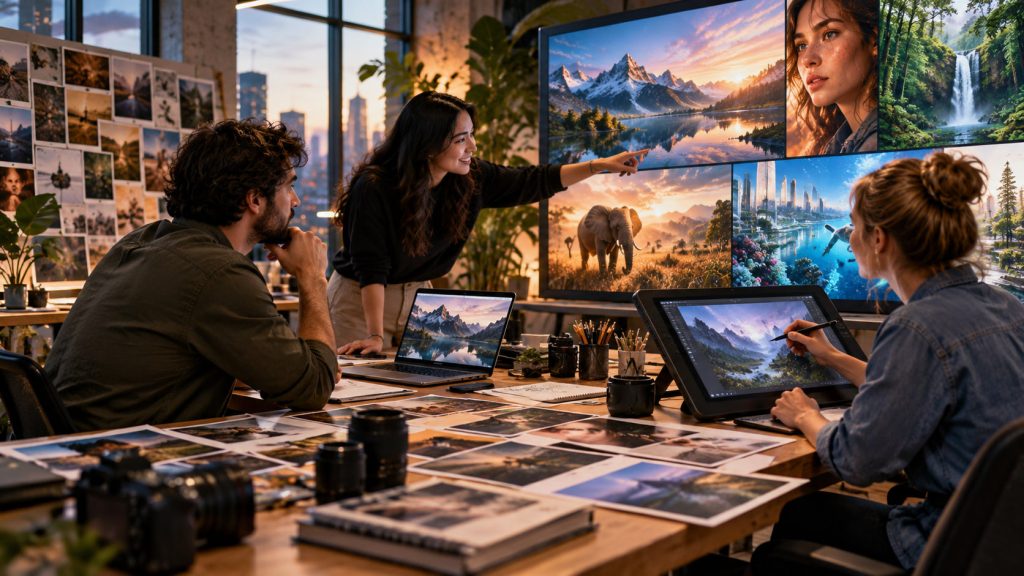
Artificial intelligence has fundamentally changed how images are created, edited, and used. What once required professional photography equipment, advanced graphic-design software, artistic experience, and hours of manual work can now begin with a simple written description.
Over the past few years, AI image generation has evolved from an experimental technology producing distorted pictures into a powerful creative tool capable of generating photorealistic scenes, product photography, digital illustrations, advertising concepts, and sophisticated visual compositions.
Modern AI image generators can create entirely new pictures, modify existing photographs, preserve recognizable subjects across multiple scenes, and respond to increasingly detailed instructions.
For industries such as automotive design, advertising, entertainment, architecture, and online publishing, this represents a significant change in the economics of visual production.
However, artificial intelligence is not simply replacing traditional image creation. It is transforming the creative process by making visual experimentation faster, more accessible, and increasingly interactive.
Understanding this transformation requires examining how the technology developed, what it can accomplish today, and where its limitations remain.
How AI Image Generation Changed Between 2022 and 2026
The turning point for modern AI-generated images came in 2022, when increasingly capable text-to-image systems became available to a much wider audience.
OpenAI’s DALL-E 2 demonstrated how natural-language descriptions could produce visually sophisticated illustrations and photographs. Midjourney attracted attention for its distinctive artistic results, while Stable Diffusion expanded access to image-generation technology.
Stable Diffusion’s public release in August 2022 was particularly important because its downloadable model weights allowed developers and researchers to experiment outside a single centralized service.
During 2023, image generation became increasingly integrated into professional creative software. Adobe introduced commercially available Firefly capabilities and brought generative features into applications including Photoshop.
By 2024, competition had intensified, with systems offering improvements in visual quality, prompt interpretation, and image-editing controls.
In 2025, another major advance arrived as conversational AI and image generation became more closely integrated. OpenAI introduced native image generation through GPT-4o, while Google expanded its Imagen technology and introduced more sophisticated conversational image editing.
By 2026, the emphasis had shifted further toward consistency, reliable editing, realistic materials, and faster production.
In September 2026, OpenAI reported that users were creating more than three billion images per week across ChatGPT Images and its image-generation models accessed through developer interfaces.
The technology had progressed from an experimental artistic novelty into a large-scale visual production platform.
How Modern AI Image Generators Actually Work
AI image generation relies on machine-learning models trained to identify relationships between visual patterns, descriptions, objects, materials, lighting, and composition.
Many influential systems use diffusion-based techniques.
During training, a model learns how visual information changes when noise is introduced into images. During generation, it uses learned patterns to construct an image from a noisy representation while following the user’s instructions.
Other architectures use different approaches, including methods that generate or process visual information in sequences.
The underlying processes vary, but the practical objective remains similar: create images that match an intended visual description.
For example, a user might request a silver electric sports car driving through a rainy European city at night.
The system must interpret several connected requirements:
- Vehicle type and body design
- Metallic surface reflections
- Wet road conditions
- Nighttime lighting
- Urban architecture
- Camera position
- Motion and depth
- Overall photographic realism
Earlier systems frequently struggled to combine multiple instructions correctly.
Modern generators are considerably better at interpreting complex descriptions, although they can still produce physically inconsistent details or misunderstand spatial relationships.
The Breakthrough in Photorealistic AI Images
One of the most visible improvements has been the quality of photorealistic image generation.
Early AI pictures often contained unnatural faces, distorted hands, incorrect reflections, and inconsistent objects.
Today’s stronger systems can produce remarkably convincing depictions of people, vehicles, buildings, landscapes, and consumer products.
Major improvements include realistic skin textures, more believable materials, sophisticated lighting, and better depth of field.
Automotive imagery illustrates this progress especially clearly.
A convincing vehicle photograph requires reflections that follow curved body panels, realistic glass, accurate tire geometry, believable shadows, and lighting that matches the surrounding environment.
AI systems have become much better at reproducing these characteristics.
A well-generated automotive image can now resemble a professional commercial photograph closely enough that casual viewers may not immediately recognize it as synthetic.
Nevertheless, visual realism does not guarantee technical accuracy. A generated vehicle may contain impossible mechanical details, incorrect branding, or proportions that would not work in production.
From Simple Prompts to Creative Direction
The role of the person creating images has also changed.
Initially, many users experimented by entering short phrases and hoping for an attractive result.
Modern AI image generation rewards more structured creative direction.
A detailed request can specify:
- Main subject
- Environment
- Camera angle
- Lighting conditions
- Lens characteristics
- Composition
- Materials and colors
- Emotional atmosphere
- Output dimensions
- Elements that must remain unchanged
For example, an automotive advertising team might request a luxury electric SUV photographed from a low front three-quarter angle, parked beside contemporary architecture during golden-hour lighting.
The user is no longer merely describing an object. They are directing a virtual photographic production.
A useful distinction is that AI reduces the technical effort needed to visualize an idea, but the quality of the result still depends heavily on creative decisions.
Image Editing Has Become as Important as Image Generation
Creating a completely new picture is only one part of the revolution.
The ability to edit existing images through natural-language instructions has become increasingly valuable.
Instead of manually selecting objects, masking backgrounds, and adjusting multiple layers, users can request changes conversationally.
AI-assisted editing can help:
- Replace backgrounds
- Remove distracting objects
- Change lighting conditions
- Modify clothing
- Adjust colors and materials
- Extend image boundaries
- Add new objects
- Restore damaged areas
- Transform visual styles
Adobe’s generative editing features helped bring these capabilities into established professional workflows.
Google’s 2025 image-editing developments also emphasized maintaining recognizable people and objects while changing surrounding details.
The strongest workflows now combine image generation with conventional editing tools.
A professional might create the initial concept using AI, refine the composition in Photoshop, correct individual details manually, and prepare the final production file using established design techniques.
This hybrid approach often provides greater control than relying exclusively on automated generation.
Consistency Across Multiple Images
One of the earliest weaknesses of generative image systems was inconsistency.
A character created in one picture might look noticeably different in the next. A vehicle’s headlights, wheels, or body shape could change between images.
This limited the usefulness of AI for advertising campaigns, illustrated stories, and product catalogs.
Recent advances have improved the ability to preserve recognizable subjects across edits and related scenes.
Reference images, image-conditioned generation, and other consistency techniques allow creators to maintain more stable visual identities.
For businesses, this capability is particularly important.
An advertising campaign may require the same product to appear in different locations, lighting conditions, and compositions.
Even with improved consistency, careful review remains essential when exact product features or brand identity must be preserved.
Better Typography and More Complex Compositions
Text rendering was another major technical obstacle.
Older image generators often produced meaningless letters, misspelled words, or distorted symbols when asked to create posters, packaging, or signs.
Newer models have improved their ability to incorporate readable text and follow instructions involving multiple visual elements.
Google’s Imagen 4 and OpenAI’s 2025 native image-generation technology both emphasized improvements in text rendering and instruction following.
This expands the potential for creating advertising concepts, presentation visuals, packaging mockups, and editorial graphics.
However, exact typography, brand guidelines, and production-ready layouts still benefit from dedicated design software.
For professional work, AI-generated text should always be reviewed for spelling, accuracy, and consistency.
AI Is Transforming Automotive Design and Advertising
The automotive industry is particularly well suited to AI-assisted visualization.
Vehicle development involves extensive exploration of exterior styling, interior layouts, color combinations, materials, lighting systems, and user experiences.
Generative AI can accelerate early-stage visual experimentation by producing alternative concepts before detailed engineering models are available.
Designers can explore futuristic electric vehicles, new cabin materials, aerodynamic styling directions, and different lighting signatures.
Marketing departments can also use AI to develop advertising concepts.
Potential applications include:
- Vehicle advertising backgrounds
- Lifestyle photography concepts
- Virtual showroom environments
- Interior design inspiration
- Color and trim previews
- Campaign storyboards
- Social media imagery
- Promotional compositions
However, AI-generated images are not substitutes for validated engineering designs.
A beautiful rendering does not prove that a vehicle meets safety, manufacturing, aerodynamic, or ergonomic requirements.
AI can accelerate automotive visualization, but engineering validation and accurate product representation must remain separate responsibilities.
Advertising and E-Commerce Are Becoming More Flexible
Traditional commercial photography can involve studios, specialized equipment, photographers, lighting technicians, location rentals, and substantial editing.
AI image generation creates new options, especially during concept development.
A company can test multiple visual approaches before committing resources to a physical production.
An online retailer might experiment with seasonal backgrounds, different compositions, or lifestyle scenes.
A small business without a large creative budget can produce initial advertising concepts that previously would have required outside assistance.
The most effective use cases do not necessarily eliminate professional photography.
For products where exact appearance matters, combining authentic product photographs with AI-generated environments may offer a better balance between accuracy and flexibility.
Companies must also avoid presenting imaginary product features as real.
Entertainment, Gaming, and Digital Art
Entertainment industries have found numerous applications for AI-generated imagery.
Film studios can use generative systems for visual exploration, preliminary storyboards, environment concepts, and mood references.
Game developers can experiment with landscapes, character designs, architectural styles, and fictional objects.
Independent creators can visualize ideas without immediately hiring a large production team.
This is particularly valuable during early development, when many concepts may be rejected before a project receives full funding.
However, finalized entertainment assets often require substantial human refinement, technical optimization, and consistency.
AI-generated images may also lack the layered structure, exact geometry, and predictable editability needed for demanding production pipelines.
What Scientific Research Reveals About AI and Creativity
The impact of AI image generation has also been examined scientifically.
A study published in PNAS Nexus in March 2024 analyzed more than four million artworks created by over 50,000 users of an online art-sharing platform.
The researchers found that adopting text-to-image AI was associated with a 25 percent increase in creative productivity and a 50 percent improvement in an artwork evaluation measure based on favorites per view.
However, the findings also revealed an important limitation.
Although the highest level of novelty in artwork subject matter increased, average novelty declined, while measures of visual novelty showed reductions.
The researchers emphasized the importance of human exploration, idea selection, and filtering.
These findings suggest that AI can help creators produce more work and discover valuable possibilities, but producing more images does not automatically mean producing more original images.
Human artistic judgment remains crucial for distinguishing meaningful creativity from repetitive visual output.
Copyright, Ownership, and Training Data
The rapid development of AI image generators has created significant legal questions.
AI models are trained using large collections of images, and disputes continue over whether particular training practices require permission from copyright holders.
Another issue concerns ownership of generated images.
In January 2025, the United States Copyright Office concluded that AI-generated material may receive copyright protection when sufficient expressive elements are determined by a human author.
Simply entering prompts, by itself, does not necessarily establish copyrightable authorship under the Office’s analysis.
Human creative modifications, arrangements, and other contributions may affect the legal assessment.
These principles are jurisdiction-specific, and legal frameworks continue to evolve.
Businesses should also review the contractual terms governing their chosen AI tools, including commercial-use permissions and restrictions.
A system allowing commercial use does not automatically guarantee that every generated image is free from intellectual-property, privacy, or other legal risks.
Deepfakes and the Problem of Visual Trust
Greater photorealism introduces a serious challenge: synthetic images can increasingly resemble authentic photographs.
AI-generated images can be used to impersonate people, fabricate events, or create misleading evidence.
This creates risks for journalism, politics, financial fraud, personal reputation, and public trust.
Technical solutions are being developed to improve image provenance.
The Coalition for Content Provenance and Authenticity has established standards supporting verifiable information about the origins and editing history of digital media.
Other approaches include digital watermarking and content-authenticity indicators.
These protections are useful but imperfect. Metadata can be removed, and the absence of a detectable watermark does not establish that an image is genuine.
Responsible publishing therefore requires verification, context, and appropriate disclosure.
The Environmental Cost of Generating Images
AI-generated images also have a physical cost.
Training and operating large image models requires computing infrastructure, electricity, cooling, and specialized hardware.
The energy consumption of a single image-generation request varies considerably depending on model architecture, hardware, image resolution, and computational settings.
For businesses producing large quantities of visual content, efficiency matters.
Unnecessary regeneration, excessive output resolution, and poorly organized workflows can increase resource consumption.
More efficient models, optimized hardware, and careful production planning can help reduce costs and environmental impacts.
How to Use AI Image Generation Professionally
The most effective approach combines AI capabilities with a structured creative workflow.
- Define the purpose. Establish whether the image is intended for advertising, illustration, concept development, or editorial publishing.
- Prepare a clear visual brief. Specify the subject, composition, lighting, style, format, and essential details.
- Generate several alternatives. Explore different creative directions rather than accepting the first result.
- Select the strongest concept. Evaluate visual quality, relevance, originality, and technical consistency.
- Refine the chosen image. Use conversational editing or conventional software to correct weaknesses.
- Check important details. Inspect faces, hands, reflections, product features, text, and environmental consistency.
- Review rights and authenticity. Confirm appropriate usage permissions and disclosure requirements.
- Prepare the final output. Export the image at suitable dimensions and quality for its intended platform.
This process is particularly effective when AI provides rapid visual exploration while humans retain responsibility for quality and final approval.
What Comes Next for AI-Generated Images?
The next stage of development is likely to emphasize stronger editing control, improved consistency, faster generation, and closer integration with professional creative applications.
More capable systems may preserve complex subjects across extensive visual sequences, follow precise spatial instructions, and support increasingly interactive design workflows.
Integration with three-dimensional modeling, product visualization, animation, and video generation could also expand the usefulness of image-based creative tools.
Yet some limitations will remain important.
A visually convincing image is not necessarily an accurate representation of reality, and an attractive design is not automatically practical or original.
The most successful creative professionals will be those who understand both the capabilities of AI and the judgment required to use it effectively.
Conclusion
Between 2022 and 2026, artificial intelligence transformed digital image generation from a specialist experiment into a widely accessible creative technology.
Improvements in photorealism, text interpretation, image editing, subject consistency, and production speed have changed how people approach photography, graphic design, advertising, automotive visualization, and digital entertainment.
AI allows creators to explore visual possibilities at a scale that would previously have required considerably more time and resources.
At the same time, copyright questions, synthetic misinformation, technical inaccuracies, environmental costs, and concerns about creative originality require responsible use.
The real revolution is not simply that artificial intelligence can create impressive pictures. It is that visual ideas can now move from imagination to realistic representation with unprecedented speed and flexibility.
The future of image creation will increasingly depend on the combination of powerful generative technology and the human skills that give visual work its accuracy, originality, meaning, and purpose.