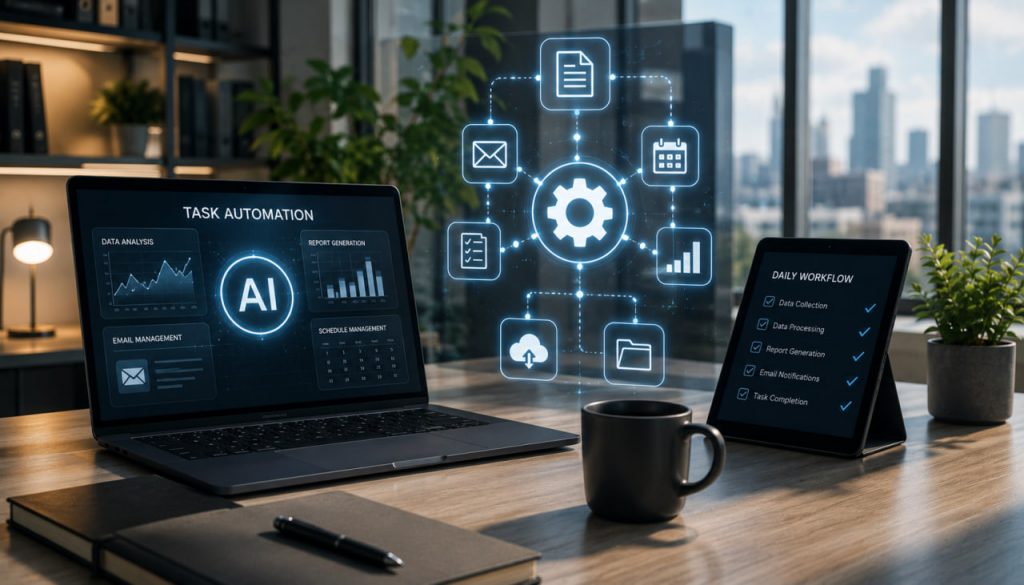
Artificial intelligence has become one of the most powerful tools for automating repetitive tasks in both business and personal life. From managing emails and scheduling meetings to generating reports and analyzing data, AI allows individuals and organizations to reduce manual work while improving efficiency and accuracy.
As AI technologies continue to evolve, automation is no longer limited to large enterprises. Small businesses, freelancers, entrepreneurs, and individual users can now leverage AI-powered tools to streamline workflows, reduce operational costs, and focus on higher-value activities.
The true value of AI automation lies not in replacing people, but in eliminating repetitive work so humans can concentrate on creativity, strategy, and decision-making.
What Is AI Automation?
AI automation refers to the use of artificial intelligence to perform tasks that traditionally required human effort.
Unlike conventional automation, which follows predefined rules, AI systems can:
- Understand natural language
- Recognize patterns
- Learn from data
- Make recommendations
- Generate content
- Adapt to changing conditions
This enables AI to automate both simple administrative work and more complex knowledge-based tasks.
Common Routine Tasks AI Can Automate
Modern AI systems can assist with a wide range of daily activities.
Examples include:
- Email drafting and replies
- Meeting summaries
- Calendar management
- Data entry
- Document generation
- Customer support
- Translation
- Social media scheduling
- Invoice processing
- Report creation
Automating these repetitive processes saves time while reducing the likelihood of human error.
AI for Business Productivity
Businesses increasingly rely on AI to optimize internal operations.
AI can help:
- Organize project documentation
- Generate marketing content
- Analyze sales performance
- Prepare presentations
- Manage customer inquiries
- Automate workflow approvals
Many organizations report measurable productivity improvements after integrating AI into routine business processes.
Automating Administrative Work
Administrative tasks consume a significant portion of the workday.
AI can simplify activities such as:
- Scheduling appointments
- Organizing files
- Creating meeting agendas
- Writing follow-up emails
- Managing task lists
- Processing forms
Reducing administrative workload allows employees to dedicate more time to strategic and customer-focused responsibilities.
AI in Customer Service
Customer support is one of the fastest-growing applications of AI automation.
Modern AI assistants can:
- Answer frequently asked questions
- Route support requests
- Generate support tickets
- Summarize customer conversations
- Provide multilingual assistance
Human agents remain essential for complex cases, while AI handles repetitive inquiries efficiently.
AI for Content Creation
Content creators and marketers use AI to automate many production tasks.
AI can generate:
- Blog outlines
- Product descriptions
- Email campaigns
- Social media posts
- Video scripts
- SEO recommendations
Although human review remains important, AI significantly accelerates content production.
Workflow Integration
Many AI platforms integrate with existing business software.
Common integrations include:
- Email platforms
- Cloud storage
- CRM systems
- Project management software
- Spreadsheets
- Communication tools
Connecting AI with existing workflows enables seamless automation across multiple business processes.
Benefits of AI Automation
Organizations adopting AI automation often experience:
- Higher productivity
- Faster task completion
- Reduced operating costs
- Fewer manual errors
- Better consistency
- Improved scalability
- Increased employee satisfaction
These advantages make AI an increasingly valuable investment for businesses of all sizes.
Challenges and Limitations
Despite its advantages, AI automation is not suitable for every task.
Challenges include:
Data Quality
AI systems depend on accurate and well-organized information.
Poor-quality data often produces unreliable results.
Human Oversight
Important decisions involving finance, healthcare, or legal matters still require human review.
AI should support—not replace—professional judgment.
Privacy and Security
Automated systems frequently process sensitive information.
Organizations should implement strong cybersecurity measures and clear data governance policies before deploying AI at scale.
Expert Perspective: Automation Should Augment Human Work
According to Andrew Ng, artificial intelligence is particularly effective at automating specific repetitive tasks rather than replacing entire jobs. He has consistently emphasized that organizations achieve the greatest value when AI enhances human capabilities instead of attempting to eliminate human involvement.
Researchers at World Economic Forum have similarly concluded that AI-driven automation is expected to reshape the labor market by reducing routine work while increasing demand for analytical, creative, and interpersonal skills.
Their findings highlight an important reality: the future workplace will increasingly combine human expertise with intelligent automation.
Best Practices for Successful AI Automation
To maximize the benefits of AI automation:
- Start with repetitive, time-consuming tasks
- Verify AI-generated outputs
- Protect sensitive information
- Train employees to use AI effectively
- Monitor automation performance regularly
- Update workflows as AI capabilities evolve
Organizations that implement AI gradually often achieve better long-term results than those attempting large-scale automation all at once.
The Future of AI Automation
The next generation of AI automation is expected to include:
- Autonomous digital assistants
- Smarter workflow orchestration
- Real-time business analytics
- Predictive task management
- Voice-controlled business operations
- Deeper integration across enterprise software
As AI becomes more capable, automation will extend beyond routine administration into increasingly sophisticated business processes.
Conclusion
Artificial intelligence is transforming routine work by automating repetitive tasks, improving productivity, and allowing individuals and organizations to focus on higher-value activities. From customer support and document creation to scheduling and workflow management, AI is becoming an essential productivity partner across nearly every industry.
As businesses continue adopting intelligent automation, success will depend on combining advanced AI technologies with human expertise, responsible governance, and continuous improvement.
Organizations that embrace AI automation thoughtfully today will be better positioned to compete, innovate, and grow in the digital economy of tomorrow.