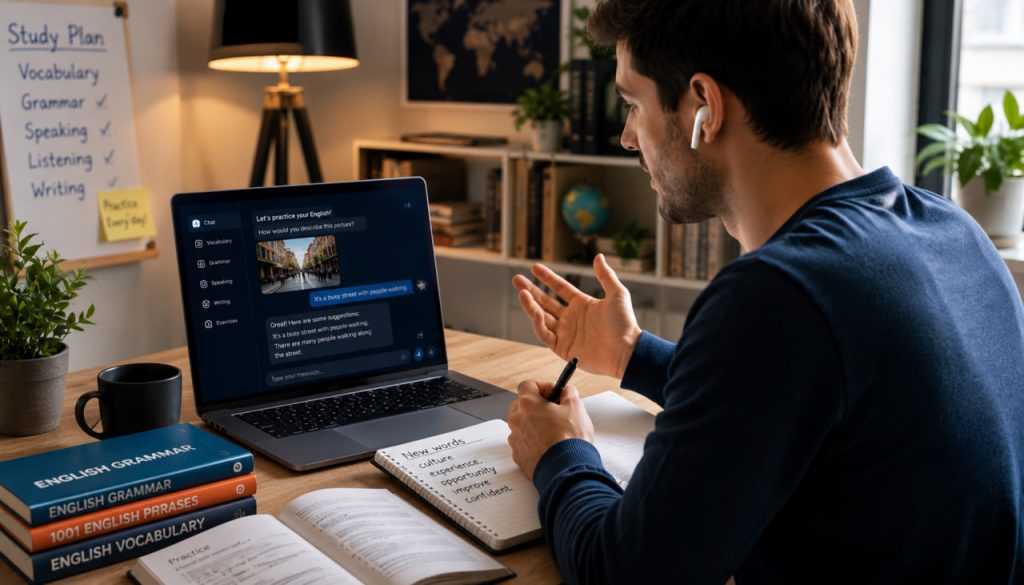
Artificial intelligence is revolutionizing language learning by making education more personalized, interactive, and accessible than ever before. Instead of relying solely on textbooks or traditional classroom instruction, learners can now practice conversations, receive instant grammar corrections, improve pronunciation, and generate customized exercises using AI-powered tools.
Whether you are learning English, Spanish, French, German, Japanese, or any other language, artificial intelligence can accelerate your progress by adapting lessons to your skill level and learning style.
AI is not replacing teachers—it is becoming one of the most powerful learning assistants available today.
Why AI Is Changing Language Learning
Traditional language courses often follow fixed lesson plans that may not suit every learner.
AI-powered platforms can instead:
- Adapt to individual progress
- Identify weak areas
- Generate unlimited practice exercises
- Provide instant feedback
- Simulate natural conversations
- Personalize vocabulary lessons
This flexibility allows students to learn more efficiently while maintaining motivation.
Practice Real Conversations Anytime
One of the biggest advantages of AI is unlimited conversation practice.
Modern AI assistants can:
- Simulate everyday conversations
- Role-play business meetings
- Conduct job interviews
- Practice travel situations
- Explain unfamiliar expressions
- Adjust language difficulty automatically
Unlike human tutors, AI is available 24 hours a day, allowing learners to practice whenever convenient.
Frequent speaking practice is one of the fastest ways to improve language fluency, and AI makes this possible without scheduling lessons.
Improve Grammar Instantly
Grammar mistakes are a natural part of learning a language.
AI can help by:
- Correcting errors immediately
- Explaining grammar rules
- Suggesting more natural wording
- Comparing formal and informal expressions
- Demonstrating correct sentence structures
Rather than simply identifying mistakes, advanced AI systems explain why corrections are necessary, helping learners develop long-term understanding.
Expand Vocabulary More Effectively
Vocabulary acquisition becomes easier when AI generates personalized examples.
Learners can request:
- Example sentences
- Synonyms
- Antonyms
- Common collocations
- Idioms
- Industry-specific terminology
AI can also create quizzes and flashcards based on recently learned words, reinforcing long-term memory.
Improve Pronunciation
Many AI-powered language platforms analyze pronunciation using speech recognition.
These systems can:
- Detect pronunciation errors
- Compare speech with native speakers
- Suggest mouth positioning
- Evaluate fluency
- Measure speaking confidence
Regular pronunciation practice helps learners develop clearer and more natural communication skills.
Use AI for Reading Practice
Reading remains essential for vocabulary growth and grammar development.
AI can generate reading materials tailored to any proficiency level.
Examples include:
- News articles
- Short stories
- Business texts
- Technical documents
- Dialogues
- Academic passages
Learners can also request simplified versions of difficult texts while preserving their original meaning.
Practice Writing with AI
Writing is often one of the most challenging language skills.
AI assists by reviewing:
- Essays
- Emails
- Reports
- Business correspondence
- Social media posts
- Creative writing
In addition to correcting mistakes, AI can recommend more natural vocabulary and improve overall writing style.
Learn Through Personalized Lessons
Unlike traditional courses, AI can generate completely customized learning plans.
A personalized program may focus on:
- Business English
- Travel communication
- Academic writing
- Exam preparation
- Medical terminology
- Legal vocabulary
This targeted approach allows learners to prioritize the language skills most relevant to their personal or professional goals.
Combine AI with Traditional Learning
Although AI is a powerful educational tool, it works best when combined with established learning methods.
A balanced study routine includes:
- Speaking with native speakers
- Watching films
- Reading books
- Listening to podcasts
- Practicing with AI
- Completing structured courses
Combining multiple learning methods improves long-term language retention.
Common Mistakes to Avoid
Many learners expect AI to replace consistent practice.
However, progress still requires:
- Daily study
- Active speaking
- Listening practice
- Regular review
- Real-world communication
AI provides guidance and feedback, but consistent effort remains essential for achieving fluency.
Expert Perspective: AI as a Language Learning Assistant
According to Louis von Ahn, artificial intelligence enables highly personalized language instruction by adapting exercises to each learner’s strengths and weaknesses, helping students stay engaged while progressing at their own pace.
Researchers at British Council have also emphasized that digital technologies, including AI-powered tools, can significantly enhance language acquisition when they complement meaningful communication, structured learning, and regular practice.
Their findings support a growing educational consensus: AI is most effective when it enhances human learning rather than replacing it.
The Future of AI in Language Education
Artificial intelligence continues to transform language learning through innovations such as:
- Real-time speech translation
- AI conversation partners
- Personalized pronunciation coaching
- Adaptive learning pathways
- Immersive virtual reality lessons
- Emotion-aware tutoring systems
These developments will make language education even more interactive, personalized, and accessible worldwide.
Conclusion
Artificial intelligence has become one of the most valuable tools for learning foreign languages. By providing personalized lessons, instant feedback, unlimited conversation practice, grammar correction, pronunciation analysis, and customized vocabulary training, AI helps learners improve more efficiently than ever before.
When combined with traditional study methods and regular real-world communication, AI creates a powerful learning environment that supports long-term fluency and confidence.
As AI technology continues to evolve, it is set to become an indispensable companion for anyone seeking to master a new language.