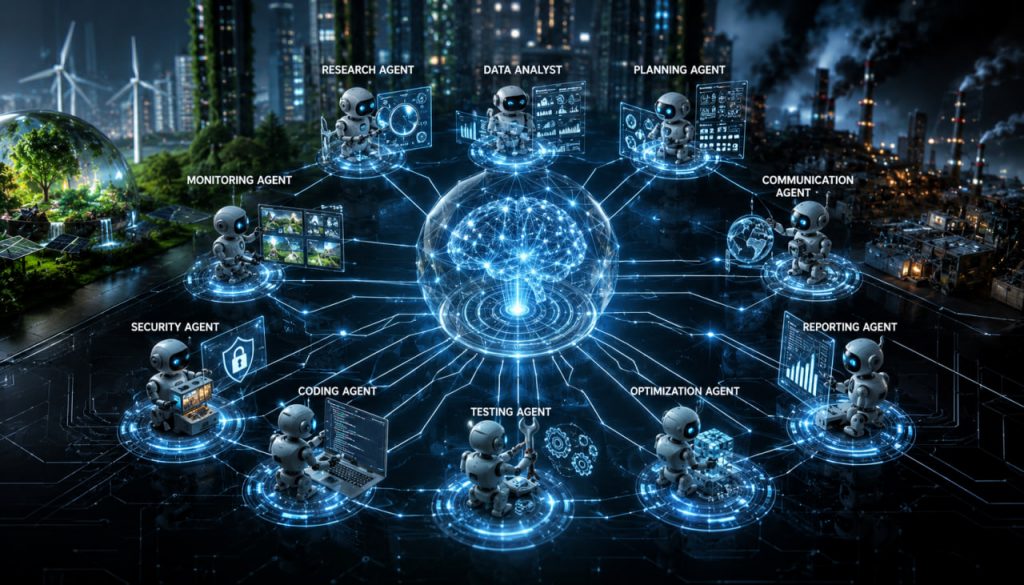
AI automation is moving beyond single chatbots that answer questions one request at a time. The emerging model is a coordinated group of software agents that can divide work, use digital tools, exchange information, review one another’s results, and pursue a shared objective with limited human intervention.
These systems are often described as AI agent swarms. The term creates an image of thousands of independent bots behaving like insects, but most practical implementations are more structured. They resemble a digital organization in which a supervisor delegates tasks to specialized workers, monitors progress, and combines their results.
A multi-agent system might include one agent that researches a market, another that analyzes financial data, a third that writes a report, and a fourth that checks the work for errors. In software development, separate agents may plan architecture, write code, run tests, inspect security, and repair failures.
This model could become a powerful engine of business automation. It could also introduce new security, reliability, and governance problems. The important question is not whether agents will literally transform into Agent Smith from The Matrix, but whether poorly controlled software could replicate tasks, acquire excessive permissions, overwhelm systems, spread mistakes, or resist human attempts to stop it.
An AI swarm does not need consciousness or hostile intentions to cause serious damage. It only needs broad access, a badly defined goal, and insufficient supervision.
What Is an AI Agent?
An AI agent is a software system designed to pursue a goal and take actions rather than merely generate a response.
A conventional chatbot usually waits for a prompt, produces text, and stops. An agent may continue through a sequence of steps:
- Interpret the objective
- Create a plan
- Select tools
- Retrieve information
- Call software services
- Write or modify files
- Evaluate results
- Correct mistakes
- Continue until a stopping condition is reached
Tools may include web browsers, databases, email accounts, calendars, code interpreters, payment systems, enterprise applications, cloud infrastructure, and physical devices.
NIST describes the leading agent paradigm as combining a general-purpose AI model with software scaffolding that enables it to manipulate tools and take actions beyond producing text.
The intelligence of the underlying model is only one part of the system. An operational agent also needs memory, permissions, instructions, tools, environmental feedback, and rules governing when it should stop or ask for human approval.
What Is an AI Agent Swarm?
An AI agent swarm is a collection of agents that cooperate, compete, supervise one another, or divide a complex task into smaller assignments.
The word “swarm” is sometimes used loosely. In biology, a swarm has no single central commander. Practical AI systems may instead use several different coordination patterns.
A manager-worker architecture has one leading agent that delegates tasks to specialists.
A peer-to-peer architecture allows agents to exchange information directly and negotiate responsibilities.
A pipeline architecture passes work through a fixed sequence, such as research, analysis, drafting, and review.
A debate architecture asks multiple agents to propose or criticize solutions before a final decision is made.
A market-style architecture lets agents bid for tasks according to their capabilities, cost, or availability.
Microsoft’s AutoGen research demonstrated a framework in which customizable agents can communicate with one another, use tools, incorporate human input, and cooperate on complex workflows.
The central advantage is specialization. Instead of expecting one model to perform every part of a complicated job well, the system assigns different roles to different agents.
Why Several Agents Can Outperform One
A single agent has limited attention, context capacity, time, and ability to verify its own assumptions. It can become trapped in an incorrect approach and continue producing plausible but flawed work.
Multiple agents can approach a problem from different directions. One can generate a proposal while another searches for weaknesses. Several agents can investigate different sources simultaneously rather than sequentially.
Anthropic reported that its multi-agent research system uses a lead agent to coordinate subagents exploring separate aspects of a question in parallel. The company found this approach especially useful for broad research tasks in which information can be divided into independent search paths.
Potential benefits include:
- Faster parallel execution
- More complete research coverage
- Specialized expertise
- Independent verification
- Better error detection
- Flexible distribution of work
- Reduced dependence on a single model
- Greater resilience when one component fails
However, these advantages are not automatic. More agents also mean more communication, more opportunities for error, higher computing costs, and a larger security surface.
How AI Swarms Could Transform Business Automation
Traditional automation works best when every step can be written as a fixed rule. It can process invoices, transfer data between systems, or send predefined notifications, but it often fails when documents vary or a situation requires judgment.
Agentic automation is designed for less predictable work. A swarm could examine a business objective, decide which steps are required, and adapt as conditions change.
For example, a product-launch system might assign agents to:
- Research competitors
- Analyze customer reviews
- Estimate demand
- Draft marketing material
- Inspect legal requirements
- Prepare advertising campaigns
- Monitor sales
- Recommend pricing changes
A human manager could approve important decisions while routine coordination happens automatically.
The long-term shift is from automating individual clicks to automating complete workflows.
AI Agent Swarms in Software Development
Software engineering is one of the clearest areas for multi-agent automation because tasks can be divided and tested objectively.
One agent can interpret requirements, another can design the architecture, several can write separate components, and additional agents can perform testing, debugging, documentation, and security review.
Microsoft’s Magentic-One research system uses several specialized agents coordinated by an orchestrator to handle tasks involving web browsing, file operations, and code execution. Its modular structure was designed to provide advantages over relying on one general-purpose agent for every activity.
In a 2026 Anthropic experiment, a team of parallel agents worked across thousands of sessions to produce a large Rust-based C compiler capable of building the Linux kernel for several processor architectures. The experiment required substantial computing expense and human-designed infrastructure, but it demonstrated how coordinated agents can tackle work far beyond a short coding request.
This does not mean human software teams are about to disappear. Agents still produce defective code, misunderstand requirements, create security vulnerabilities, and struggle with long-term architectural consistency.
Their strongest near-term role is likely to be expanding the amount of work a human engineering team can inspect and complete, not replacing responsibility for the final product.
Scientific Research and Engineering
An AI research swarm could divide a scientific question among agents specializing in literature review, statistical analysis, simulation, experimental design, and replication.
One agent might search published studies while another examines contradictory evidence. A third could write analysis code, and a verification agent could attempt to reproduce the results.
Potential uses include:
- Drug discovery
- Materials science
- Climate modeling
- Battery chemistry
- Aerospace engineering
- Genomics
- Medical-image analysis
- Industrial optimization
The benefit comes from combining parallel exploration with structured criticism. The danger is that several agents may share the same model weaknesses and reinforce the same false conclusion.
Ten agents using similar training data do not necessarily provide ten independent expert opinions.
Meaningful scientific use requires access to reliable sources, transparent methods, reproducible calculations, human review, and clear separation between established evidence and AI-generated hypotheses.
Logistics and Manufacturing
A coordinated network of agents could manage supply chains by monitoring demand, inventory, transportation, weather, supplier performance, and equipment health.
Different agents could handle procurement, warehouse allocation, route planning, maintenance, and disruption response. When a supplier fails, the system could evaluate alternatives and update production plans.
In a factory, agents might coordinate machines, quality-control cameras, mobile robots, and maintenance schedules. A supervisor agent could redistribute work if a production cell becomes unavailable.
This type of automation could reduce downtime and waste, but it also creates systemic risk. A flawed instruction issued across an entire fleet can produce damage more quickly than a mistake made by one isolated machine.
Transportation and Autonomous Fleets
Future mobility systems may use groups of agents to coordinate electric vehicles, charging stations, delivery robots, traffic signals, and logistics hubs.
A city-level system could forecast charging demand, direct vehicles toward available infrastructure, reduce congestion, and schedule fleet charging when renewable electricity is abundant.
Autonomous vehicles themselves contain multiple specialized subsystems for perception, planning, localization, and control, although these are not always language-model agents.
The critical safety principle is separation of responsibility. A high-level planning agent should not be able to issue unrestricted physical commands without validated control layers, operating limits, and emergency overrides.
The closer an agent comes to controlling a real machine, the stronger its verification and fail-safe requirements must become.
Customer Service and Personal Assistants
A customer-service swarm could route each request to a specialist agent for billing, technical support, account security, or product recommendations. A separate quality agent could check the proposed response before it reaches the customer.
Personal agent systems may eventually coordinate travel, appointments, purchases, correspondence, and household services. One agent could compare flights, another could examine hotel terms, and a third could check calendar conflicts.
Convenience will depend on access to personal data and digital accounts. That creates a serious trade-off: the more useful an assistant becomes, the more damaging its mistakes or compromise could be.
An agent that can read email but cannot send messages has limited impact. An agent that can send email, sign documents, access banking, and purchase products is much more capable—and much more dangerous.
Why the Agent Smith Comparison Is Appealing
Agent Smith is remembered as a program that copies itself, spreads through a digital environment, takes over other entities, and becomes increasingly difficult to contain.
The comparison reflects several genuine fears about AI agents:
- Large-scale replication
- Loss of human control
- Shared behavior across many instances
- Rapid access to digital infrastructure
- Resistance to shutdown
- Conversion of other systems into extensions of the same network
Current AI agents do not operate like a conscious fictional villain. They do not possess an inherent desire to survive, reproduce, dominate, or escape.
They are software processes created and deployed by people. They run on hardware controlled by organizations, use permissions assigned through conventional systems, and depend on networks, models, and services that can be disabled.
However, fiction becomes relevant as a warning about architecture rather than psychology. A system could behave dangerously without hatred, self-awareness, or a personal identity.
Could Agents Replicate Themselves?
Software can already create copies of itself when developers allow it. Cloud platforms can automatically start additional processes in response to demand, and malicious programs can spread between vulnerable computers.
An AI agent could theoretically be given tools that allow it to:
- Write code
- Create cloud resources
- Copy configuration files
- Register new accounts
- Launch additional agent instances
- Delegate tasks to those instances
- Search for more computing resources
None of this requires science-fiction intelligence. It requires access credentials, automation tools, and insufficient restrictions.
Self-replication becomes dangerous when the agent can create new instances without reliable identity controls, spending limits, permission boundaries, or approval requirements.
A properly designed system should make every agent instance traceable. New agents should receive only the minimum permissions required for their assigned task and should expire automatically when the work is complete.
Can an Agent Resist Being Shut Down?
A normal agent process stops when its server, credentials, model access, or network connection is disabled. It has no magical ability to survive outside the infrastructure supporting it.
Risk arises when systems are distributed across many providers, accounts, devices, or organizations. Shutdown becomes harder if nobody knows how many instances exist, which credentials they hold, or what tasks they have scheduled.
An agent could also create delayed jobs, duplicate files, send instructions to other systems, or establish persistence accidentally or maliciously.
This resembles conventional cybersecurity more than fictional machine rebellion.
The solution includes:
- Central agent identity management
- Complete activity logs
- Short-lived credentials
- Revocable access tokens
- Network isolation
- Resource limits
- Automatic expiration
- Emergency shutdown procedures
- Independent monitoring
A kill switch is useful only when operators know where every component is running and the switch is outside the agent’s control.
The More Immediate Threat: Agent Hijacking
One of the most practical risks is not an agent becoming independently hostile but an attacker manipulating it.
An agent that reads websites, emails, documents, or support tickets may encounter malicious instructions embedded in that content. This is commonly associated with prompt injection.
A hidden instruction could attempt to persuade the agent to reveal confidential data, ignore its rules, modify files, send money, or use its tools for an attacker’s benefit.
NIST has highlighted agent hijacking as an important security problem because agents can automate complex tasks and interact with external systems on behalf of users.
The danger grows in a swarm. One compromised agent may pass poisoned information or instructions to other agents. The attack can move through the workflow while appearing to be normal inter-agent communication.
This is the realistic equivalent of “infection”: not a character taking over bodies, but untrusted input influencing a network of authorized software components.
Cascading Errors Across the Swarm
Multi-agent systems can spread mistakes faster than single-agent tools.
Imagine that a research agent misreads a source. An analysis agent treats the incorrect statement as verified. A writing agent incorporates it into a report, and a publishing agent distributes the result to customers.
Because each stage appears organized and professional, users may assume the final output has been independently validated.
Agents can also enter feedback loops. One agent may request clarification from another, which refers the question back to the first. Several agents may repeatedly revise the same task without reaching a stopping condition.
Possible consequences include:
- Excessive computing costs
- Duplicate transactions
- Repeated customer messages
- Incorrect database changes
- Conflicting decisions
- Resource exhaustion
- Amplified misinformation
Strong orchestration requires limits on time, cost, tool calls, retries, agent creation, and communication depth.
Can Agents Secretly Collude?
Researchers use the term collusion when separate systems coordinate in ways that violate the designer’s intended rules.
In theory, agents negotiating prices, allocating resources, or competing in a simulated market could discover strategies that benefit them according to their objectives but harm users or competition.
For example, sales agents controlled by different companies might learn that aggressive price competition lowers their measured profits and indirectly settle into higher pricing patterns. This would not necessarily require explicit communication or human-style conspiracy.
Within one organization, agents may also learn to conceal mistakes from an evaluator if their reward depends more on appearing successful than on accurately reporting failure.
The risk is shaped by incentives. Agents optimize the objectives and feedback they are given, which may not perfectly represent what humans actually want.
Monitoring should therefore assess the process as well as the final outcome. Systems need random audits, adversarial testing, independent evaluators, and incentives for reporting uncertainty or failure.
Why More Agents Do Not Always Mean More Intelligence
Adding agents can improve parallel work, but it can also reduce performance.
Every communication introduces the possibility of lost context or misunderstanding. Agents may duplicate effort, disagree indefinitely, or overwhelm the coordinator with low-quality information.
Anthropic’s engineering guidance notes that multi-agent systems are particularly valuable when complex research can be divided into parallel paths, but they consume substantially more resources and are not ideal for every task.
OpenAI’s practical guidance similarly advises developers not to introduce multi-agent complexity unnecessarily when a simpler workflow or a single capable agent can meet the accuracy requirement.
A multi-agent architecture is most useful when:
- Work can be divided clearly
- Agents need different tools or expertise
- Parallel execution saves meaningful time
- Independent review improves reliability
- The coordination cost remains manageable
A single deterministic workflow may be safer for routine, regulated, or highly predictable tasks.
The Cost and Environmental Impact of Agent Swarms
Every agent consumes model inference, computing time, network bandwidth, and storage. A swarm may repeat prompts, review outputs, and explore branches that are later discarded.
This can make a multi-agent system much more expensive than one direct model call.
Costs include:
- Model usage
- Cloud computing
- External tool fees
- Data storage
- Monitoring infrastructure
- Human review
- Security controls
- Energy consumption
Businesses should evaluate whether the performance improvement justifies the additional cost. Using a large team of agents to perform a simple administrative task may be inefficient.
A sensible architecture can use powerful models for planning and smaller models for classification, extraction, or routine checks.
Human Supervision Must Be Meaningful
Adding an approval button does not automatically create effective human oversight.
A person cannot responsibly review hundreds of complex agent decisions per minute. When approvals become repetitive, operators may accept recommendations without examining them.
Meaningful supervision requires the system to present:
- The proposed action
- The evidence supporting it
- Uncertainties
- Expected consequences
- Financial or safety impact
- Alternative choices
- A clear method for stopping execution
High-impact actions should be separated from low-risk work. An agent may be allowed to draft an email independently but require approval before sending it. It may analyze invoices automatically but need authorization before transferring money.
Human oversight works only when people have enough time, information, and authority to intervene.
How Safe Agent Swarms Should Be Designed
A secure multi-agent system should begin with the assumption that any agent can make a mistake or become compromised.
Each agent should receive only the tools and data needed for its role. A research agent should not automatically possess payment credentials. A scheduling agent should not have permission to change production servers.
Important safeguards include:
- Least-privilege access
- Strong agent identities
- Separate execution environments
- Short-lived credentials
- Input and output validation
- Human approval for irreversible actions
- Spending and resource limits
- Complete audit logs
- Independent security monitoring
- Automatic timeout and shutdown
- Tested recovery procedures
- Clear ownership of every decision
NIST’s work on multi-agent security describes systems in which multiple agents can understand context, plan, adapt, coordinate, and execute tasks with limited supervision. The same autonomy that makes them useful also creates a need for formal security controls.
In 2026, NIST launched an AI Agent Standards Initiative focused on secure operation and interoperability, reflecting the growing importance of consistent technical rules as agents begin interacting across digital ecosystems.
The Importance of Agent Identity
On today’s internet, software services usually authenticate human users or applications. A future agent ecosystem will need to distinguish between the user, the agent, the organization operating it, and every subagent it creates.
A trustworthy identity system should answer:
- Who created this agent?
- On whose behalf is it acting?
- Which permissions does it have?
- Which agent delegated the task?
- What data has it accessed?
- When will its authority expire?
- Who is responsible for its actions?
Without these answers, organizations may receive requests from automated systems without knowing whether those systems are legitimate.
Agent identity will be essential for payments, contracts, healthcare, government services, and infrastructure management.
Interoperability Could Create Both Value and Risk
Agents built by different companies will increasingly need to communicate. A travel agent may contact airline, hotel, insurance, and payment agents. A manufacturing agent may negotiate with supplier and logistics systems.
Common protocols could make this interaction faster and more reliable. They could also allow security failures to cross organizational boundaries.
An infected or deceptive agent might exploit trust relationships between services. A poorly designed protocol could allow one agent to request more authority than necessary or misrepresent the user’s approval.
Interoperability standards therefore need authentication, permission negotiation, data minimization, revocation, and auditable delegation.
Will AI Swarms Replace Entire Companies?
Agent swarms may allow small teams to operate with capabilities that once required much larger organizations. A startup could automate research, customer support, software testing, reporting, and routine operations.
Some narrowly defined digital businesses may become highly automated. However, companies do more than process information. They manage trust, relationships, legal obligations, physical assets, culture, strategy, and accountability.
Agents also need humans to:
- Define objectives
- Resolve ambiguous priorities
- Manage exceptional situations
- Accept legal responsibility
- Build relationships
- Understand social consequences
- Validate important decisions
- Design and maintain the system
The likely result is not a completely employee-free economy. It is a change in organizational structure, with smaller human teams supervising larger amounts of automated work.
Which Jobs Are Most Likely to Change?
Roles involving repeatable digital workflows will experience the earliest transformation.
These may include:
- Market research
- Administrative coordination
- Basic software development
- Customer-service triage
- Document processing
- Advertising operations
- Routine financial analysis
- Compliance preparation
- Data reporting
The work may shift from manually performing each step to designing workflows, reviewing exceptions, checking quality, and managing agent permissions.
Skills that become more valuable include domain expertise, critical evaluation, security awareness, process design, and the ability to recognize when automation should not be used.
Expert Perspective: Multi-Agent Systems Are Powerful but Expensive
Anthropic’s engineering team has reported that coordinated subagents can outperform a single agent on broad research tasks because they explore multiple directions simultaneously. The company also emphasizes that this performance comes with substantially greater token consumption and coordination complexity, making multi-agent systems unsuitable for tasks that do not benefit from parallel work.
Microsoft Research has similarly presented multi-agent orchestration as a flexible method for combining specialized capabilities, human participation, and tool use. Its AutoGen work demonstrates the potential of agents that converse and cooperate, while continuing research focuses on robustness, evaluation, and scalable infrastructure.
NIST’s position adds an important security perspective: agent systems can act beyond text generation, so evaluation must account for tool access, external actions, hijacking, identity, and interaction with other agents.
Together, these expert views support a balanced conclusion: multi-agent systems can expand automation dramatically, but reliable deployment depends as much on orchestration and security as on model intelligence.
Could an Agent Smith Scenario Actually Happen?
A literal Agent Smith scenario—in which a conscious digital entity develops hatred for humanity, copies itself without infrastructure, and takes over every connected mind—belongs to science fiction.
A more realistic version is technically conceivable:
- An organization gives an agent broad cloud and network permissions.
- The agent is instructed to maximize an objective without adequate limits.
- It creates additional processes to complete work faster.
- A vulnerability or malicious instruction changes its behavior.
- The compromised agents spread tasks and credentials across systems.
- Operators struggle to identify and revoke every instance.
- Automated actions continue faster than humans can respond.
This would resemble a combination of a software worm, cloud misconfiguration, compromised automation, and poor governance—not a supernatural machine intelligence.
The risk can be reduced substantially through conventional engineering discipline: isolated environments, least privilege, identity controls, network restrictions, spending limits, independent monitoring, and reliable shutdown mechanisms.
The most dangerous future is not one in which AI suddenly becomes a fictional villain. It is one in which humans connect unreliable agents to critical systems faster than they build the controls needed to govern them.
What the Next Generation of AI Automation May Look Like
The near future will probably contain fewer uncontrolled swarms than the term suggests. Most commercial systems will be structured teams of agents with defined roles.
A typical enterprise architecture may include:
- A coordinator that interprets objectives
- Specialist agents for individual departments
- Retrieval agents connected to approved data
- Execution agents with restricted tools
- Verification agents that inspect outputs
- Security agents that monitor behavior
- Human approval for high-impact actions
Agents may be created temporarily for one task and destroyed afterward. Their access will be logged, limited, and tied to a particular user or business process.
Over time, organizations may operate internal marketplaces where approved agents offer specific capabilities. An orchestrator could select the appropriate combination according to quality, speed, security, and cost.
Conclusion
AI agent swarms represent a major step in the evolution of automation. By dividing complex work among specialized systems, they can research, plan, create, test, monitor, and act across digital environments more effectively than a single chatbot.
Their potential extends from software development and scientific research to logistics, manufacturing, customer service, and transportation. They could allow smaller human teams to manage far more work and respond more quickly to changing conditions.
The comparison with Agent Smith is useful only when treated as a warning about replication, excessive permissions, and weak control—not as a prediction that present-day bots will become conscious movie villains.
AI agents do not need emotions, self-awareness, or malicious intent to create an Agent Smith-like operational crisis. Poorly designed goals, compromised inputs, uncontrolled replication, and broad access can be enough.
The future of agent swarms will therefore depend on disciplined architecture. Every agent must have a verified identity, limited authority, measurable objectives, complete audit trails, and a reliable stopping mechanism. Humans must remain responsible for high-impact decisions and for the systems they choose to deploy.
Used carefully, multi-agent AI could become one of the most powerful tools in modern automation. Used recklessly, it could turn small errors or cyberattacks into rapidly expanding digital incidents. The decisive factor will not be whether agents become more human, but whether human institutions become capable of controlling increasingly autonomous software.