Artificial intelligence has experienced another remarkable year of technological progress. Throughout 2026, AI systems have become more capable of writing software, analyzing complicated documents, generating realistic images and videos, conducting research, and operating digital tools with less direct human involvement. Technologies that recently seemed experimental are increasingly appearing in professional software, industrial operations, education, and everyday consumer applications. The biggest change is that artificial intelligence is evolving from a system that primarily answers questions into technology that can help complete substantial amounts of work.
However, the progress of AI in 2026 should not be confused with the arrival of fully autonomous, universally reliable machine intelligence. Even advanced models continue to make factual mistakes, misunderstand instructions, and struggle with unpredictable real-world situations. Meanwhile, businesses face growing questions about operating costs, cybersecurity, privacy, regulation, and the reliability of automated decisions. Understanding what artificial intelligence actually achieved in 2026 is essential for predicting which developments are realistic in 2027 and which expectations remain speculative.
How Much Did Artificial Intelligence Improve in 2026?
The Stanford University 2026 AI Index Report provides one of the clearest assessments of recent progress. The researchers documented rapid improvements in software engineering, scientific reasoning, mathematics, and multimodal understanding, based largely on developments measured through 2025 and early 2026. The report found that organizational AI adoption reached 88% in its underlying survey data, demonstrating how extensively businesses were experimenting with or implementing artificial intelligence. It also highlighted rapidly improving benchmark performance, although the results varied considerably depending on the task being evaluated.
These figures reveal an important distinction between technical capability and practical usefulness. A model may achieve excellent results on standardized mathematics problems while struggling with an unfamiliar business document or an ambiguous customer request. Benchmark results also depend on testing methodology, available tools, and whether examples resemble material encountered during model development. The most meaningful AI improvements are those that transfer from controlled evaluations into dependable real-world performance.
AI Agents Became More Capable of Completing Tasks
AI agents were among the most important technology developments of 2026. Unlike conventional chatbots that mainly generate responses, agents can use software tools, navigate websites, examine files, and perform sequences of actions to achieve a specific objective. For example, an agent may organize market research, prepare a spreadsheet, generate a presentation, and revise the final material according to instructions. These workflows bring artificial intelligence closer to practical digital assistance rather than isolated text generation.
However, giving an AI system access to external applications introduces considerable responsibility. An agent might misunderstand a request, select the wrong file, encounter an unexpected website interface, or repeat a mistake across several connected tasks. Sending messages, deleting information, and making purchases require particularly careful authorization because their consequences may be difficult to reverse. In 2027, improvements in agent reliability and permission management could prove more valuable than simply increasing the number of actions AI can perform.
Software Development Is Changing Rapidly
Programming has become one of the strongest commercial applications of generative AI. Modern coding assistants can inspect large repositories, generate functions, identify potential defects, write tests, and suggest improvements across multiple files. This allows developers to concentrate more attention on architecture, performance requirements, and the overall purpose of an application. Smaller teams can also experiment with software projects that previously required considerably more manual programming.
Anthropic’s 2026 Agentic Coding Trends Report describes a shift from writing individual pieces of code toward coordinating AI systems that perform larger development workflows. The report emphasizes that effective implementation remains collaborative and requires active human supervision. In the company’s underlying research, developers reported using AI across approximately 60% of their work but considered only a much smaller proportion of tasks suitable for complete delegation. AI is becoming a powerful software engineering collaborator, but independent testing and professional judgment remain necessary.
AI Became Better at Mathematics and Scientific Research
Scientific applications attracted increasing attention during 2026 as AI models became more capable of handling complex reasoning problems. Researchers have been exploring systems that generate mathematical arguments, analyze experimental results, and suggest promising directions for investigation. One especially important approach combines generative models with formal verification systems that can check whether individual steps in a mathematical proof are logically valid. This is fundamentally different from accepting a convincing explanation simply because it sounds mathematically sophisticated.
Artificial intelligence also supports research involving materials science, chemistry, biotechnology, and engineering. Models can help researchers examine large datasets, compare possible molecular structures, or identify patterns that deserve further investigation. Nevertheless, predictions generated by AI do not automatically constitute experimental discoveries, and suggested results often require independent testing. The strongest scientific applications combine computational speed with rigorous verification, reproducible experiments, and expert interpretation.
Artificial Intelligence Is Helping Researchers Develop Better AI
Another important development is the growing use of AI inside artificial intelligence laboratories themselves. Researchers can use coding agents to implement experiments, analyze benchmark results, investigate errors, and accelerate repetitive engineering tasks. These activities may shorten the time required to test technical ideas and improve model development workflows. However, it remains difficult to separate the contribution of AI assistance from improvements in hardware, staffing, research methods, and organizational processes.
In November 2026, the independent research organization METR published an assessment of AI-assisted research and development at Anthropic. Its analysis estimated that measured model capability progress had accelerated to approximately 1.9 times an earlier rate, based on the benchmarks and period examined. The researchers considered AI assistance a plausible major contributor while emphasizing uncertainty about the precise causes. This finding suggests that AI may increasingly accelerate its own development, but it does not demonstrate unlimited or fully autonomous technological progress.
Realistic Video Generation Became More Accessible
AI-generated video made meaningful advances in visual consistency, camera movement, scene composition, and synchronization with sound. Modern systems can transform written descriptions or reference images into short video sequences suitable for creative experimentation. Advertising teams can use these tools to explore campaign concepts, while independent creators can visualize scenes that would be expensive to film conventionally. Improvements in editing and reference-based generation are also making it easier to maintain a consistent visual style across multiple clips.
Nevertheless, generated video still struggles with complex physical interactions, continuity between shots, and detailed movements. Objects may change shape, background details can disappear, and characters may behave unnaturally during complicated actions. These limitations matter when videos are used to demonstrate real products, document events, or communicate factual information. As synthetic video becomes more convincing, transparent disclosure and reliable content verification will become increasingly important.
Synthetic Voices and Digital Humans Are Improving
Artificial intelligence has also advanced in speech synthesis, voice interaction, and realistic digital character creation. Modern systems can generate speech with more natural pauses, rhythm, and conversational variation than earlier text-to-speech technologies. When combined with facial animation, these capabilities make virtual presenters and interactive customer service characters appear increasingly lifelike. Businesses can use synthetic voices for instructional materials, accessibility features, and multilingual communication.
However, realistic voice generation introduces significant risks involving impersonation and consent. Fraudsters may attempt to imitate a trusted person’s voice, while misleading videos can make fictional events appear genuine. Organizations must therefore consider identity verification and appropriate disclosure when deploying synthetic communication systems. The commercial value of realistic digital humans depends on building audience trust rather than disguising artificial content as authentic human experience.
Multimodal AI Can Understand More Than Written Text
A major improvement in contemporary AI is its ability to work across several information formats. Multimodal models can interpret photographs, examine diagrams, analyze documents, process audio, and combine these inputs with written instructions. This opens opportunities in professional environments where important information is distributed across spreadsheets, technical drawings, photographs, and equipment manuals. For example, an engineer might use AI to compare a photograph of damaged machinery with maintenance documentation and prepare an initial inspection summary.
The challenge is that understanding individual pieces of information does not guarantee a correct overall conclusion. A system can recognize a component accurately while misunderstanding how that component operates within a larger machine. Document analysis may also fail when pages contain unusual formatting or contradictory information. Multimodal AI is expanding the range of useful applications, but professional verification remains essential when errors could affect safety or financial decisions.
Intelligent Robots Are Moving Beyond Controlled Demonstrations
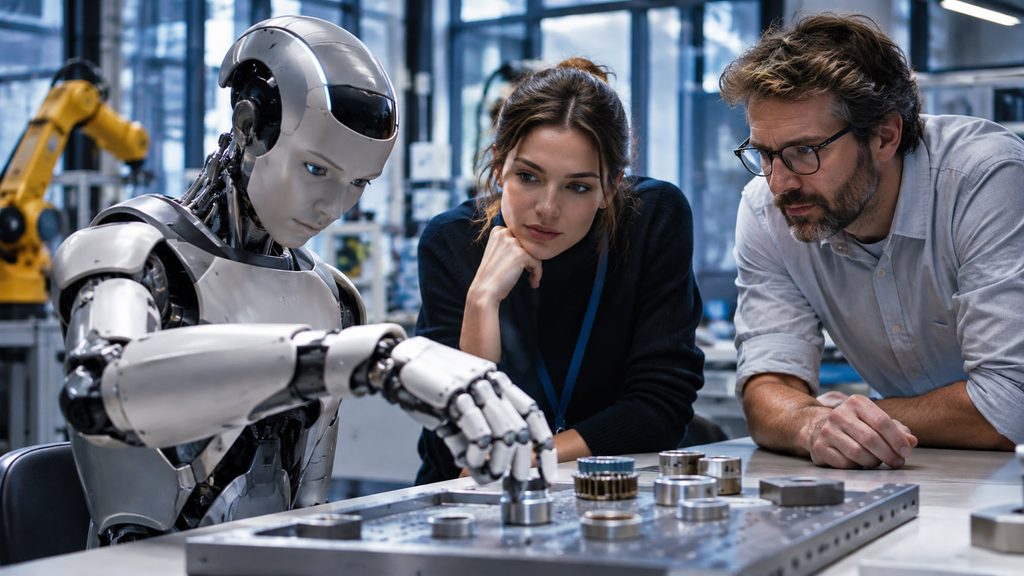
Robotics is becoming an increasingly important application of advanced machine learning. Researchers are developing systems that combine visual perception, language understanding, motion planning, and physical control. These capabilities could allow robots to handle a wider range of tasks without requiring engineers to program every movement individually. Manufacturing facilities and logistics operations are particularly attractive environments because many activities are repetitive and occur within defined physical areas.
However, controlling a robot is fundamentally different from generating a digital response. A minor software error can damage equipment, interrupt production, or injure someone standing nearby. Successful demonstrations also do not guarantee reliable operation across different factories, lighting conditions, and unfamiliar objects. In 2027, industrial robotics is likely to advance through carefully supervised deployments rather than an immediate replacement of human workers across entire industries.
The Automotive Industry Is Becoming More Dependent on AI
Artificial intelligence is already influencing vehicle development, production planning, quality inspection, and software engineering. Automotive manufacturers can use AI to examine manufacturing data, identify possible component defects, and accelerate selected design activities. Connected vehicles also generate diagnostic information that may support maintenance analysis and improvements in fleet management. Natural-language assistants are becoming another potential interface between drivers and increasingly complicated vehicle functions.
However, automotive applications require an especially careful distinction between convenience features and safety-critical systems. An inaccurate entertainment recommendation is inconvenient, while an incorrect driving decision can have serious consequences. Advanced driver-assistance systems must therefore undergo rigorous validation under diverse operating conditions. AI may improve automotive technology substantially, but fully autonomous driving remains a demanding engineering and regulatory challenge.
Businesses Are Learning Where AI Actually Saves Time
Organizations increasingly use artificial intelligence for administrative tasks, programming, customer support, document analysis, and marketing production. These applications can reduce repetitive work and allow smaller teams to handle projects that previously required additional resources. However, productivity improvements are not uniform across industries or job categories. A document generated in minutes can still require extensive correction if its information is inaccurate or its structure does not meet professional standards.
Companies also need to account for subscription fees, computing costs, employee training, and integration with existing software. The benefits of automation should be evaluated against the complete cost of implementation rather than the speed of producing an initial result. Effective organizations are increasingly measuring output quality alongside time savings. Artificial intelligence creates the greatest value when it improves complete workflows instead of merely generating more content.
Why AI Still Makes Mistakes
Despite major improvements, AI systems continue to produce incorrect information and unreliable reasoning. They can confuse similar concepts, overlook important context, or provide answers with more confidence than the available evidence justifies. These problems become particularly serious when an agent performs many consecutive actions without sufficient verification. An early mistake can influence subsequent calculations, documents, and decisions.
The practical response is to design systems that recognize uncertainty and support external checks. High-risk applications may require source validation, automated testing, independent calculations, and human authorization before actions are completed. Organizations also need clear procedures for correcting errors and determining responsibility when something goes wrong. Greater intelligence does not automatically produce reliability, and responsible AI deployment requires appropriate safeguards.
Energy Consumption Is Becoming a Major Constraint
AI development requires substantial computing infrastructure, including specialized processors, networking equipment, cooling systems, and reliable electricity supplies. Training advanced models consumes considerable resources, while serving millions of users creates continuing demand for computing capacity. The International Energy Agency’s 2026 energy analysis projected that global data center electricity consumption could rise from approximately 485 terawatt-hours in 2025 to 950 terawatt-hours by 2030. The agency also warned that infrastructure bottlenecks could influence the pace of expansion.
More efficient chips and smaller models may reduce the energy required for individual tasks. However, overall electricity demand can continue increasing if the number and complexity of AI applications grow faster than efficiency improves. Data centers also raise questions about grid capacity, cooling requirements, and local environmental impacts. The next generation of AI must become not only more capable but also more economically and energetically efficient.
Regulation and Digital Trust Became More Important
The spread of realistic synthetic content and increasingly autonomous software has intensified debates about regulation. Governments are attempting to address risks involving personal data, deceptive media, discrimination, cybersecurity, and accountability for automated decisions. The European Union’s AI Act introduced a structured approach to regulating selected AI applications, with important provisions taking effect through a phased implementation schedule. Organizations must consider the requirements relevant to their particular systems rather than assuming that every AI tool faces identical obligations.
Transparency is especially important when users communicate with artificial systems or encounter realistic generated content. Clear explanations of data handling, automated decision-making, and human oversight can help build confidence. Excessively complicated rules may also create implementation costs, particularly for smaller businesses. The challenge for policymakers is to encourage useful innovation while protecting people from foreseeable harm.
What AI Developments Are Most Likely in 2027?
The strongest forecast for 2027 is continued improvement in technologies already demonstrated during 2026. AI agents are likely to become better at maintaining context, using applications, recovering from errors, and asking for approval before sensitive actions. Multimodal systems may become more convenient for working with complex documents, images, video, and technical information. Coding assistants could also handle larger software projects while giving engineers better tools for reviewing their work.
Another likely direction is broader adoption of specialized AI systems designed for particular professional tasks. Smaller and more efficient models could make useful capabilities available at lower operating costs or directly on devices. Robotics and scientific research may benefit from improved planning and verification, although progress will vary considerably by application. These developments are reasonable projections, not guarantees that every industry will experience the same level of change.
Will AI Replace More Human Jobs?
Artificial intelligence is changing how work is organized, especially in occupations involving repetitive digital activities. Routine documentation, basic content production, some programming tasks, and selected customer service operations are increasingly open to automation. However, replacing an individual task does not necessarily mean eliminating an entire occupation. Many jobs require communication, physical adaptability, ethical judgment, and responsibility that remain difficult to automate completely.
The effects on employment will depend on business decisions, economic conditions, regulation, and access to training. Some workers may become more productive by supervising AI systems, while others may face reduced demand for particular skills. New responsibilities involving AI evaluation, integration, cybersecurity, and oversight may also expand. The most practical preparation for 2027 is learning how to use AI effectively while developing expertise that supports reliable judgment and decision-making.
Conclusion
Artificial intelligence made substantial progress in 2026, particularly in software development, autonomous digital workflows, multimodal understanding, synthetic media, and scientific research. These advances are transforming AI from an experimental productivity tool into a more important component of professional technology. Nevertheless, reliability, cybersecurity, energy consumption, and human oversight remain major obstacles to broader deployment. The achievements of 2026 demonstrate technological progress, but they do not establish that artificial intelligence has become universally capable or infallible.
Looking toward 2027, the most important improvements may involve making existing AI capabilities more dependable, affordable, and accessible. Businesses will increasingly evaluate systems according to measurable results rather than impressive demonstrations. Researchers will continue exploring intelligent agents, robotics, scientific applications, and more efficient models. The next stage of AI development will be defined by how safely and consistently technology can help people solve real problems.
Which AI development do you expect to have the greatest impact in 2027: autonomous agents, intelligent robots, scientific discoveries, or realistic digital media? Share your opinion in the comments.