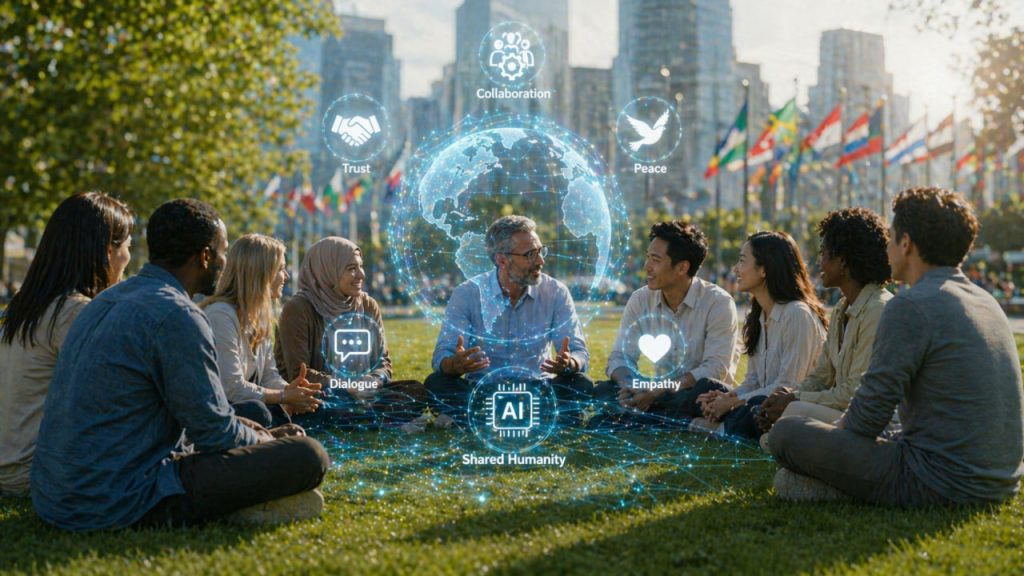
Artificial intelligence is often associated with automation, business efficiency, and technological disruption. However, one of its most profound and less discussed potentials lies in its ability to contribute to global peace. While AI itself is a tool—neither inherently good nor bad—its applications can influence diplomacy, conflict prevention, economic stability, and international cooperation.
In a world facing geopolitical tensions, inequality, and resource competition, AI has the potential to become a stabilizing force, if used responsibly.
Early Conflict Detection and Prevention
One of the most promising uses of AI is in predicting and preventing conflicts before they escalate.
AI systems can analyze:
- satellite imagery
- social media activity
- economic indicators
- migration patterns
By identifying unusual patterns, governments and organizations can detect early warning signs of instability, such as:
- rising tensions between groups
- military mobilization
- resource shortages
According to United Nations research initiatives, data-driven approaches are increasingly being explored to improve early warning systems for conflict prevention.
Enhancing Diplomacy with Data
Diplomacy has traditionally relied on human negotiation and intuition. AI can enhance this process by providing data-driven insights.
AI tools can:
- simulate negotiation scenarios
- analyze historical agreements
- identify mutually beneficial outcomes
This allows policymakers to make more informed decisions and explore solutions that might not be obvious through traditional methods.
Fighting Misinformation and Reducing Tensions
Misinformation and propaganda are major drivers of conflict in the modern world. AI can play a key role in:
- detecting fake news
- identifying deepfakes
- analyzing information spread patterns
By improving the integrity of information, AI helps reduce:
- public panic
- political polarization
- manipulation of public opinion
This contributes to more stable and informed societies.
Supporting Economic Stability
Economic inequality and instability are often root causes of conflict. AI can support peace by improving economic systems through:
- better resource allocation
- predictive economic modeling
- smarter supply chains
For example, AI can help governments anticipate:
- food shortages
- unemployment trends
- inflation risks
This enables proactive policies that reduce social unrest.
Humanitarian Aid and Crisis Response
AI is already being used in humanitarian efforts to improve efficiency and effectiveness.
Applications include:
- disaster response coordination
- refugee movement prediction
- resource distribution optimization
Organizations like International Red Cross use data-driven tools to better respond to crises and deliver aid where it is needed most.
Cross-Cultural Communication
Language barriers often hinder cooperation between nations. AI-powered translation and communication tools are helping bridge these gaps.
Modern AI systems can:
- provide real-time translation
- adapt to cultural context
- improve mutual understanding
Better communication reduces misunderstandings and fosters collaboration.
AI in Peacekeeping Operations
AI can enhance peacekeeping missions by improving situational awareness.
Examples include:
- analyzing surveillance data
- monitoring ceasefire agreements
- detecting unusual activity in conflict zones
This allows peacekeeping forces to act more effectively and reduce risks.
Ethical Risks and Dual-Use Technology
Despite its potential, AI also poses risks to global peace.
Challenges include:
- autonomous weapons
- cyber warfare
- surveillance misuse
AI is a dual-use technology, meaning it can be used for both peaceful and harmful purposes.
Managing these risks requires:
- international regulation
- ethical frameworks
- global cooperation
The Role of Global Cooperation
For AI to contribute to peace, countries must collaborate rather than compete destructively.
This includes:
- sharing best practices
- establishing common standards
- preventing an arms race in AI technologies
International organizations and agreements will play a critical role in shaping how AI is used globally.
Key Insight
AI alone cannot create peace—but it can support the systems and decisions that make peace possible.
Conclusion
Artificial intelligence has the potential to become a powerful tool for promoting global peace. By improving conflict detection, enhancing diplomacy, fighting misinformation, and supporting economic stability, AI can address many of the root causes of conflict.
However, this outcome is not guaranteed. The impact of AI will depend on how it is governed, regulated, and applied. With responsible development and international cooperation, AI can help build a more stable and peaceful world.