
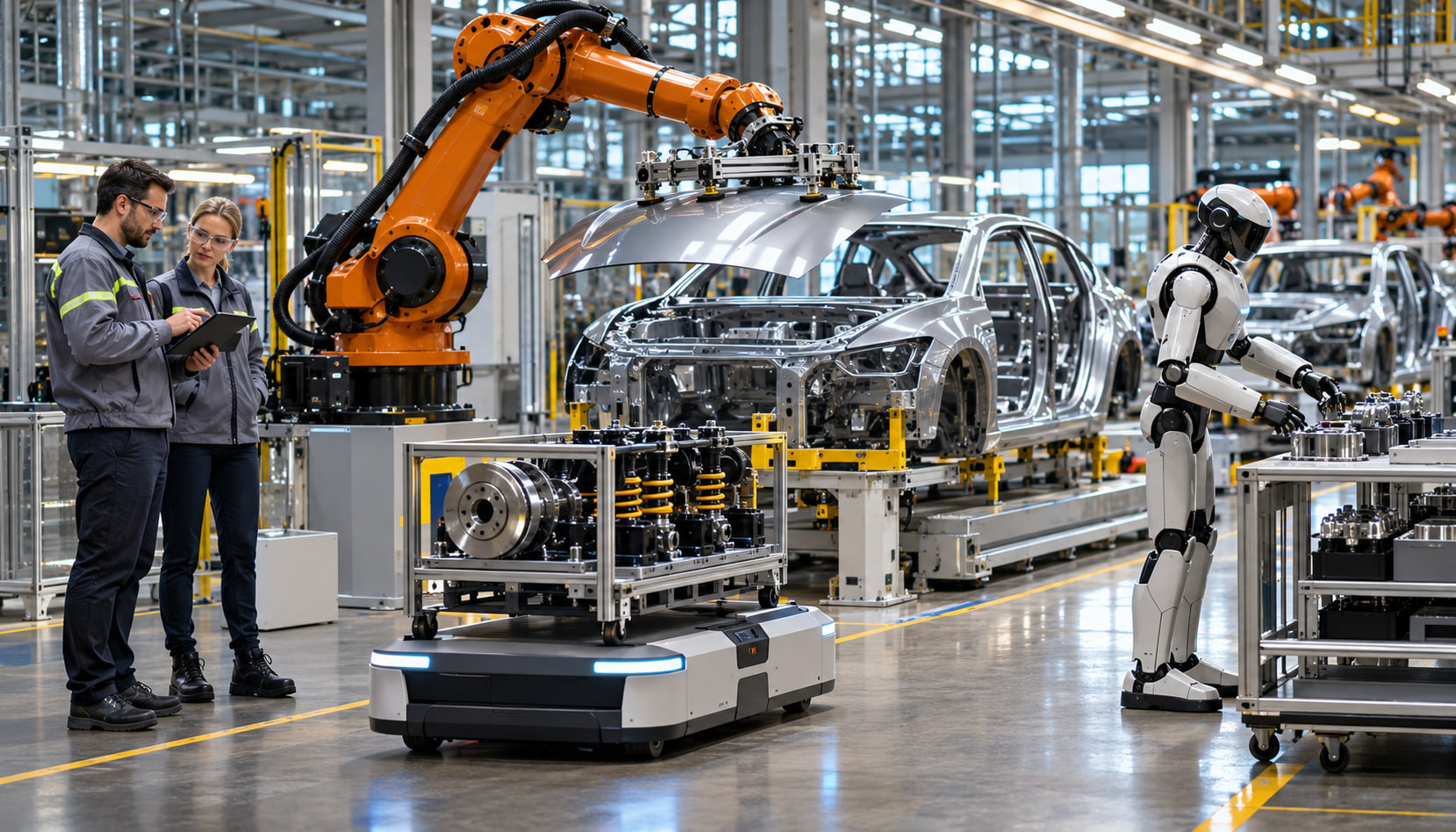
Industrial robotics is entering a new phase. For decades, manufacturing robots have welded automotive bodies, assembled electronic components, handled heavy materials, and performed repetitive tasks with extraordinary precision. Today, artificial intelligence is expanding their capabilities, allowing machines to recognize objects, adapt to changing conditions, and perform operations that previously required extensive programming or human intervention.
The transformation is particularly visible in automotive manufacturing, where companies such as BMW, Mercedes-Benz, and Hyundai are experimenting with increasingly intelligent robotic systems. Humanoid robots, autonomous mobile platforms, collaborative robotic arms, and AI-powered inspection equipment are gradually becoming part of modern production environments. Some technologies are already operating commercially, while others remain in carefully controlled pilot projects.
The most important development is not simply that factories are installing more robots, but that robots are becoming more adaptable, connected, and capable of working alongside people. Understanding this transition helps explain what manufacturing automation can achieve today and which innovations may become practical over the next several years.
How Much Has Industrial Robotics Grown?
Industrial automation is already a major global industry. According to the International Federation of Robotics (IFR), factories worldwide installed approximately 603,000 industrial robots in 2025, an increase of 11% compared with the previous year. The total number of operational industrial robots reached approximately 5.08 million, representing another record.
China remained the largest market, installing approximately 354,000 industrial robots during 2025 and accounting for 59% of worldwide installations. The United States became the second-largest national market, with nearly 38,500 installations, followed by Japan. Germany remained Europe's leading industrial robotics market.
Jane Heffner, President of the International Federation of Robotics, described industrial automation as advancing rapidly, noting that the global operational robot population had more than doubled within seven years. These figures demonstrate that robotization is no longer an experimental concept but an established foundation of modern industrial production.
Traditional Industrial Robots Versus AI-Powered Robots
Conventional industrial robots generally follow predefined programs. A robotic arm might weld the same vehicle body section thousands of times, following carefully programmed positions and movements. These systems can operate quickly and accurately, but unexpected changes to component placement or production conditions may require reprogramming.
AI-powered robots introduce additional flexibility through cameras, sensors, machine learning, and adaptive control. A robot equipped with computer vision may identify objects that are positioned differently from one production cycle to another. More advanced systems can use learned models to select movements or adjust their actions within defined operating limits.
However, not every robot advertised as intelligent uses sophisticated artificial intelligence. Some depend primarily on traditional automation, while others incorporate AI for only specific tasks. The distinction matters because genuine adaptive capability must be demonstrated through reliable factory performance rather than impressive promotional videos.
Automotive Manufacturing Is Leading the Transformation
Automotive factories are among the most highly automated industrial environments. Robots already perform welding, painting, adhesive application, material handling, and numerous assembly operations. Their advantages include repeatability, precise movement, and the ability to operate in environments containing heat, chemicals, or heavy equipment.
Electric vehicle production is creating additional opportunities for automation. Battery modules require accurate component positioning, consistent assembly procedures, and extensive quality checks. AI-powered inspection systems can help identify manufacturing defects, while robotic handling equipment reduces the need for workers to repeatedly lift heavy parts.
Nevertheless, final vehicle assembly remains challenging to automate completely. Wiring harnesses, interior components, flexible materials, and numerous vehicle configurations require dexterity and adaptation. These tasks explain why manufacturers are investigating more capable robotic systems rather than relying exclusively on traditional industrial arms.
BMW and Figure AI: Humanoid Robots Working in a Real Factory
One of the most significant recent examples comes from BMW's manufacturing facility in Spartanburg, South Carolina. During 2025, BMW conducted an industrial pilot with Figure AI's Figure 02 humanoid robot. The machine was assigned to handling and positioning sheet-metal components during vehicle production.
According to BMW, the robot contributed to the production of more than 30,000 BMW X3 vehicles during a ten-month deployment. It handled over 90,000 components, accumulated approximately 1,250 operating hours, and completed around 1.2 million steps. The work involved repeated positioning tasks requiring high accuracy.
These results demonstrate that a humanoid robot can contribute to actual automotive production rather than performing only laboratory demonstrations. However, the pilot involved a defined application in an established manufacturing environment, not unrestricted autonomous operation throughout the factory.
In 2026, BMW expanded its robotics research with the Figure 03 platform in Spartanburg and the AEON humanoid robot developed by Hexagon Robotics at its Leipzig plant. The Leipzig project focuses on potential applications in high-voltage battery assembly and component production. BMW's approach illustrates how manufacturers are moving from isolated demonstrations toward evaluating the practical integration of intelligent robots into existing production systems.
Mercedes-Benz and the Apollo Humanoid Robot
Mercedes-Benz has also been exploring humanoid robotics through its collaboration with Apptronik, an American robotics company. The automaker announced an investment in Apptronik in March 2025 while investigating the use of its Apollo humanoid robot in manufacturing. Potential applications include transporting components to production lines and supporting quality inspection operations.
The project has involved teleoperation, allowing human operators to control robot movements while generating training data for future autonomous behavior. This method helps developers teach robots practical tasks that are difficult to define through conventional programming alone. It also provides an opportunity to study how humanoid machines interact with existing industrial equipment.
The experiments remain different from large-scale commercial deployment. Manufacturers must still demonstrate that humanoid systems can maintain sufficient reliability, speed, and operating efficiency across demanding production schedules. Their ability to perform a task once does not establish that they can perform it economically thousands of times.
Hyundai and Boston Dynamics: The Development of Atlas
Hyundai Motor Group is pursuing another ambitious approach through Boston Dynamics and its fully electric Atlas humanoid robot. In January 2026, Boston Dynamics introduced a product version of Atlas designed with industrial applications in mind. The machine combines advanced mobility, articulated joints, sensors, and AI-based control technology.
In September 2026, Boston Dynamics opened a Robotics Metaplant Application Center at Hyundai's manufacturing campus near Savannah, Georgia. The facility provides a real-world environment for training Atlas robots in automotive manufacturing tasks, particularly parts handling and production logistics. Initial applications involve preparing and arranging components before assembly.
Boston Dynamics has outlined plans to expand Atlas applications toward component assembly by 2030. Hyundai has also announced ambitious long-term deployment and production-capacity targets, although these are plans rather than completed installations.
Atlas represents a potentially important technological direction, but extensive training and controlled evaluation are still required before humanoid robots can become ordinary equipment across automotive factories.
Why Humanoid Robots Attract So Much Attention
Most factories were originally designed for human workers. Their doors, workstations, storage areas, tools, and component containers reflect human dimensions and movement patterns. A robot with arms, hands, and human-compatible reach may therefore perform certain tasks without requiring every part of the factory to be redesigned.
This versatility creates potential advantages in environments where production requirements change frequently. A humanoid machine might eventually move materials, organize components, inspect equipment, and assist assembly operations using related hardware. In theory, this could reduce the need for separate specialized machines for every activity.
However, humanoid robots also have important disadvantages. Walking consumes energy, mechanical complexity increases maintenance requirements, and balancing a two-legged machine introduces control challenges. Wheeled robots and fixed industrial arms are often faster, cheaper, or more stable for specific repetitive tasks.
Humanoid robots are not automatically the best solution for factory automation. Their commercial value depends on whether their flexibility justifies their additional complexity.
Collaborative Robots Are Already Changing Smaller Factories
Collaborative robots, commonly called cobots, represent a more established approach to flexible automation. These machines are designed for applications in which people and robots may share workspaces under appropriate safety conditions. They are used for component handling, machine tending, assembly assistance, and packaging.
Companies including Universal Robots, ABB, and FANUC provide collaborative robotic systems for industrial applications. Compared with some traditional automation installations, cobots can offer relatively accessible programming and flexible integration. Their smaller footprints make them attractive for manufacturers that lack the space or production volume required for large robotic cells.
According to the IFR's 2026 industry statistics, approximately 66,000 collaborative robots were installed worldwide during 2025, accounting for about 11% of industrial robot installations. Their growing adoption highlights demand for automation that can be introduced into existing workplaces.
However, collaborative operation does not mean that every movement is automatically safe. Tool design, payload, operating speed, and the surrounding environment still require formal risk assessment and appropriate safeguards.
Autonomous Mobile Robots Are Transforming Factory Logistics
Traditional industrial robots typically remain in fixed positions, but autonomous mobile robots can transport materials between different areas of a facility. These battery-powered machines use sensors, onboard computing, and mapping software to navigate production environments. Some carry components directly, while others move carts or transport heavy loads.
Unlike older automated guided vehicles that often depend on fixed routes or installed guidance infrastructure, modern mobile robots can navigate more flexibly within mapped environments. They can identify obstacles, select alternative routes, and coordinate movements through fleet-management software. This makes them useful for delivering parts to assembly stations and transferring finished products to warehouses.
The IFR's 2026 service robotics report recorded approximately 117,500 transportation and logistics robots sold during 2025. These figures cover a broader category than factory mobile robots alone, but they demonstrate substantial demand for robotic material transportation.
Mobile robots are among the most immediately practical forms of AI-enabled automation because moving materials is a repetitive requirement across almost every manufacturing sector.
AI Computer Vision and Automated Quality Inspection
Manufacturing quality control is another area experiencing rapid technological change. Traditional inspection often relies on human workers or fixed measurement equipment to identify surface defects, incorrect assembly, and dimensional inconsistencies. AI-powered computer vision can analyze images and sensor measurements to support these procedures.
For example, cameras positioned along an automotive production line can inspect painted surfaces, welds, fasteners, and installed components. Machine learning models may recognize visual patterns associated with defects and direct suspicious items toward additional inspection. The technology can also support more consistent monitoring across extended production shifts.
However, image recognition is not perfect. Changes in lighting, reflections, component finishes, or camera positioning can generate false alarms or missed defects. Manufacturers must validate models using representative production data and continue monitoring their performance.
The most effective applications combine automated inspection with traceable production records and qualified human review. AI can improve quality assurance, but its results must remain measurable and verifiable.
Digital Twins and Virtual Robot Training
One of the most promising developments is the use of digital twins and simulation environments. A digital twin is a virtual representation of a physical machine, production line, or facility that can be used to analyze operating conditions. Manufacturers may test robot movements, workstation arrangements, and production changes before implementing them in the physical factory.
Simulation can also help AI-powered robots learn movement strategies through repeated virtual training. NVIDIA's Isaac robotics platform and its GR00T foundation-model initiative are examples of technologies designed to support robot development, synthetic training data, and simulated environments.
These approaches may reduce the cost of experimentation and help identify problems before equipment enters production. Nevertheless, simulated conditions cannot reproduce every physical variable accurately, including friction, component deformation, sensor noise, and unexpected human behavior. Robots still require extensive real-world validation.
Safety Is Becoming More Important as Robots Gain Autonomy
Industrial robots can create serious hazards when moving heavy equipment or operating powerful mechanical systems. Increasing autonomy introduces additional challenges because robot behavior may depend on sensor interpretation and software decisions rather than exclusively predefined movements. Manufacturers must therefore ensure that unexpected situations lead to predictable and safe responses.
The ISO 10218-1:2025 and ISO 10218-2:2025 standards establish safety requirements for industrial robots and their applications. Risk assessment, protective equipment, emergency-stop systems, and appropriate operating procedures remain essential. AI capabilities do not eliminate these established engineering responsibilities.
Safety systems should also account for cybersecurity, communication failures, and unintended interactions with workers. A robot that performs accurately during normal production must still respond safely when components are misplaced or personnel enter restricted areas.
The industrial value of an intelligent robot depends as much on dependable safety engineering as on advanced artificial intelligence.
Will Robots Replace Human Factory Workers?
Industrial automation changes the demand for particular tasks and skills. Robots can reduce the need for repetitive handling, routine inspection, and physically demanding operations. At the same time, automated facilities require technicians, software engineers, maintenance specialists, and employees capable of supervising complex equipment.
These changes do not affect every worker equally. Some jobs may disappear or require fewer employees, while new positions emerge in robot integration, programming, maintenance, and process optimization. Workers whose tasks are highly repetitive may face greater disruption than those responsible for troubleshooting, planning, and complex decision-making.
The transition also depends on company investment and workforce training. Manufacturers that introduce automation without developing employee skills may encounter operational difficulties and resistance. The central employment challenge is not simply the number of robots installed, but how businesses manage changes in skills, productivity, and job opportunities.
The Economic Reality of Robotization
Robots are often promoted as solutions to labor shortages, rising production costs, and quality problems. However, purchasing a robot is only one part of the investment. Manufacturers must also account for integration, software, maintenance, safety equipment, charging infrastructure, and potential production interruptions.
A fixed industrial arm performing thousands of identical operations daily may offer a relatively straightforward economic case. A general-purpose humanoid robot performing several unpredictable tasks presents a more complicated calculation. Its value depends on uptime, task completion speed, adaptability, and the cost of human supervision.
Smaller manufacturers face additional obstacles because their production volumes may not justify expensive automation projects. Leasing arrangements, robotics-as-a-service models, and simpler collaborative systems may reduce initial investment requirements. Nevertheless, every project should be evaluated using actual operating costs and measurable productivity improvements.
What Will Change Between 2027 and 2030?
The next several years are likely to bring wider use of machine vision, mobile robots, adaptive manipulation, and AI-assisted production planning. Manufacturers will continue experimenting with humanoid systems, although widespread adoption will depend on improvements in reliability, operating cost, and safety. More industrial equipment will also be connected through centralized software that coordinates production and material movement.
The International Federation of Robotics forecasts approximately 655,000 new industrial robot installations worldwide in 2026 and 806,000 annually by 2029. These are industry forecasts rather than guaranteed outcomes, and regional markets may develop at different speeds. Nevertheless, they indicate expectations for sustained growth in industrial automation.
Humanoid robots may become increasingly useful for selected logistics, inspection, and assembly tasks during this period. However, specialized industrial arms, collaborative robots, and autonomous mobile platforms will likely remain the foundation of factory robotics. The nearest realistic future is a factory where different types of intelligent machines cooperate with human workers, rather than a completely automated facility operated exclusively by humanoid robots.
Conclusion
Factory automation has moved far beyond the era of isolated robotic arms performing predetermined movements. More than five million industrial robots are already operating worldwide, while manufacturers are increasingly combining traditional automation with artificial intelligence, computer vision, mobile robotics, and advanced software. Automotive companies such as BMW, Mercedes-Benz, and Hyundai are actively testing technologies that could expand the range of tasks robots can perform.
However, technological demonstrations should not be confused with proven industrial-scale deployment. Humanoid robots still face limitations involving cost, energy consumption, safety, dexterity, and reliability. Meanwhile, collaborative robots, autonomous mobile platforms, and AI-powered inspection systems are already providing practical solutions across manufacturing environments.
The most significant transformation over the next five years is likely to be the gradual development of more flexible, connected, and intelligent factories where robots handle increasingly complex physical tasks while people remain responsible for supervision, innovation, and critical decisions.
The future of manufacturing will not be determined by whether robots can imitate humans perfectly, but by how effectively artificial intelligence and robotic technology can improve industrial productivity, workplace safety, and the quality of manufactured products.