Skills and development

Creative Professions and AI: A Threat or a New Tool?
Skills and development Creative Arts AI in Media Production

Creative Professions and AI: A Threat or a New Tool?

The rapid development of artificial intelligence has sparked intense debate across creative industries. Designers, writers, musicians, filmmakers, and illustrators increasingly encounter AI systems capable of generating images, composing music, editing videos, and producing written content within seconds. This technological shift raises a fundamental question: is AI a threat to creative professions, or does it represent a powerful new instrument that expands human potential? The answer lies not in extremes, but in understanding how creativity, technology, and human originality interact.


Tools for Speech Recognition and Speech Synthesis: How Modern Voice Technologies Work
Skills and development Creative Arts AI in Media Production

Tools for Speech Recognition and Speech Synthesis: How Modern Voice Technologies Work

Speech technologies have become a fundamental part of everyday digital interaction, enabling humans to communicate naturally with machines. From voice assistants and automated customer support to accessibility tools and content creation, speech recognition and speech synthesis are transforming how information is processed and delivered. These technologies rely on artificial intelligence to convert spoken language into text and generate natural-sounding speech from written content. Understanding the tools behind these systems helps explain their capabilities, limitations, and real-world value.

Low-Code and No-Code AI Platforms: Creating Models Without Programming
Skills and development Applications AI in Media Production

Low-Code and No-Code AI Platforms: Creating Models Without Programming

Artificial intelligence is no longer reserved exclusively for programmers, data scientists, or large technology companies. In recent years, low-code and no-code AI platforms have dramatically lowered the barrier to entry, allowing non-technical users to build, train, and deploy AI models without writing traditional code. These platforms are changing how businesses, educators, and creators approach AI—shifting the focus from algorithms to problems, data, and outcomes. Low-code and no-code AI does not eliminate complexity entirely, but it hides it behind intuitive interfaces, visual workflows, and automated processes. As a result, AI development becomes more accessible, faster, and more aligned with real-world business needs.

Google Colab Review: An Ideal Platform for AI Experiments
Skills and development Business Growth AI for Content Creators

Google Colab Review: An Ideal Platform for AI Experiments

Artificial intelligence experimentation often fails not because of weak ideas, but because of limited access to computing resources and complex setup requirements. Google Colab solves this problem by providing a ready-to-use, cloud-based environment where anyone can run AI and machine learning experiments directly in the browser. It removes friction at the earliest stage of learning and prototyping, allowing users to focus on models, data, and ideas rather than infrastructure. This combination of accessibility, power, and simplicity has made Colab one of the most popular tools in modern AI education and experimentation.

Best Free AI and Machine Learning Courses for Beginners
Education and training Skills and development AI for Everyday Life

Best Free AI and Machine Learning Courses for Beginners

Artificial intelligence and machine learning have moved from niche academic fields into core technologies shaping business, science, and everyday life. For beginners, the biggest challenge is not motivation but knowing where to start without wasting time or money. Fortunately, many world-class universities and technology companies offer free, high-quality courses that teach AI and ML fundamentals in a structured, beginner-friendly way. Choosing the right learning path early helps build strong foundations and avoids confusion caused by fragmented or overly advanced materials.

Computer Vision: How AI Understands and Analyzes Images
Education and training Skills and development Smart Technologies

Computer Vision: How AI Understands and Analyzes Images

Computer vision is one of the most powerful and fast-evolving branches of artificial intelligence, enabling machines to extract meaning from images and video. At its core, computer vision allows AI systems to transform raw pixels into structured information that can be interpreted, classified, and acted upon. This capability underpins technologies such as facial recognition, medical imaging, autonomous driving, quality control in manufacturing, and visual search. While humans perceive images almost instantly, AI must learn to see through layers of mathematical abstraction, data representation, and probabilistic reasoning.

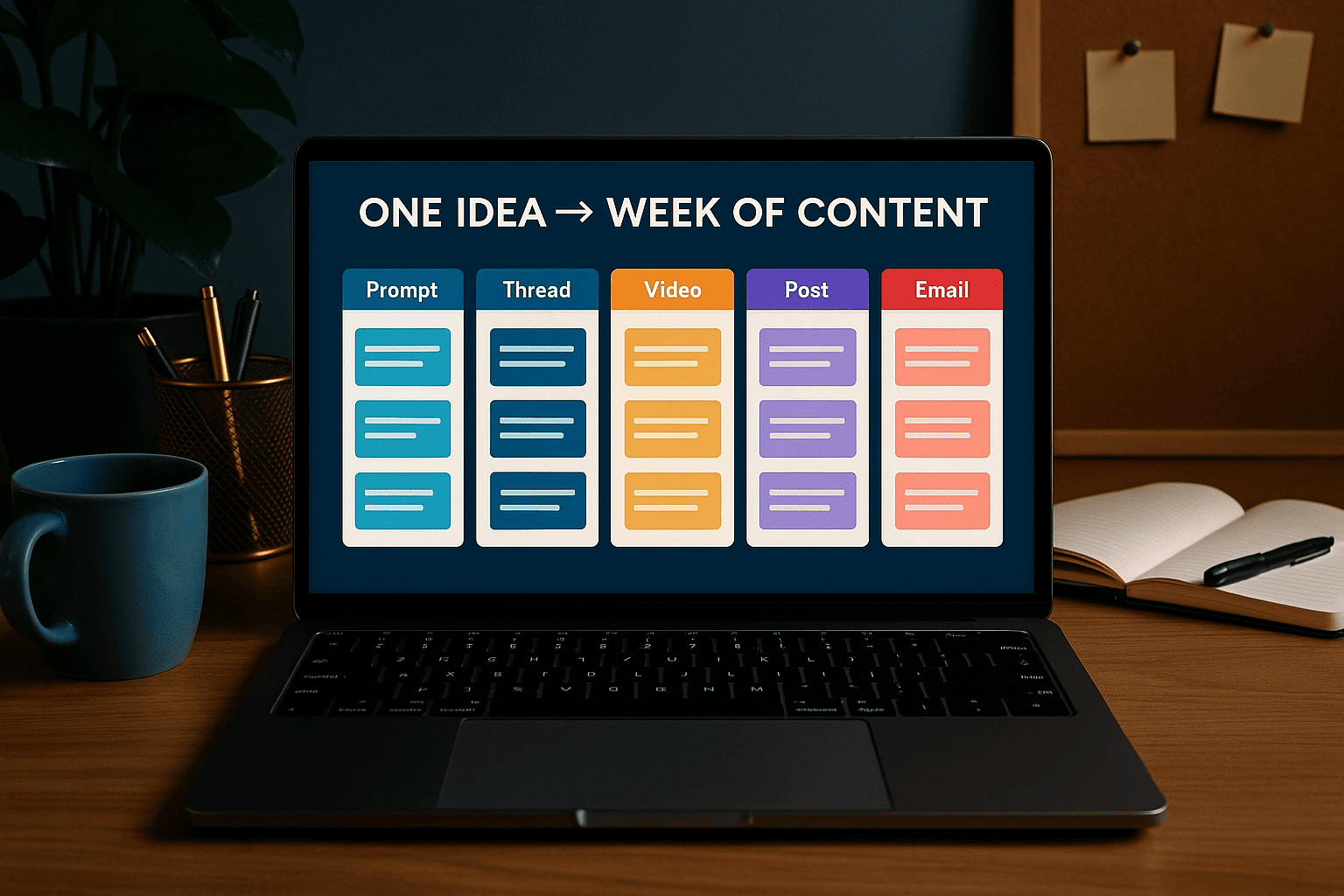
Prompt-to-Product: A System to Turn One Idea into a Week of Cross-Channel Content
Skills and development Applications Customer Experience

Prompt-to-Product: A System to Turn One Idea into a Week of Cross-Channel Content

Most creators don’t lack ideas—they lack a repeatable system that compounds one solid idea into many native pieces across platforms. This playbook shows how to go from a single prompt to a full week of output—articles, threads, shorts, carousels, emails—without sounding repetitive or generic. You’ll build a “content engine” that preserves your voice, adapts to each channel, and gets better with every cycle.

GPT in the Classroom: Supercharging Learning Without Undermining Teaching
Education and training Skills and development Applications

GPT in the Classroom: Supercharging Learning Without Undermining Teaching

Schools and universities are living through a real-time experiment: large language models enter lesson plans, grading flows, and students’ pockets. For some, GPT looks like a tireless tutor and teaching assistant; for others, it’s a plagiarism machine that hollows out critical thinking. The truth sits between extremes. Used with clarity and guardrails, GPT can amplify teachers and personalize learning. Used carelessly, it can flatten rigor and mask gaps. This article maps practical uses, risks, and concrete norms so classrooms gain leverage—not shortcuts.

Career Moats in the Age of AI: Skills That Compound Instead of Commoditize
Career Education and training Skills and development

Career Moats in the Age of AI: Skills That Compound Instead of Commoditize

AI supercharges average output, which means average is no longer a strategy. The people who thrive build career moats—hard-to-copy capabilities that compound with each project, tool, and connection. This playbook shows which skills actually compound in an AI-saturated market, how to cultivate them deliberately, and how to weave AI into your processes without becoming interchangeable with it.

Beyond Chat: Advanced AI Workflows with Programming, APIs, and Automation
Skills and development Applications Smart Technologies

Beyond Chat: Advanced AI Workflows with Programming, APIs, and Automation

Most people meet AI through a chat box. Power users meet it through code. When you combine large models with clean APIs, event-driven automation, and solid engineering discipline, AI stops being a novelty and becomes an always-on capability inside your apps and business processes. This guide walks through advanced, production-grade scenarios that show how to design, secure, and scale AI systems for real work.