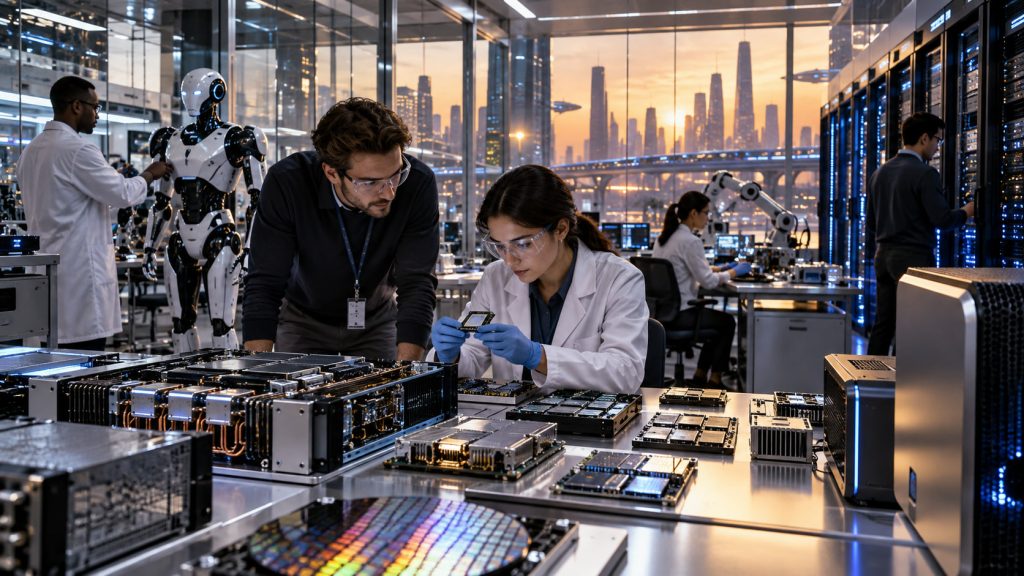
The IT industry in 2026 is moving through one of its fastest periods of change in decades. Artificial intelligence is no longer simply an extra feature inside software. It is influencing processor design, personal computers, cloud infrastructure, cybersecurity, data centers, networking and the way companies organize everyday work.
At the same time, semiconductor manufacturers are moving to more advanced manufacturing processes, AI models are increasingly running directly on personal devices, autonomous software agents are taking on multi-step tasks, and the technology industry is beginning a serious transition toward post-quantum security.
The scale of investment reflects this transformation. Gartner’s July 2026 forecast estimates worldwide IT spending will reach approximately $6.37 trillion in 2026, an increase of 14.2 percent from 2025. The organization identifies data-center systems and infrastructure-as-a-service as particularly strong growth areas, largely because of demand for artificial intelligence computing.
The defining IT trend of 2026 is not one individual product. It is the transition from software that waits for instructions to computing systems designed to understand, reason, act and continuously assist users.
Agentic AI Is Replacing the Simple Chatbot Model
Generative AI first became widely familiar through systems that responded to prompts. In 2026, the industry is moving toward a more ambitious model: AI agents.
An AI agent does more than generate a paragraph or answer a question. It can potentially interpret a goal, break that goal into steps, use external tools, access permitted business systems, evaluate intermediate results and continue working until a task is completed.
Typical enterprise applications include:
- Researching and preparing reports
- Monitoring business processes
- Analyzing documents
- Managing support workflows
- Assisting software development
- Preparing customer responses
- Investigating technical incidents
- Coordinating tasks between applications
- Processing repetitive administrative work
Google, Microsoft and other major technology companies have increasingly reorganized their enterprise AI platforms around this concept.
Google Cloud, for example, expanded Gemini Enterprise in 2026 around agent development, deployment, governance and monitoring. Its platform includes capabilities for long-running agents, workflow agents, reusable skills, session memory and controlled connections between agents and external tools.
This reflects an important change.
The competitive question is becoming less about which AI gives the best single answer and more about which platform can safely complete useful work across multiple systems.
That also creates new security problems. An AI agent with permission to access email, databases or business applications can cause far more damage if compromised than an ordinary chatbot. Identity management, access control, monitoring and audit trails are therefore becoming fundamental components of enterprise AI.
AI Is Moving from the Cloud onto the PC
One of the biggest hardware trends of 2026 is the rapid development of the AI PC.
Earlier generations of generative AI depended heavily on remote data centers. A user sent information to a cloud server, a large model processed it, and the result returned over the internet.
New processors increasingly contain dedicated neural processing hardware designed to run AI workloads locally.
This creates several advantages:
- Faster response times
- Reduced dependence on internet connectivity
- Lower cloud-computing costs
- Greater control over private data
- Better support for always-running assistants
- Improved integration with local files and applications
Intel’s Core Ultra Series 3 processors, based on the Panther Lake architecture, reached the market in 2026 using Intel’s advanced 18A manufacturing technology. Intel designed the platform around a combination of CPU, GPU and dedicated AI processing, with total platform AI performance reaching up to 180 TOPS in selected configurations.
AMD also expanded its Ryzen AI 400 family in 2026, including desktop and professional processors with dedicated neural processing units. Selected Ryzen AI 400 processors provide up to 50 TOPS from the NPU, allowing increasingly sophisticated AI features to operate directly on the computer.
The concept is now progressing beyond occasional AI acceleration.
AMD has described a new class of agentic PCs, designed to keep AI agents operating locally for extended periods. These systems combine CPU, GPU, NPU and large memory resources so that different parts of an AI workflow can run on the most appropriate hardware.
Personal Computers Are Becoming Local AI Workstations
The separation between a traditional personal computer and a small AI server is becoming less obvious.
NVIDIA and Microsoft have been developing Windows systems specifically designed around personal AI agents. NVIDIA’s RTX Spark platform represents this direction, combining powerful graphics and AI processing with large memory configurations intended for local models.
NVIDIA says RTX Spark-class systems can support extremely large local AI workloads, including models with tens of billions of parameters.
Apple is pursuing a similar strategy through tightly integrated hardware and software.
In August 2026, Apple introduced the M6, its first 2-nanometer chip. The processor includes a 12-core CPU, 12-core GPU with neural acceleration and a dual 16-core Neural Engine. Apple designed the platform to accelerate local AI workloads while maintaining the power-efficiency advantages of its integrated architecture.
The new generation of desktop hardware shows where the industry is heading.
A premium PC in 2026 is increasingly expected to do more than run applications. It is becoming a local platform capable of running AI models, agents and automated workflows continuously.
For users, this can improve privacy because sensitive files do not necessarily need to leave the device. For businesses, it may reduce the cost of repeatedly sending every AI request to a remote cloud service.
NVIDIA Vera Rubin Pushes AI Data Centers into a New Era
While AI is moving onto personal devices, the largest models still require enormous data-center infrastructure.
NVIDIA’s Vera Rubin platform is one of the most important developments in enterprise computing during 2026.
Rather than treating the GPU as an isolated component, Vera Rubin is designed as a complete AI computing architecture incorporating processors, networking, memory, switching, software, cooling and rack-scale system design.
The Vera Rubin NVL72 configuration connects dozens of Rubin GPUs into a tightly integrated system. NVIDIA has positioned the architecture primarily for the increasingly demanding training, reasoning and inference workloads created by advanced AI models and autonomous agents.
By mid-2026, Vera Rubin systems were moving into production environments across major cloud and AI infrastructure providers.
The significance is broader than raw processing speed.
Large AI systems consume enormous amounts of electricity, memory bandwidth and networking capacity. As a result, performance per watt and the cost of generating AI output are becoming just as important as peak benchmark performance.
The modern AI data center is increasingly being designed as one giant computer rather than a building containing thousands of independent servers.
Data Centers Have Become a Strategic Infrastructure Industry
AI growth is transforming data centers from a specialized part of IT into critical economic infrastructure.
Gartner’s latest 2026 forecast estimates spending on data-center systems at roughly $822 billion for the year, up more than 60 percent from 2025 in its forecast.
Demand is expanding across:
- AI accelerators
- High-bandwidth memory
- Servers
- Networking
- Optical interconnects
- Storage
- Liquid cooling
- Power systems
- Backup generation
- Cloud infrastructure
The result is a major construction and energy challenge.
The International Energy Agency reports that expanding data-center capacity is contributing to rising electricity demand alongside electric vehicles, industrial electrification, air conditioning and other rapidly growing uses of power.
This means the future of the IT industry increasingly depends on sectors that once seemed separate from computing: electricity generation, transmission networks, cooling technology, real estate and energy storage.
For technology companies, efficiency is no longer just an environmental objective.
Power availability is becoming a practical limit on how quickly AI infrastructure can grow.
The Semiconductor Race Is Moving Beyond Smaller Transistors
Advanced semiconductor manufacturing remains essential, but chip development in 2026 is increasingly about system design rather than transistor size alone.
The industry is improving performance through:
- Chiplet architectures
- Advanced packaging
- High-bandwidth memory
- Specialized AI accelerators
- Faster chip-to-chip connections
- Dedicated neural engines
- Improved power management
- Optical networking
Apple’s M6 demonstrates the move toward 2-nanometer-class consumer processors, while Intel’s 18A platform represents a major effort to restore advanced manufacturing leadership.
At the data-center level, companies including NVIDIA, AMD, Google, Amazon and other cloud providers continue developing specialized processors optimized for AI.
The result is a more diverse computing market.
For decades, general-purpose CPUs performed most mainstream computing tasks. In 2026, modern systems may combine several different processors, each optimized for a specific workload.
A single machine can contain a CPU for general tasks, GPU for massively parallel processing, NPU for efficient AI inference and dedicated accelerators for security, networking or media processing.
Cybersecurity Is Entering the AI-Agent Era
Artificial intelligence is improving defensive cybersecurity, but it is also making attacks faster and more scalable.
AI can help attackers generate convincing phishing messages, search for software weaknesses, automate reconnaissance and adapt malicious activity.
Defenders are responding with AI-based systems capable of analyzing extremely large volumes of security data and identifying unusual behavior more quickly.
The introduction of autonomous agents makes security even more complicated.
An AI assistant that can only produce text presents a limited risk. An agent that can modify files, access internal databases, purchase services or execute code requires much stronger controls.
Organizations increasingly need to manage AI agents much like human or machine identities.
That means controlling:
- What information an agent can access
- Which applications it can use
- What actions it can perform
- How its activity is logged
- When human approval is required
- How abnormal behavior is stopped
The rise of agentic AI is turning identity and permission management into one of the most important cybersecurity problems of the decade.
Post-Quantum Cryptography Becomes a Real Deployment Priority
Quantum computing has not suddenly replaced classical computers in 2026, but preparations for a quantum future are becoming much more practical.
A sufficiently powerful fault-tolerant quantum computer could threaten widely used public-key cryptographic systems, including RSA and elliptic-curve cryptography.
Organizations cannot simply wait until such a machine exists.
Sensitive information encrypted today may still be valuable years later. Attackers could theoretically collect encrypted data now and attempt to decrypt it when more capable quantum computers become available.
The National Institute of Standards and Technology has already finalized post-quantum cryptographic standards and continues encouraging organizations to begin migration planning.
In 2026, NIST’s migration work emphasizes identifying where vulnerable cryptography is used, creating cryptographic inventories, testing interoperability and preparing systems for new algorithms.
Post-quantum security is shifting from a theoretical research discussion to a long-term infrastructure upgrade.
The transition is likely to take years because cryptography is embedded throughout operating systems, applications, network equipment, cloud platforms, vehicles and industrial systems.
Quantum Computing Is Becoming More Engineering-Focused
Quantum computing itself is also becoming more mature.
IBM’s 2026 roadmap focuses on exploring early examples of quantum advantage by combining quantum processors with high-performance classical computers.
This hybrid approach is important.
Quantum computers are unlikely to replace conventional computing. Instead, they may eventually act as specialized accelerators for particular types of simulation, optimization, chemistry and materials problems.
Different companies are pursuing different hardware approaches, including superconducting circuits, trapped ions, neutral atoms and photonic systems.
The industry remains experimental, and practical quantum advantage for broadly useful commercial problems is still limited.
Nevertheless, 2026 is notable because the conversation is increasingly moving from simply increasing the number of qubits toward improving error rates, system integration, manufacturing and useful workloads.
Cloud Computing Is Becoming More Specialized
The cloud market is also changing.
For years, cloud computing meant renting conventional processors, storage and databases from large providers. The AI boom has created demand for a new generation of highly specialized infrastructure.
AI-focused cloud providers increasingly compete around access to accelerators, high-speed networking and large clusters optimized for model training and inference.
Traditional hyperscalers are responding by developing their own AI chips and expanding their accelerator fleets.
This creates a more complicated market in which organizations may choose infrastructure according to workload rather than relying on one provider for everything.
A company might use one cloud for traditional applications, another for GPU-intensive model training and local hardware for sensitive inference.
Hybrid computing in 2026 increasingly means deciding not only where data is stored, but where intelligence should run.
Robotics and Physical AI Are Moving Closer to Mainstream IT
Another important trend is the convergence of AI software and physical machines.
Computer vision, language models and improved processors are enabling robots to interpret more complicated environments and follow higher-level instructions.
Industrial robots remain the largest practical market, but development is accelerating in warehouses, logistics, manufacturing, agriculture and mobile service machines.
The same processors originally designed for AI PCs are increasingly capable of supporting robotics.
Intel, for example, has positioned Panther Lake for edge and robotics applications in addition to conventional personal computing.
This reflects a broader development known as physical AI: systems that combine artificial intelligence with cameras, sensors, motors and real-world control.
The automotive industry is part of the same transition. Advanced driver-assistance systems, automated parking, voice assistants, battery management and predictive vehicle diagnostics increasingly depend on specialized AI processors.
What the IT Industry of 2026 Is Really Building
The individual innovations of 2026 may appear unrelated: new processors, AI agents, quantum systems, advanced encryption, data centers and smarter PCs.
In reality, they are parts of the same structural transition.
Computers are becoming more heterogeneous, combining specialized processors instead of depending entirely on CPUs.
Software is becoming more autonomous, progressing from applications toward agents capable of completing multi-step tasks.
AI processing is becoming distributed between enormous data centers, corporate infrastructure, personal computers and edge devices.
Security is evolving to control both human users and autonomous software identities.
And the physical infrastructure supporting computing is becoming closely connected with electricity, cooling and advanced semiconductor manufacturing.
Gartner analyst John-David Lovelock described the construction of computing capacity required for AI as the largest infrastructure project ever attempted by humanity. That description captures the scale of the current transformation.
Conclusion
The biggest IT innovations of 2026 are not simply faster processors or more capable AI models. The industry is rebuilding the architecture of computing around artificial intelligence.
Agentic AI is changing enterprise software. AI PCs are bringing powerful models onto local devices. NVIDIA Vera Rubin and other accelerator platforms are reshaping data centers. Apple, Intel and AMD are placing increasingly powerful AI engines inside consumer and professional computers. Post-quantum cryptography is preparing digital infrastructure for future security threats, while quantum computing continues its gradual transition from laboratory science toward engineered systems.
At the same time, enormous growth in AI infrastructure is creating new challenges involving electricity, cooling, cybersecurity, memory supply and capital investment.
The most important technology trend of 2026 is therefore the emergence of an AI-native computing ecosystem in which chips, operating systems, cloud platforms, security systems and data centers are increasingly designed around intelligent software from the beginning.
The companies that succeed in this environment will not necessarily be those that simply build the largest AI model. The long-term winners are more likely to be those that can make artificial intelligence useful, efficient, secure, affordable and deeply integrated into the devices and infrastructure people already depend on.