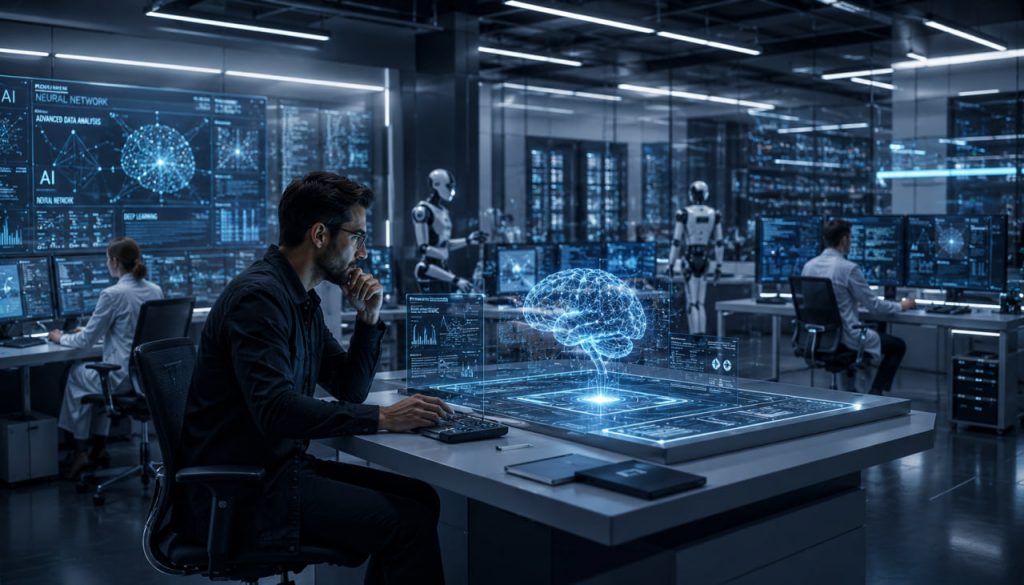
Artificial intelligence is evolving faster than any previous digital technology revolution. By 2026, AI is no longer limited to chatbots and image generators. The industry is rapidly moving toward autonomous agents, advanced reasoning systems, multimodal intelligence, robotics integration, and AI-powered infrastructure capable of transforming entire sectors of the global economy.
What makes 2026 especially important is that AI has moved beyond experimentation. Companies are now deploying AI at scale in business operations, healthcare, transportation, software development, manufacturing, cybersecurity, and scientific research.
The current wave of innovation is not simply about smarter algorithms. It is about creating AI systems capable of understanding, reasoning, planning, and interacting with the physical and digital world more efficiently than ever before.
AI Agents Are Becoming Autonomous Digital Workers
One of the biggest innovations of 2026 is the rise of AI agents.
Unlike traditional chatbots that only answer prompts, AI agents can now perform multi-step tasks with limited supervision. Modern agents are increasingly capable of:
- conducting research
- managing workflows
- browsing the web
- analyzing files
- generating reports
- writing code
- interacting with software tools
- automating repetitive operations
Many companies now use AI agents as productivity assistants for customer support, business analytics, scheduling, and internal operations.
The key breakthrough is persistence. AI systems can now maintain context across longer tasks and make decisions dynamically rather than responding only to isolated prompts.
According to Sam Altman, future AI systems will increasingly function as collaborative digital coworkers instead of passive assistants.
This shift may fundamentally change how businesses organize knowledge work.
Multimodal AI Is Becoming the Industry Standard
Another major innovation is multimodal intelligence.
Modern AI systems in 2026 can process:
- text
- images
- video
- spreadsheets
- PDFs
- audio
- voice
- code
This creates a far more natural interaction model.
For example, a user can now upload a financial report, ask AI to analyze charts, generate a presentation, summarize risks, and create visual content within one workflow.
Multimodal AI is especially important for industries such as:
- healthcare
- engineering
- education
- finance
- architecture
- media production
Instead of relying on multiple disconnected tools, organizations increasingly use unified AI platforms that understand different types of information simultaneously.
The future of AI is no longer text-only.
AI Reasoning Models Are Becoming More Advanced
One of the most important technical improvements in 2026 is advanced reasoning.
Modern AI systems are significantly better at:
- strategic planning
- logical analysis
- technical problem solving
- scientific reasoning
- long-context understanding
- complex coding tasks
This represents a major evolution from earlier generative AI systems that often produced shallow or inconsistent answers.
New reasoning-focused architectures can now spend additional computational effort analyzing difficult tasks before responding.
This improves:
- reliability
- factual consistency
- instruction following
- multi-step problem solving
Businesses increasingly rely on reasoning models for tasks involving:
- legal analysis
- enterprise planning
- engineering support
- financial modeling
- medical research
AI-Powered Robotics Is Accelerating
2026 is also becoming a major year for AI robotics.
Advanced AI models are now being integrated directly into physical machines capable of interacting with real-world environments.
Modern humanoid and industrial robots can increasingly:
- recognize objects
- navigate spaces
- manipulate tools
- follow verbal instructions
- learn from demonstrations
- adapt to changing conditions
Robotics companies are combining computer vision, large language models, and reinforcement learning to create machines capable of handling more flexible tasks.
Industries actively investing in AI robotics include:
- logistics
- manufacturing
- warehousing
- healthcare
- agriculture
- construction
The long-term goal is to create general-purpose robotic systems that can assist humans in both industrial and domestic environments.
AI in Healthcare Is Advancing Rapidly
Healthcare remains one of the most transformative AI sectors in 2026.
Modern medical AI systems now assist with:
- diagnostic analysis
- medical imaging
- drug discovery
- patient monitoring
- treatment planning
- healthcare administration
AI models are increasingly capable of analyzing enormous medical datasets much faster than traditional methods.
This accelerates:
- disease detection
- pharmaceutical research
- personalized medicine
- clinical workflow optimization
Several healthcare organizations are already using AI-assisted diagnostics to improve efficiency and reduce administrative burdens on medical professionals.
However, experts continue emphasizing that AI is intended to support doctors rather than replace them entirely.
Generative Video and Synthetic Media Are Evolving
AI-generated video technology has improved dramatically.
Modern systems can now generate:
- cinematic scenes
- realistic animations
- digital presenters
- marketing videos
- training materials
- virtual environments
The quality of AI video generation in 2026 is significantly more realistic than previous generations of synthetic media.
This innovation is transforming industries such as:
- entertainment
- advertising
- education
- gaming
- social media
- filmmaking
Many businesses now use AI-generated content to reduce production costs and accelerate marketing workflows.
At the same time, governments and technology companies are increasingly focused on watermarking and authenticity verification to combat misinformation risks.
AI Infrastructure and Chips Are Becoming Critical
Behind every major AI breakthrough is massive computing infrastructure.
One of the most important innovations of 2026 is the rapid development of specialized AI hardware.
Companies are investing heavily in:
- AI accelerators
- custom processors
- high-bandwidth memory
- energy-efficient data centers
- advanced GPU systems
AI training and inference now require enormous computational resources.
As a result, infrastructure providers have become some of the most strategically important companies in the technology industry.
Energy efficiency is also becoming critical because modern AI models consume large amounts of electricity during training and deployment.
Cybersecurity AI Is Expanding
Artificial intelligence is increasingly used in cybersecurity.
Modern AI systems can:
- detect threats
- analyze suspicious activity
- automate security monitoring
- identify vulnerabilities
- respond to attacks faster
However, AI also creates new security risks because cybercriminals can use generative AI for:
- phishing campaigns
- malware development
- social engineering
- automated attacks
This creates an ongoing technological arms race between defensive and offensive AI systems.
Cybersecurity experts increasingly view AI as both a major protective tool and a significant emerging risk.
Personalized AI Assistants Are Becoming More Human-Like
AI assistants in 2026 are becoming more adaptive and personalized.
Modern systems increasingly support:
- long-term memory
- custom personalities
- workflow preferences
- voice interaction
- emotional context awareness
This makes AI interactions feel more natural and useful for daily life.
AI assistants are now commonly used for:
- scheduling
- writing
- education
- brainstorming
- coding
- productivity management
- personal organization
Many technology companies believe future operating systems may revolve around conversational AI interfaces rather than traditional app-centered experiences.
According to Satya Nadella, AI assistants and agents could eventually become the primary interface for interacting with digital systems.
AI Regulation and Ethics Are Becoming Central Issues
As AI becomes more powerful, regulation is becoming increasingly important.
Governments worldwide are developing frameworks focused on:
- AI transparency
- data privacy
- copyright protection
- safety testing
- misinformation prevention
- bias mitigation
Businesses now face growing pressure to deploy AI responsibly.
The debate around AI ethics intensified in 2026 because advanced systems increasingly influence:
- hiring decisions
- financial systems
- healthcare recommendations
- public information
- automated decision-making
Balancing innovation and regulation remains one of the biggest global challenges in artificial intelligence.
AI and the Future of Work
One of the most discussed topics in 2026 is AI’s impact on employment.
AI is automating portions of many professions, particularly repetitive digital tasks.
At the same time, AI is also creating new industries and job categories involving:
- AI supervision
- prompt engineering
- automation management
- AI safety
- synthetic media
- robotics operations
Most experts now believe the future workplace will involve close collaboration between humans and AI systems rather than full automation of all jobs.
The most valuable workers may become those who know how to work effectively alongside AI.
Conclusion
The AI innovations of 2026 are transforming nearly every major industry. Autonomous agents, multimodal intelligence, robotics, advanced reasoning systems, AI healthcare tools, and synthetic media technologies are pushing artificial intelligence far beyond its early chatbot era.
The next stage of AI development is increasingly focused on integration into real-world systems, workflows, infrastructure, and physical environments.
While challenges involving regulation, energy usage, misinformation, and job disruption remain significant, the pace of innovation continues accelerating rapidly.
Artificial intelligence is no longer a future technology. In 2026, it is becoming a foundational layer of the modern global economy — reshaping how people work, communicate, create, and interact with the world around them.