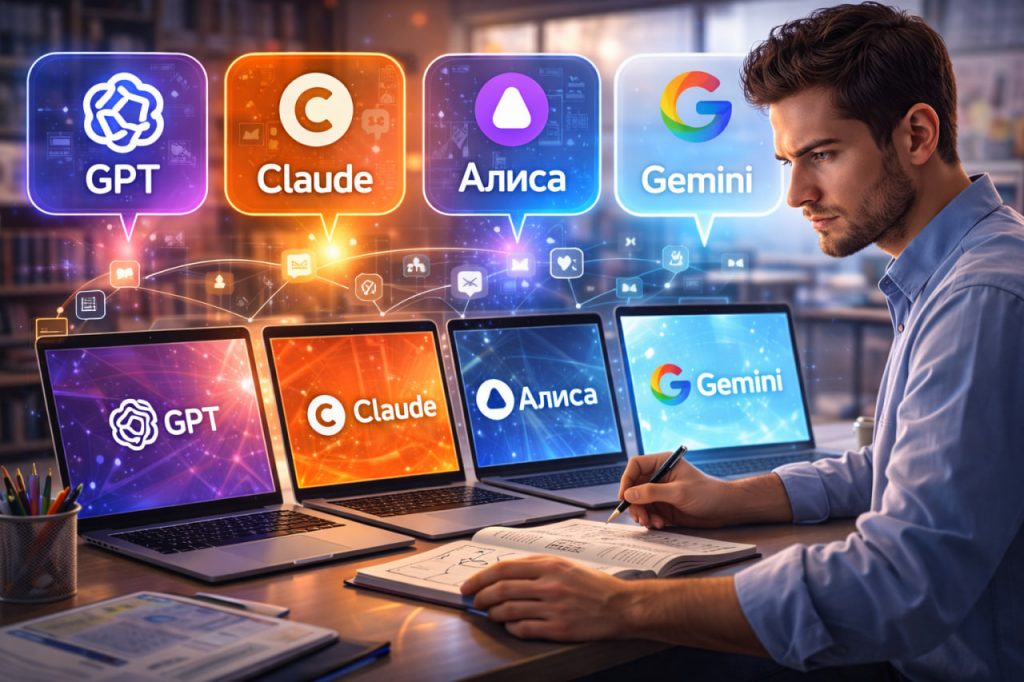
Large language models have rapidly become central interfaces between humans and digital systems. What started as experimental chatbots has evolved into powerful platforms capable of writing, reasoning, coding, summarizing, and assisting across industries. GPT, Claude, Alice, and Gemini represent four different philosophies of how conversational AI should be designed, trained, and deployed. Comparing them is not about declaring a single winner, but about understanding how priorities such as reasoning depth, safety, ecosystem integration, and cultural context shape each system’s strengths and limitations.
What All These Models Have in Common
At a foundational level, all four systems belong to the class of large language models (LLMs). They are trained on vast collections of text data and learn to predict the next token based on context, enabling fluent dialogue and text generation. Despite differences in branding and interfaces, each model relies on transformer architectures, attention mechanisms, and large-scale optimization. None of them “understand” language in a human sense; instead, they model statistical structure at scale.
“Modern language models differ less in fundamentals and more in alignment, objectives, and integration,” — Dr. Sarah Mitchell, AI systems researcher.
GPT: General-Purpose Reasoning and Versatility
GPT models are widely known for their breadth of capabilities. They perform well across writing, coding, reasoning, tutoring, and creative tasks, making them highly versatile. One defining feature is strong instruction following, which allows GPT to adapt to diverse prompts and roles with minimal setup. GPT systems are often used as general assistants, copilots for programming, and tools for knowledge work. Their flexibility makes them suitable for both beginners and professionals, though this generality can sometimes lead to overly confident answers if prompts lack precision.
Claude: Emphasis on Safety and Long-Form Reasoning
Claude is designed with a strong focus on safety, coherence, and extended context handling. It is particularly effective in analyzing long documents, maintaining consistent tone, and providing careful, structured responses. Claude often prioritizes caution and clarity over speed or creativity, which makes it appealing in legal, policy, and analytical settings.
“Claude is optimized for deliberation and reliability rather than maximal expressiveness,” — Dr. Jonathan Reed, AI alignment specialist.
Alice: Local Context and Cultural Integration
Alice (Алиса) is deeply integrated into a regional digital ecosystem, focusing on local language nuance, voice interaction, and everyday consumer tasks. Rather than positioning itself as a universal reasoning engine, Alice excels at contextual assistance: navigation, smart home control, media, and conversational responses tuned to cultural expectations. Its strength lies in accessibility and seamless integration with consumer services rather than advanced analytical reasoning.
Gemini: Multimodal and Ecosystem-Centric Design
Gemini is built with a strong emphasis on multimodality, meaning it is designed from the ground up to handle text, images, code, and data together. Tight integration with productivity tools, search, and cloud services positions Gemini as an AI layer across a broader digital ecosystem. Its design reflects a strategy where AI is not a standalone assistant but a deeply embedded capability across workflows.
“Gemini reflects the idea that AI should be ambient—present wherever information is created or consumed,” — Dr. Kevin Zhou, AI product strategist.
Reasoning, Creativity, and Control
When comparing reasoning styles, GPT often favors flexible problem-solving and creative synthesis. Claude tends toward structured analysis and careful framing. Gemini integrates reasoning with external tools and data sources, while Alice focuses on conversational usefulness rather than deep abstraction. Creativity also varies: GPT typically generates more diverse outputs, while Claude prioritizes consistency and safety. These differences reflect design choices rather than technical limitations.
Safety, Alignment, and Trust
Safety and alignment strategies differ significantly. Claude is known for conservative responses and strong refusal behavior in ambiguous scenarios. GPT balances openness with guardrails, adapting tone and depth based on instructions. Gemini relies heavily on policy enforcement combined with ecosystem controls. Alice emphasizes user-friendly boundaries appropriate for consumer interaction.
“Trust in AI systems comes from predictability, not just intelligence,” — Dr. Helen Carter, AI ethics researcher.
Performance Depends on Use Case
No single model is objectively superior across all tasks. GPT is often preferred for general knowledge work and creative assistance. Claude excels in document-heavy analysis and careful reasoning. Gemini shines when integrated with tools, data, and multimodal workflows. Alice is most effective in localized, voice-driven, everyday interactions. Choosing the right system depends on context, not hype.
The Strategic Direction of AI Platforms
These models illustrate different futures for AI. One path emphasizes universal assistants, another prioritizes safe analytical partners, a third embeds AI into platform ecosystems, and a fourth focuses on consumer convenience and cultural fit. Over time, these approaches may converge, but for now they reflect distinct strategic bets about how humans will interact with intelligent systems.
Conclusion
GPT, Claude, Alice, and Gemini are not simply competing chatbots—they are expressions of different philosophies about intelligence, safety, integration, and user experience. Understanding their differences helps users choose the right tool for the right task and highlights how AI is evolving beyond a single model toward a diverse ecosystem of intelligent systems.


I have been using ChatGPT, since it was on open beta. I was lucky enough to get an invitation, to test it out before it became mainstream to the public. One thing I have noticed way before then is how aggressive it was scraping reddit. Reddit being one of the most toxic website that has been with lots of wrong information, theorizing. It was not able to differ fan fiction from an original lore in terms of video games which back in the day, that was what I used it for. Currently, with more and more investments and data, it is able to differ however, at a certain point that with its current rule-sets and overseers, the data it provides is washed up version of what you can actually find. Its soulles, empty and sterile. After some point, I have switched to DeepSeek, which also aggressively scrapes, however, it scrapes Chinese people. Directly, through their interactions, phones, personal day to day lives through digital citizenship. It is much better at understanding humans, due to scraping real life humans rather than reddit personas. Answers feel more natural, steadfast and coherent. With the upcoming development of agent-1 on GPT’s side, there is no doubt that they will gain the upperhand, with the amount of investments that they are bringing currently and amount of land that they can obtain for their Computer Farms if US takes over Greenland or Venenzuela. On the other side, china also has a huge land mass, great spyware and centruies of copy cat culture which they can get agent-1 and adapt it to deepseek. It really is cold war v2 and we are not discussing it enough… yet