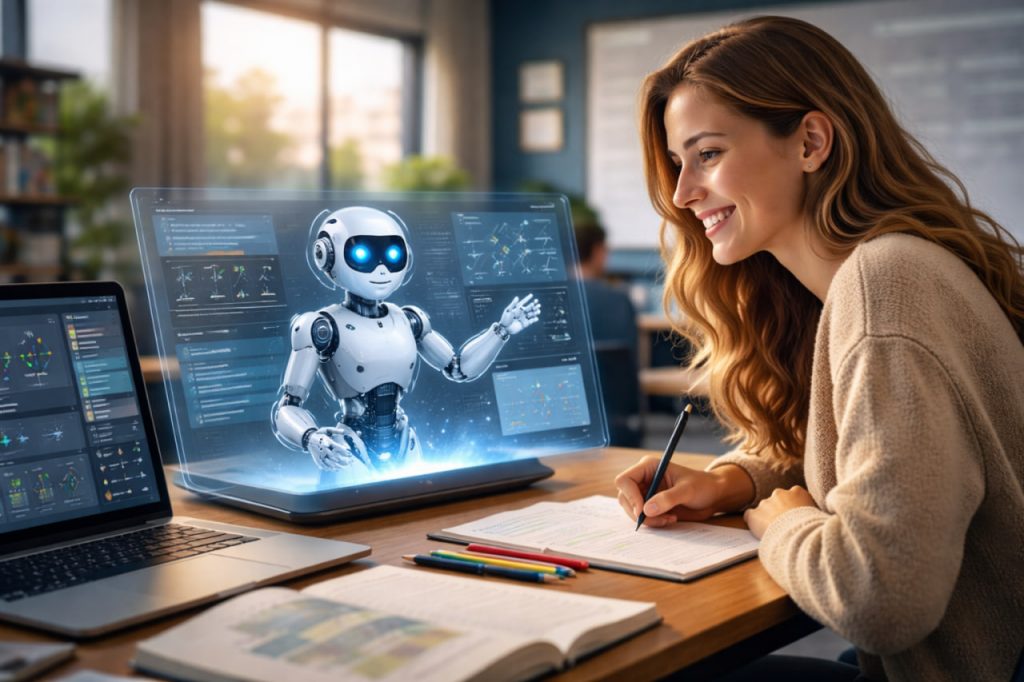
Artificial intelligence is fundamentally reshaping the global education system by introducing personalized instruction models, automated performance evaluation, and intelligent digital support tools. Traditional education has long relied on standardized curricula, fixed pacing, and classroom-wide instruction, which often fail to accommodate individual learning differences. Today, artificial intelligence (AI) enables adaptive systems that respond dynamically to each learner’s progress, strengths, and weaknesses. Rather than replacing teachers, AI enhances their effectiveness by providing data-driven insights and scalable support mechanisms. As educational institutions increasingly adopt digital infrastructure, AI is becoming a strategic pillar in improving engagement, performance, and long-term academic outcomes.
Adaptive Learning: Personalized Education at Scale
One of the most transformative developments in educational technology is adaptive learning, a system that customizes instructional content in real time. Adaptive platforms use machine learning algorithms, which are computational models that improve through exposure to data rather than explicit programming. These systems analyze quiz results, response time, engagement patterns, and error frequency to determine a student’s knowledge level. Based on this analysis, the platform adjusts difficulty, revisits misunderstood topics, or accelerates progression for advanced learners.
According to educational technology researcher Dr. Melissa Grant:
“Adaptive systems reduce learning gaps by meeting students exactly where they are rather than forcing them into standardized pacing.”
Unlike static online courses, adaptive systems continuously refine their recommendations as new data becomes available. This dynamic personalization improves knowledge retention and prevents disengagement caused by content that is either too difficult or too simple. Over time, adaptive learning models generate comprehensive performance profiles that help educators understand each student’s development trajectory.
AI-Powered Knowledge Assessment and Automated Evaluation
Another major area of impact is AI-driven assessment, which automates grading while delivering detailed, consistent feedback. Traditional grading methods can be time-consuming and subject to inconsistency, especially in large classes. AI systems leverage natural language processing (NLP) — a technology that enables machines to interpret and analyze human language — to evaluate essays, short answers, and open-ended responses.
Modern assessment platforms do more than assign scores. They analyze logical structure, argument coherence, vocabulary diversity, and concept accuracy. This enables educators to detect patterns in misunderstandings across entire cohorts. Additionally, AI can flag potential plagiarism using semantic comparison rather than simple keyword matching, significantly improving academic integrity enforcement.
According to digital education specialist Professor Daniel Brooks:
“Automated assessment enhances consistency while freeing educators to focus on mentorship and higher-order thinking skills.”
By reducing administrative workload, AI allows teachers to dedicate more time to personalized instruction and student interaction, reinforcing the human dimension of education.
Digital Tutors and Conversational AI Support
Digital tutors represent one of the most visible AI applications in education. These systems simulate one-on-one instruction by answering questions, explaining concepts, and generating customized practice exercises. Unlike traditional help resources, AI tutors provide interactive feedback and adapt explanations based on student comprehension levels.
Advanced digital tutoring systems rely on conversational AI, which allows real-time dialogue between student and system. By analyzing linguistic cues, tone, and question patterns, these platforms adjust their responses to improve clarity. They can offer step-by-step problem solving in mathematics, concept breakdowns in science, or writing feedback in language studies.
According to AI learning systems researcher Dr. Laura Mendes:
“Digital tutors extend access to individualized instruction beyond the physical classroom, supporting learners at any time of day.”
This 24/7 accessibility is particularly valuable in remote education environments and for students who require additional reinforcement outside regular school hours.
Data Analytics and Institutional Decision-Making
Beyond individual learners, AI provides powerful educational analytics for institutions. AI dashboards aggregate performance data across classrooms and generate insights into curriculum effectiveness, engagement trends, and dropout risk indicators. Early identification of at-risk students allows proactive intervention strategies, improving retention rates and academic success.
Machine learning models can also analyze long-term learning patterns, helping institutions refine teaching methodologies. These insights enable more strategic curriculum design and evidence-based academic planning.
Ethical Considerations and Responsible Implementation
Despite its advantages, AI integration in education raises critical issues related to data privacy, algorithmic fairness, and transparency. Student performance data is highly sensitive and must be protected through secure storage and regulatory compliance. Furthermore, biased training data may result in unequal educational recommendations if not carefully monitored.
According to AI ethics expert Dr. Helen Brooks:
“Trust in educational AI depends on transparency, accountability, and strong governance frameworks.”
Responsible AI implementation requires clear policies, human oversight, and continuous auditing of algorithmic outcomes. AI should function as a support system, not an opaque decision-maker.
The Future of AI-Driven Education
Looking ahead, AI is expected to integrate more deeply with immersive technologies such as augmented reality classrooms and virtual learning environments. Intelligent systems may assist in career guidance, skill gap analysis, and lifelong learning strategies. However, the educator’s role remains irreplaceable. AI enhances scalability and precision, but human mentorship, empathy, and inspiration remain central to meaningful education.
Conclusion
Artificial intelligence is redefining education through adaptive learning systems, intelligent knowledge assessment, and digital tutoring platforms. By personalizing instruction, automating evaluation, and providing real-time support, AI enhances both efficiency and learning outcomes. While ethical oversight and responsible governance are essential, AI’s role in education is best understood as an empowering tool that strengthens, rather than replaces, human educators. The future of learning will be shaped by collaboration between teachers and intelligent systems, creating more flexible, inclusive, and effective educational environments.


great another👏👏 excuse for schools to fire teachers and save money