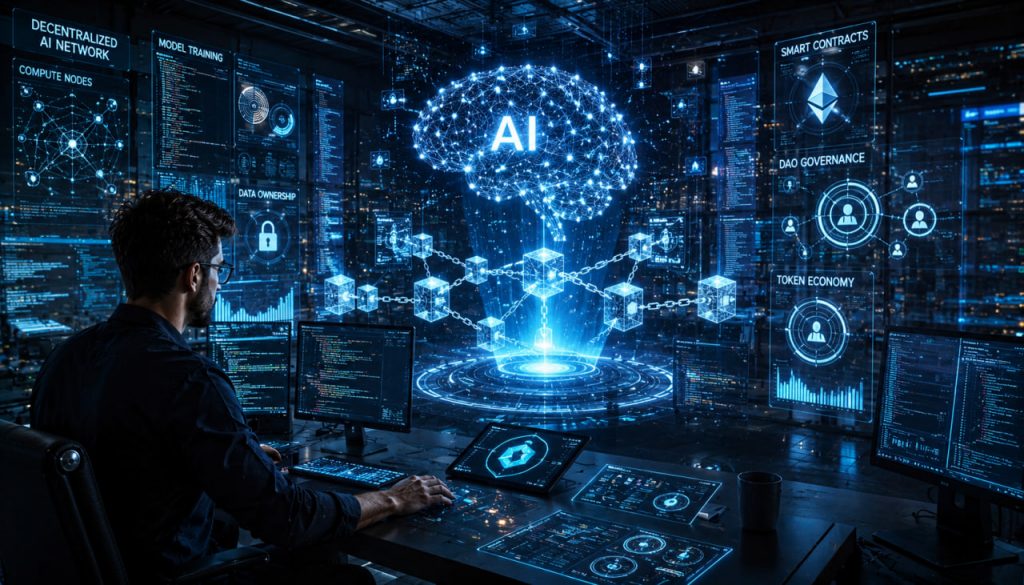
Artificial intelligence and Web3 are two of the most transformative technologies of the modern digital era. Individually, both industries are already reshaping business, finance, software development, content creation, and online infrastructure. Together, they could fundamentally change how digital systems operate over the next decade.
AI focuses on automation, reasoning, data analysis, and intelligent decision-making. Web3 focuses on decentralization, blockchain infrastructure, digital ownership, and trustless systems. At first glance, the technologies may appear unrelated. In reality, they are increasingly converging in areas such as decentralized AI marketplaces, autonomous agents, blockchain automation, tokenized computing, data ownership, and AI-powered smart contracts.
This intersection is creating an entirely new ecosystem where intelligence and decentralization merge into one digital infrastructure layer.
Why AI and Web3 Are Starting to Converge
The modern internet is becoming increasingly dependent on data, algorithms, and automation. Traditional AI systems are typically controlled by large centralized corporations that own:
- computing infrastructure
- training datasets
- AI models
- cloud systems
- distribution platforms
Web3 emerged partly as a response to centralized digital control.
Blockchain technologies aim to create systems that are:
- decentralized
- transparent
- permissionless
- user-owned
- censorship-resistant
The intersection of AI and Web3 attempts to combine the strengths of both technologies.
In theory:
- AI provides intelligence and automation
- Web3 provides decentralization and ownership
The long-term vision is an open AI ecosystem not fully controlled by a few dominant corporations.
Decentralized AI Networks
One of the biggest trends is decentralized AI infrastructure.
Traditional AI training requires enormous computing resources controlled mainly by major technology companies. Web3 projects are exploring ways to distribute computing power across decentralized networks.
These systems may allow users to:
- share GPU resources
- contribute computing power
- rent decentralized AI infrastructure
- access open AI marketplaces
- train collaborative AI models
This model resembles how blockchain networks distribute financial transactions across thousands of nodes.
Several startups are already building decentralized GPU and AI compute marketplaces to compete with centralized cloud providers.
AI Agents and Smart Contracts
One of the most important areas of convergence is autonomous AI agents operating on blockchain infrastructure.
AI agents can potentially interact with:
- smart contracts
- decentralized applications
- crypto wallets
- blockchain protocols
- decentralized exchanges
This creates systems capable of:
- executing financial transactions
- managing digital assets
- automating investment strategies
- handling decentralized governance
- optimizing blockchain operations
For example, an AI agent could theoretically:
- analyze market conditions
- interact with smart contracts
- rebalance a crypto portfolio
- execute transactions automatically
- report results to users in real time
This moves blockchain automation beyond static code toward intelligent adaptive systems.
Tokenized AI Economies
Another emerging trend is tokenized AI ecosystems.
Some Web3 projects use tokens to incentivize participation in decentralized AI networks.
Tokens may reward users for:
- contributing computing power
- supplying training data
- validating outputs
- improving AI models
- participating in governance
This creates economic systems where communities collectively support AI infrastructure.
Supporters argue that tokenized ecosystems may reduce dependence on centralized cloud monopolies.
Critics, however, warn that many projects remain highly speculative and immature.
Data Ownership and AI Training
One of the most controversial topics in artificial intelligence is data ownership.
Modern AI systems often train on enormous internet-scale datasets involving:
- images
- text
- videos
- code
- user-generated content
Web3 technologies may offer new models for digital ownership and compensation.
Blockchain-based systems could potentially allow creators to:
- track content usage
- license datasets
- monetize training data
- receive royalties for AI-generated outputs
This could become increasingly important as legal disputes around AI copyright and intellectual property continue expanding globally.
The combination of AI and blockchain may eventually reshape how digital content is owned and monetized.
Decentralized Autonomous Organizations and AI
Decentralized Autonomous Organizations, or DAOs, are blockchain-based governance systems where communities vote on decisions using tokens.
AI could significantly expand DAO functionality.
Future AI-powered DAOs may use machine learning for:
- proposal analysis
- fraud detection
- governance optimization
- treasury management
- automated reporting
- operational forecasting
This may create more efficient decentralized organizations capable of operating with reduced manual coordination.
However, fully autonomous governance also raises major concerns involving accountability and security.
AI and Blockchain Security
Cybersecurity is becoming another major intersection area.
Blockchain systems face risks such as:
- smart contract vulnerabilities
- fraud
- wallet theft
- phishing attacks
- market manipulation
AI systems are increasingly used to detect:
- suspicious transactions
- abnormal blockchain activity
- automated attacks
- fraud patterns
Machine learning models can analyze blockchain activity at enormous scale and speed.
At the same time, attackers are also beginning to use AI for more advanced cyber threats.
This creates an ongoing technological arms race between AI-powered defense and AI-powered attacks.
AI-Generated Digital Assets and NFTs
Artificial intelligence is also reshaping the digital asset economy.
AI-generated content now includes:
- digital art
- music
- video
- avatars
- virtual environments
- gaming assets
Blockchain technology allows these assets to be tokenized through NFTs and other ownership systems.
This combination may create entirely new creator economies where AI-generated assets are bought, sold, licensed, and traded across decentralized platforms.
However, copyright and authenticity concerns remain significant challenges.
Web3 Could Help AI Become More Transparent
One criticism of modern AI systems is opacity.
Many advanced models function as “black boxes” where users cannot fully understand:
- training methods
- decision processes
- model ownership
- data sources
Blockchain infrastructure could potentially improve transparency through immutable records involving:
- model updates
- training history
- governance changes
- dataset tracking
- inference verification
While blockchain alone cannot solve every AI transparency issue, it may improve accountability in certain systems.
The Role of Open-Source Development
Open-source ecosystems are becoming increasingly important in both AI and Web3.
Many developers support decentralized AI because they fear excessive concentration of power among a small number of technology giants.
Open-source AI models combined with decentralized infrastructure could create alternative ecosystems focused on:
- accessibility
- transparency
- interoperability
- community governance
This may become one of the biggest ideological battles in future technology development.
Challenges Facing AI and Web3 Integration
Despite enormous interest, the intersection of AI and Web3 still faces serious obstacles.
Major challenges include:
- scalability limitations
- high blockchain transaction costs
- AI infrastructure expenses
- regulatory uncertainty
- cybersecurity risks
- speculative hype
- energy consumption
- technical complexity
Many current projects remain experimental.
In some cases, companies simply combine “AI” and “blockchain” terminology for marketing purposes without meaningful technological integration.
This makes it important to separate genuine innovation from speculation.
Expert Perspectives on the Future
Many technology leaders believe AI and decentralized systems will increasingly influence each other.
Vitalik Buterin has discussed both the opportunities and risks of combining AI with decentralized technologies, especially regarding governance, alignment, and automated systems.
Meanwhile, AI researchers continue debating whether decentralized AI can realistically compete with centralized AI infrastructure dominated by major cloud providers.
The outcome may shape the future structure of the internet itself.
The Future of AI and Web3
Over the next decade, the intersection of AI and Web3 may produce entirely new digital ecosystems.
Potential future developments include:
- decentralized AI marketplaces
- autonomous financial agents
- AI-powered DAOs
- tokenized compute networks
- blockchain-verified AI outputs
- self-operating digital economies
- decentralized robotic systems
The long-term vision is ambitious: an internet where intelligence, ownership, automation, and value exchange operate together without centralized intermediaries.
Whether that vision becomes mainstream remains uncertain, but innovation in the sector is accelerating rapidly.
Conclusion
Artificial intelligence and Web3 represent two powerful technological movements converging around automation, decentralization, digital ownership, and intelligent infrastructure.
AI brings reasoning, automation, and decision-making capabilities. Web3 brings transparency, tokenization, and decentralized control. Together, they could fundamentally reshape how digital systems are built and operated.
While many projects remain early-stage and experimental, the intersection of AI and Web3 is already generating new approaches to infrastructure, governance, cybersecurity, digital ownership, and autonomous systems.
The coming years may determine whether decentralized AI ecosystems can become a true alternative to centralized technology platforms — potentially redefining the future architecture of the internet itself.