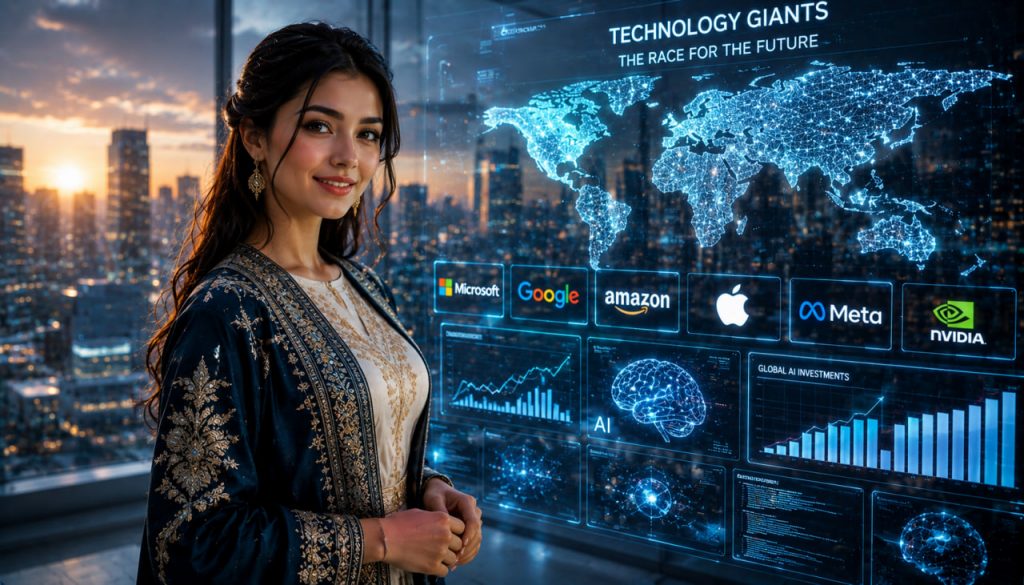
The global technology industry is entering one of the most competitive periods in modern history. Artificial intelligence, cloud computing, semiconductors, robotics, quantum research, and digital infrastructure are now driving a massive race between the world’s largest technology companies.
What makes this competition unique is scale. The leading corporations are investing hundreds of billions of dollars into AI systems, cloud platforms, chips, autonomous technologies, and next-generation digital ecosystems.
The outcome of this technological race may shape the global economy for decades.
Today, the biggest competitors include:
- Microsoft
- OpenAI
- NVIDIA
- Amazon
- Apple
- Meta
- Tesla
- AMD
- Chinese technology giants such as Tencent, Alibaba, Huawei, and Baidu
Each company dominates different areas of innovation, but artificial intelligence has become the central battlefield.
Why the Technology Race Accelerated So Quickly
The rapid growth of generative AI completely changed the technology industry.
Before modern AI systems, companies competed mainly in:
- smartphones
- cloud services
- social media
- e-commerce
- online advertising
Now the focus has shifted toward:
- large AI models
- AI infrastructure
- semiconductors
- autonomous systems
- robotics
- AI productivity ecosystems
- energy-intensive computing infrastructure
The company that controls the most advanced AI systems may gain enormous influence over software, business operations, education, media, and global productivity.
Artificial intelligence is increasingly viewed as the next foundational technology platform.
Microsoft and OpenAI: The AI Power Alliance
One of the strongest positions in the current race belongs to the partnership between Microsoft and OpenAI.
Microsoft invested heavily into OpenAI and integrated AI deeply into:
- Windows
- Office products
- Azure cloud infrastructure
- enterprise software
- developer ecosystems
Meanwhile, OpenAI became one of the most recognized AI companies globally through ChatGPT and advanced reasoning models.
This partnership gave Microsoft a major advantage because it combines:
- world-class AI research
- massive cloud infrastructure
- enterprise distribution
- software integration
According to Satya Nadella, AI may become the most important technological shift since the rise of personal computing and mobile devices.
Many analysts believe Microsoft currently holds one of the strongest strategic positions in enterprise AI.
NVIDIA: The Company Powering the AI Revolution
While many companies compete in software, NVIDIA became one of the most important infrastructure companies in the AI era.
Modern AI systems require enormous computing power, and NVIDIA dominates the high-performance GPU market used for AI training and inference.
Its hardware powers much of the global AI ecosystem, including systems developed by:
- OpenAI
- Meta
- Amazon
- Tesla
- AI startups worldwide
The rise of generative AI transformed NVIDIA into one of the most valuable companies in the world.
CEO Jensen Huang repeatedly emphasized that AI infrastructure may become as essential as electricity and internet connectivity in the future economy.
Without advanced chips, modern AI systems cannot exist at scale.
Google: The AI Pioneer Fighting to Stay Ahead
Google remains one of the most powerful AI companies globally.
Google’s research teams helped create many foundational AI technologies used today, including breakthroughs involving transformers and large language models.
The company continues investing heavily in:
- Gemini AI models
- cloud AI services
- AI search integration
- robotics
- quantum computing
- AI assistants
However, Google also faces pressure because generative AI threatens traditional search business models.
The company is now racing to integrate AI deeply into its ecosystem while protecting its advertising dominance.
Despite increased competition, Google still possesses enormous advantages:
- global infrastructure
- research talent
- massive datasets
- Android ecosystem integration
- YouTube dominance
Meta and the Open AI Ecosystem
Meta is taking a different approach.
Instead of focusing entirely on closed AI systems, Meta invested heavily in open AI models through its Llama ecosystem.
The company believes open-source AI may become critical for long-term innovation and developer adoption.
Meta is also investing aggressively in:
- AI assistants
- virtual reality
- augmented reality
- metaverse technologies
- smart wearables
- AI-generated content systems
CEO Mark Zuckerberg views AI and immersive computing as interconnected long-term technologies.
The company’s strategy differs from competitors because Meta aims to build massive AI ecosystems accessible to developers worldwide.
Amazon: Quietly Expanding AI Infrastructure
Amazon remains one of the strongest players due to AWS cloud infrastructure.
While Amazon receives less public attention than OpenAI or Google in generative AI discussions, the company controls one of the world’s largest cloud computing platforms.
Amazon is investing heavily in:
- AI cloud services
- enterprise AI tools
- logistics automation
- robotics
- warehouse AI systems
- custom AI chips
Its advantage lies in infrastructure scale and operational efficiency.
Amazon may become one of the biggest winners as businesses increasingly require cloud-based AI deployment.
Apple and the Consumer AI Strategy
Apple approaches AI differently from many competitors.
Rather than focusing mainly on public AI chatbots, Apple prioritizes:
- on-device AI
- privacy-focused AI systems
- hardware integration
- energy-efficient machine learning
- ecosystem optimization
Apple’s strength remains its tight integration between hardware and software.
Future Apple AI systems may focus heavily on:
- personal assistants
- mobile AI processing
- wearable technology
- mixed reality
- consumer productivity
While Apple entered the generative AI race more cautiously, its ecosystem strength gives it enormous long-term potential.
Tesla and the Robotics Future
Tesla is competing not only in electric vehicles but also in AI, robotics, and autonomous systems.
Tesla invests heavily in:
- self-driving AI
- robotics
- AI supercomputers
- autonomous navigation
- humanoid robots
CEO Elon Musk repeatedly stated that AI and robotics may eventually become larger businesses than electric vehicles themselves.
Tesla’s long-term vision involves combining:
- AI systems
- autonomous transportation
- robotics
- energy infrastructure
The company may become one of the most important players in physical-world AI deployment.
China’s Growing Technological Influence
Chinese technology companies are also becoming increasingly important competitors.
Major players include:
- Huawei
- Tencent
- Alibaba
- Baidu
- ByteDance
- Xiaomi
China invests heavily in:
- AI chips
- robotics
- EV technology
- autonomous driving
- quantum computing
- telecommunications infrastructure
The technological race is increasingly geopolitical.
Governments now view AI, semiconductors, and advanced computing as strategic national assets rather than ordinary commercial industries.
The Semiconductor War
One of the most critical battles is semiconductor manufacturing.
Advanced AI systems depend heavily on cutting-edge chips produced by companies such as:
- TSMC
- NVIDIA
- AMD
- Intel
- Samsung
Chip manufacturing has become one of the most strategically important industries globally.
Without advanced semiconductor supply chains, AI progress would slow dramatically.
This is why governments are investing billions into domestic chip production and technological independence.
Cloud Infrastructure Is Becoming the Foundation
Another major competitive area is cloud infrastructure.
Modern AI systems require enormous computing resources and storage capacity.
Leading cloud providers include:
- Microsoft Azure
- Amazon AWS
- Google Cloud
The company controlling the most efficient AI cloud infrastructure may dominate enterprise AI deployment over the next decade.
Cloud computing is increasingly becoming the backbone of global AI expansion.
Who Is Actually Winning?
The answer depends on the category.
Current leaders include:
- Microsoft/OpenAI in enterprise AI integration
- NVIDIA in AI hardware
- Google in foundational AI research
- Meta in open-source AI ecosystems
- Amazon in cloud infrastructure
- Apple in consumer ecosystem integration
- Tesla in autonomous systems and robotics
There is no single winner yet because the industry is still evolving rapidly.
The technology race is no longer about one product — it is about controlling entire ecosystems of infrastructure, software, AI, and energy systems.
The Next Phase of Competition
Over the next decade, the competition will likely intensify around:
- autonomous AI agents
- robotics
- AI infrastructure
- semiconductor dominance
- quantum computing
- energy-efficient AI systems
- decentralized computing
- smart city infrastructure
The companies that successfully combine AI, infrastructure, software, and physical-world systems may become the defining corporations of the future global economy.
Conclusion
The race between technology giants is no longer limited to smartphones, apps, or social media. The modern battle is centered around artificial intelligence, infrastructure, semiconductors, robotics, and digital ecosystems.
Microsoft, OpenAI, NVIDIA, Google, Amazon, Meta, Apple, Tesla, and Chinese technology firms are all competing to shape the future of computing and automation.
The stakes are enormous because AI may become one of the most powerful economic and geopolitical technologies ever created.
The companies leading today possess massive advantages, but the industry is evolving so quickly that leadership positions may continue shifting over the coming years.
One thing is certain: the global technology race is only beginning.