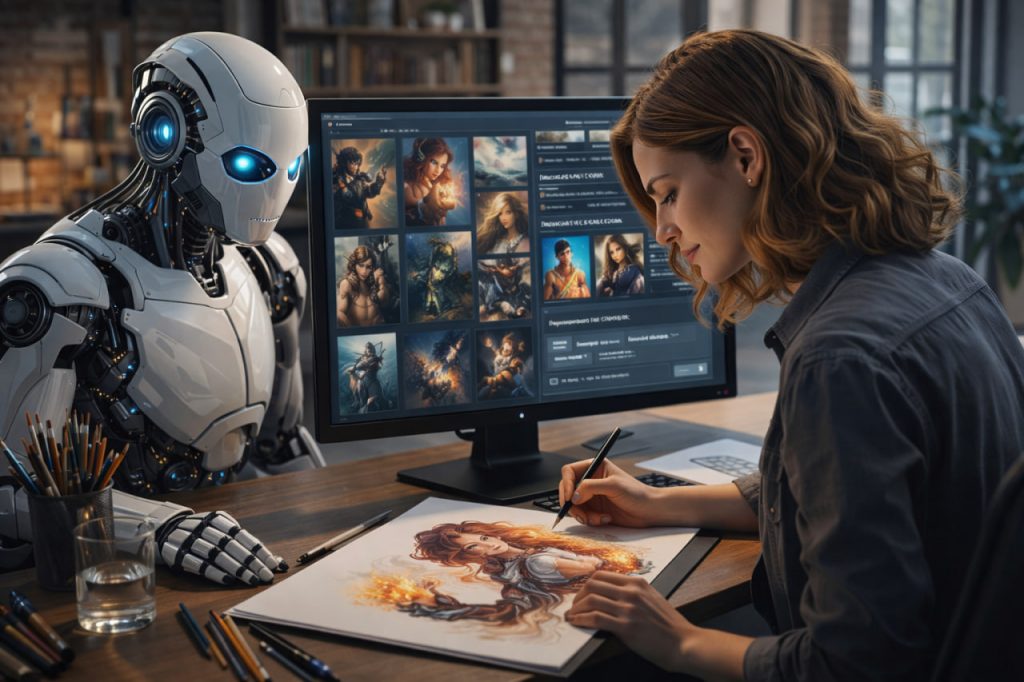
The rapid development of artificial intelligence has sparked intense debate across creative industries. Designers, writers, musicians, filmmakers, and illustrators increasingly encounter AI systems capable of generating images, composing music, editing videos, and producing written content within seconds. This technological shift raises a fundamental question: is AI a threat to creative professions, or does it represent a powerful new instrument that expands human potential? The answer lies not in extremes, but in understanding how creativity, technology, and human originality interact.
What AI Can Actually Do in Creative Fields
Modern creative AI relies on machine learning and generative models, systems trained on vast datasets to recognize patterns and produce new outputs based on learned structures. For example, generative adversarial networks (GANs) and large language models (LLMs) can generate visual art or written content that resembles human-created material. However, these systems do not possess personal experience, emotion, or intention. They predict outputs based on probability rather than inspiration.
“AI does not create from meaning; it creates from patterns,” — Dr. Melissa Hart, digital creativity researcher.
The Fear of Replacement
One of the primary concerns among creative professionals is automation. If AI can produce illustrations, marketing copy, or music tracks rapidly and cheaply, some fear reduced demand for human work. This concern is particularly strong in commercial sectors such as advertising, content marketing, and stock media production. The fear stems from economic displacement, where efficiency may outpace traditional labor models.
“Technological disruption has historically reshaped creative labor rather than eliminating it,” — Professor Daniel Brooks, media economics specialist.
AI as a Creative Accelerator
Rather than replacing creativity, AI often functions as a creative amplifier. Designers use AI tools for concept generation, writers use them for idea structuring, and musicians experiment with AI-generated sound patterns. These tools reduce repetitive tasks, allowing professionals to focus on higher-level creative direction. AI can rapidly generate variations, mood boards, or draft concepts that would otherwise require hours of manual work. In this context, AI acts as a collaborative assistant rather than a competitor.
Human Creativity vs Algorithmic Output
Human creativity is rooted in context, emotion, lived experience, and cultural awareness. AI-generated output may appear innovative, but it lacks intentional storytelling and subjective meaning. Creativity often emerges from personal struggle, memory, and social interaction—elements that algorithms cannot replicate.
“Authentic creativity involves intention and perspective, qualities that machines do not possess,” — Dr. Laura Mendes, cognitive science researcher.
Ethical and Intellectual Property Concerns
The integration of AI into creative industries raises important ethical issues. Questions about copyright ownership, training data transparency, and artistic authenticity remain under active debate. Many creators demand clearer regulations to ensure fair attribution and compensation. Responsible AI deployment must balance innovation with respect for original creators and intellectual property rights.
New Roles and Emerging Opportunities
While some traditional roles may evolve, AI also creates new opportunities. Careers in prompt engineering, AI-assisted design, digital content supervision, and creative AI strategy are emerging. Professionals who adapt and integrate AI into their workflow often gain a competitive advantage. Historically, creative industries have always adapted to technological shifts—from photography to digital editing—without losing their human core.
The Psychological Dimension
Beyond economics, AI challenges the psychological identity of creators. Many professionals associate creativity with uniqueness and human distinction. When machines generate art-like outputs, it can feel like a challenge to that identity. However, tools have always extended human capability without diminishing human authorship.
The Future of Creativity in the AI Era
The future is likely to involve human–AI collaboration rather than replacement. AI will automate repetitive aspects of production, while humans retain control over narrative, emotion, ethics, and originality. The value of distinctly human creativity may even increase as algorithmic content becomes more common.
Conclusion
Artificial intelligence presents both disruption and opportunity for creative professions. While automation may reshape workflows and business models, AI lacks the intentionality and emotional depth that define human creativity. Rather than an existential threat, AI is best understood as a powerful new instrument—one that enhances productivity and experimentation when used thoughtfully. The future of creativity will not be machine-driven, but human-led with intelligent tools at its side.

umans r always better then machines at the creative stuff 😊