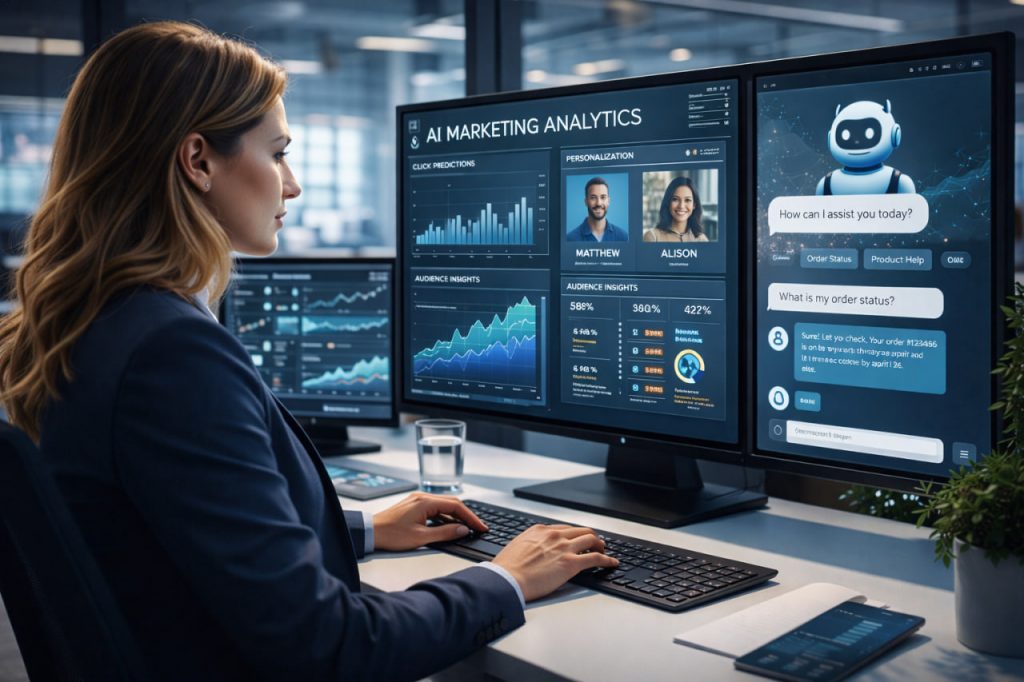
Artificial intelligence has become a transformative force in modern marketing, reshaping how brands communicate, predict behavior, and build long-term customer relationships. Traditional marketing relied heavily on demographic segmentation and broad messaging strategies, often resulting in inefficient campaigns and wasted budgets. Today, AI enables real-time analysis of user behavior, allowing companies to deliver highly targeted and personalized experiences. From predicting which advertisement a customer is likely to click to automating customer support through intelligent chatbots, AI is redefining digital engagement at scale.
Personalization at Scale Through Machine Learning
One of the most powerful applications of artificial intelligence (AI) in marketing is personalization. AI systems analyze browsing behavior, purchase history, search patterns, and engagement metrics to tailor content to individual users. Using machine learning algorithms, marketers can dynamically adjust website content, email campaigns, and product recommendations based on user preferences. Unlike static segmentation models, AI-driven personalization evolves continuously as new data becomes available.
“True personalization is not about guessing preferences—it is about learning from behavior in real time,” — Dr. Laura Mitchell, digital marketing analytics researcher.
Predicting Clicks and User Behavior
AI plays a central role in click-through rate (CTR) prediction, which estimates the probability that a user will click on a specific advertisement or link. These predictions rely on predictive modeling, where algorithms analyze historical performance data and user characteristics. By forecasting user engagement, AI helps marketers allocate budgets more efficiently and optimize campaign performance. Advanced systems also incorporate A/B testing automation, allowing algorithms to continuously refine creative elements and targeting parameters.
“Predictive analytics reduces marketing waste by focusing resources where engagement probability is highest,” — Michael Chen, performance marketing strategist.
Recommendation Engines and Conversion Optimization
Modern e-commerce platforms rely heavily on recommendation engines, which suggest products based on behavioral similarity and contextual signals. These systems use collaborative filtering and deep learning models to identify patterns across large datasets. Personalized recommendations significantly increase conversion rates and average order value. AI-driven optimization tools also adjust pricing strategies, promotional timing, and user interface elements to maximize performance.
AI-Powered Chatbots and Customer Support Automation
Customer support has been revolutionized by AI chatbots powered by natural language processing (NLP). These systems understand user queries, provide relevant responses, and escalate complex issues to human agents when necessary. Unlike early scripted bots, modern chatbots can interpret context, detect sentiment, and maintain conversational flow. This reduces response times, lowers operational costs, and improves customer satisfaction.
“AI chatbots enhance support efficiency while preserving the human touch through intelligent escalation,” — Dr. Steven Parker, conversational AI specialist.
Real-Time Marketing and Dynamic Decision-Making
AI enables real-time marketing, where decisions are made instantly based on live user data. For example, dynamic advertising platforms adjust bids in milliseconds during digital auctions. AI analyzes contextual factors such as device type, time of day, and browsing behavior to determine optimal bidding strategies. This level of automation allows brands to compete effectively in fast-paced digital ecosystems.
Ethical Considerations and Data Responsibility
Despite its advantages, AI in marketing raises important concerns related to data privacy, algorithmic bias, and user transparency. Responsible AI deployment requires compliance with data protection regulations and clear communication about how user data is utilized. Marketers must balance personalization benefits with ethical responsibility to maintain consumer trust.
“Sustainable marketing innovation depends on transparency and responsible data governance,” — Dr. Helen Brooks, digital ethics researcher.
The Future of AI in Marketing
As AI models become more advanced, marketing strategies will increasingly rely on predictive intelligence rather than reactive analysis. Future developments may include deeper emotional recognition, improved voice-based interactions, and greater integration across digital and physical channels. Companies that effectively integrate AI while maintaining ethical standards will gain significant competitive advantages.
Conclusion
Artificial intelligence is redefining marketing by enabling personalization, predicting user behavior, and automating customer support. Through machine learning, predictive analytics, and conversational AI, businesses can engage audiences more effectively and efficiently. When implemented responsibly, AI-driven marketing not only improves performance but also enhances customer experience and long-term brand loyalty.


chatbots are litterally everywhere now lol 😂🤣