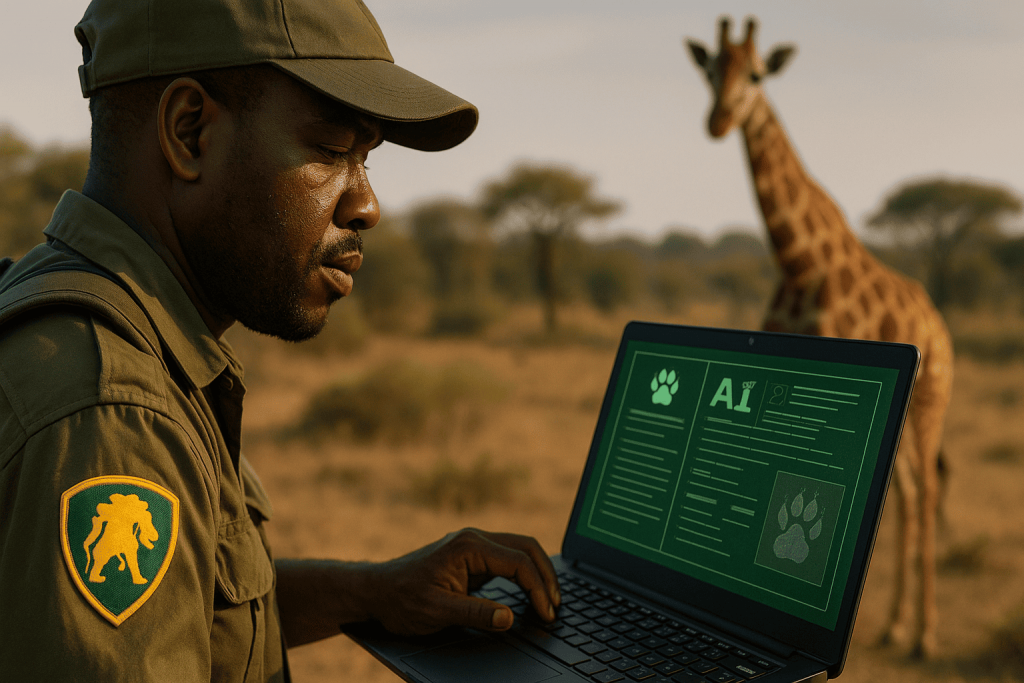
Artificial intelligence is edging into rainforests, savannas, and coastal waters—not as a sci-fi savior, but as a force multiplier for the people already protecting life on Earth. This article explores how GPT-class models and allied AI tools can monitor wildlife, deter poaching, and safeguard biodiversity, while staying grounded in ethics, local knowledge, and ecological reality. The promise is huge; the pitfalls are real. Used well, AI helps rangers act earlier, scientists learn faster, and communities lead the work. 🐾
From Data Deluge to Decisions: Why Conservation Needs GPT
Conservation runs on information: camera traps capture millions of images, acoustic sensors record months of audio, satellites stream new pixels daily, and rangers log incident reports across vast areas. GPT doesn’t just “analyze”; it translates chaos into action—summarizing field notes, triaging alerts, drafting incident briefings, and synthesizing research across disciplines and languages so teams converge on the next best step.
Camera Traps and Drones: Seeing the Unseen
Vision models classify species, count individuals, and detect human presence in camera-trap and drone feeds. GPT improves the workflow around those models: it writes data-entry checks, labels edge cases for human review, explains why a detection is uncertain, and compiles site-level reports for managers. When an image looks like “person with rifle,” the system escalates with rationale and map context rather than a cryptic confidence score.
Conservation at the Speed of Sound: Bioacoustics
Forests are loud with meaning—gunshots, chainsaws, boat engines, and the calls of rare species. Signal models flag events; GPT turns events into operations. It aggregates detections into patrol recommendations, drafts notifications in local languages, and explains false alarms to avoid “alert fatigue.” For species monitoring, it compiles seasonal calling patterns and suggests survey designs that boost detectability while minimizing disturbance. 🎧
Predictive Patrols: From Hotspots to “Right Now”
Anti-poaching models learn where and when illegal incursions cluster. GPT adds the human layer: it fuses risk maps with ranger schedules, terrain, and weather; generates route plans with safety notes; and writes post-patrol summaries that feed back into the model. Critically, GPT can justify routes in plain language—transparency that builds trust with field teams and auditors.
Satellites, SAR, and the Ocean
Remote sensing detects habitat loss, night-time lights, vessels without AIS (“dark ships”), and illegal mining scars. GPT helps triage: it compares multi-sensor evidence, drafts regulatory notices, and coordinates multi-agency responses. For marine parks, it can summarize vessel patterns, prioritize boarding checks, and generate multilingual outreach scripts for fishers—reducing friction and improving compliance. 🛰️
Paperwork that Protects: NLP for Policy and Permits
Enforcement often stalls on documents—permits, shipping manifests, CITES listings, and environmental impact assessments. GPT can extract species names, quotas, HS codes, and origins; flag mismatches; and draft follow-up questions. It also helps communities navigate regulation by producing plain-language guides and templates that reduce accidental non-compliance.
Community First: Co-Design and Indigenous Data Sovereignty
Conservation succeeds when local people lead. GPT can adapt materials to local languages, generate culturally appropriate outreach, and assemble grant applications from community priorities. Respect for Indigenous data sovereignty means communities decide what to collect, how to share it, and when to revoke access. GPT should enforce these rules—not bypass them—by refusing to summarize or export restricted knowledge without consent. 🌍
Ranger Copilot: Safer, Smarter Field Work
On a rugged tablet, GPT can act as an offline copilot: checklisting safety gear, suggesting de-escalation scripts for encounters, converting voice notes to structured incident logs, and preparing quick “hand-over” briefs at shift change. After a long patrol, it compiles observations into a narrative linked to GPS tracks and photos, reducing paperwork while improving data quality.
Species Recovery: From Ecology Notes to Action Plans
Recovery plans synthesize habitat needs, threats, and feasible interventions. GPT can assemble literature, extract effect sizes, compare interventions (fencing, head-starting, predator control), and format monitoring frameworks with SMART indicators. It helps teams pre-write protocols and data sheets so the science is tight before boots hit the ground.
Early-Warning Systems: When Minutes Matter
For fires, disease outbreaks, or mass strandings, GPT fuses sensor triggers with historical baselines and drafts actionable alerts: what’s happening, where, plausible causes, and immediate steps. It prioritizes contacts, prepares press lines, and assigns roles so response teams move as one. In the post-event analysis, it produces a concise “what worked/what didn’t” to harden the system.
Ethics in the Wild: Don’t Trade One Harm for Another
Poaching networks monitor social media and even academic releases. Publishing exact nest coordinates or rare-species detections can endanger wildlife. GPT must implement “sensitivity rules”—coarsen locations, delay releases, and redact identifiers automatically. Add consent metadata to datasets; ensure models honor it. For human subjects, strip PII and follow trauma-informed practices when summarizing incident narratives.
Bias, Drift, and the Ecology of Error
Models trained in one forest misclassify in another; rare species are under-detected; weather shifts change acoustic signatures. GPT should report uncertainty, highlight “known unknowns,” and route low-confidence cases to humans. Periodic “drift checks” compare current error profiles to past baselines; when drift is detected, GPT schedules retraining tasks and documents data gaps rather than hiding them.
Low-Connectivity Design: Edge First
Many parks have no reliable internet. Push model inference to edge devices; store prompts and translation packs locally; sync summaries, not raw media. GPT can queue messages for HF radio or SMS gateways and compress reports to bite-size packets. Reliability beats bells and whistles in the bush.
Funding, Reporting, and Donor Trust
Conservation teams spend valuable time writing grants and reports. GPT can draft logical frameworks, budgets, and milestone updates with evidence pulled from patrol logs and sensors, then adapt the same core narrative to each donor’s format—without inflating claims. Clear, consistent reporting attracts sustained funding and frees staff for fieldwork.
Metrics That Matter (and How GPT Helps Track Them)
Instead of vanity dashboards, track indicators tied to outcomes: snares removed per kilometer patrolled, time-to-response after alerts, nesting success rates, deforestation avoided, bycatch reduced. GPT automates the math, flags anomalies, and explains changes in plain language so managers can act and communities can hold projects accountable.
Practical Prompt Patterns for Conservation Teams
Patrol planner: “Given last 30 days of incidents, weather, and river levels, propose a 6-hour patrol route with waypoints, risks, and alternatives; justify each segment.”
Incident brief: “Summarize these 12 field notes into a 1-page brief with timeline, assets involved, legal context, and recommended actions; redact sensitive locations.”
Species report: “From these detections and nest checks, estimate occupancy and detectability; list data gaps and a minimal new survey to reduce uncertainty by 30%.”
Community outreach: “Draft a two-minute radio message in [language] explaining the new fishing rules; include examples and a phone number for questions.”
Governance and Transparency: Make AI Auditable
Store prompts, model versions, training data lineage, and policy rules in a versioned “methods folder.” When an alert triggers an intervention, GPT should record the chain of reasoning and cite data sources. Auditable decisions protect rangers from blame, bolster legal cases, and allow independent review.
Collaboration: Science, Rangers, and Communities as One Team
AI shines when it bridges silos. GPT can translate a biologist’s modeling memo into ranger-friendly SOPs, convert ranger insights into research hypotheses, and summarize community meetings for policymakers. The goal is not cooler dashboards, but faster, safer coordination toward shared outcomes.
What GPT Can’t Do (and Shouldn’t Try)
AI does not replace ecological judgment, fieldcraft, or the relationships that sustain conservation. It won’t negotiate land rights, mediate conflict, or carry a stretcher through a ravine. It can recommend, not command; propose, not impose. Keep final decisions with accountable humans who bear the consequences.
A Roadmap You Can Start This Quarter
Pick one protected area and one workflow bottleneck (e.g., camera-trap triage). Stand up a small pipeline: edge inference → GPT summaries → human review → patrol plan → feedback to models. Write the rules that protect sensitive data on day one. Publish a short “what we tried/what we learned” to invite partners and funders into the loop.
Conclusion: Augment the Guardians, Don’t Automate Them
GPT can’t save endangered species alone—but it can give time back to the people who can. By turning noise into signal, paperwork into plans, and fragments into shared understanding, AI helps conservation move earlier and act smarter. Pair that speed with community leadership, rigorous ethics, and ecological wisdom, and we get what the planet needs most: humans and machines pulling in the same direction, while there’s still time to keep the wild alive. 🌿


Smart and grounded. More of this!