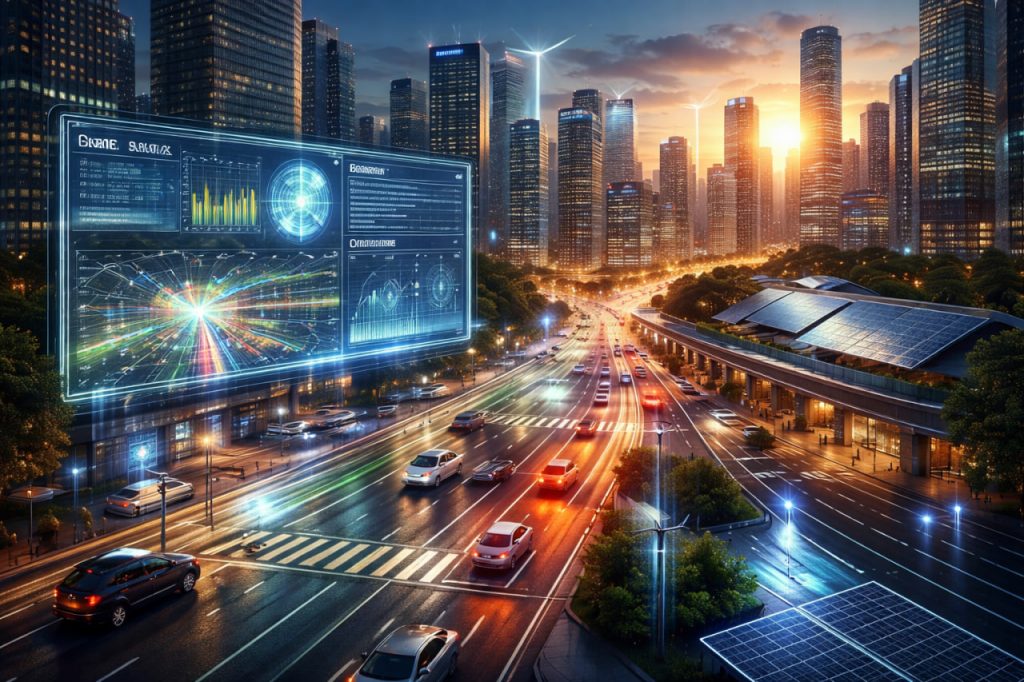
Urbanization is accelerating worldwide, placing increasing pressure on transportation systems, energy grids, and public safety infrastructure. Traditional city management models, which rely heavily on manual oversight and reactive decision-making, struggle to keep pace with growing population density and infrastructure complexity. In response, municipalities are integrating artificial intelligence (AI) into urban systems to create what is known as a smart city — an interconnected environment where data-driven technologies optimize daily operations. AI does not simply automate tasks; it analyzes massive real-time data streams to predict congestion, balance electricity demand, and enhance public safety. As cities evolve, AI is becoming a foundational technology that reshapes how urban environments function.
AI-Driven Traffic Management and Congestion Reduction
One of the most visible applications of AI in smart cities is intelligent traffic management. Urban roads generate enormous volumes of data through cameras, sensors, GPS devices, and connected vehicles. AI systems use machine learning algorithms, which identify patterns within large datasets, to predict traffic flow and dynamically adjust traffic signals. Instead of operating on fixed timers, AI-controlled traffic lights respond in real time to congestion levels, pedestrian crossings, and emergency vehicle routes.
Advanced systems also use predictive analytics, meaning they forecast traffic conditions before congestion fully develops. By analyzing historical patterns, weather conditions, and special event schedules, AI can reroute traffic or adjust signal timing proactively. This reduces idle time, lowers fuel consumption, and decreases emissions.
According to urban mobility researcher Dr. Marcus Hill:
“AI transforms traffic control from reactive management into predictive optimization, significantly reducing congestion in dense urban corridors.”
Smart traffic platforms also integrate with public transportation systems, improving bus punctuality and prioritizing high-capacity transit vehicles.
Intelligent Energy Management and Smart Grids
Energy consumption in modern cities fluctuates throughout the day based on residential, commercial, and industrial demand. Traditional grids distribute electricity uniformly without real-time adaptability. AI enhances this model through smart grids, which are digitally connected energy networks capable of dynamic adjustment.
AI algorithms monitor electricity demand, renewable generation output, and storage capacity in real time. Using load balancing techniques, the system redistributes power to prevent overloads and minimize energy waste. For example, during peak demand periods, AI can optimize distribution from battery storage or adjust non-critical loads automatically.
According to sustainable infrastructure expert Dr. Elena Fischer:
“AI-enabled smart grids improve efficiency while supporting renewable energy integration at scale.”
This intelligent management reduces blackout risk, stabilizes voltage levels, and accelerates the transition toward cleaner energy systems.
AI in Urban Safety and Surveillance
Public safety is another critical pillar of smart city infrastructure. AI supports law enforcement and emergency services through computer vision systems, which analyze video feeds to detect unusual activity, traffic accidents, or safety hazards. These systems use deep learning models, advanced neural networks capable of recognizing complex visual patterns.
AI can identify anomalies such as unattended objects, crowd surges, or suspicious behavior in real time. Importantly, these systems do not replace human decision-making but provide early alerts that allow faster response. Additionally, predictive crime analysis tools examine historical data to identify high-risk zones, improving patrol efficiency.
According to public safety technology specialist Dr. Laura Mendes:
“AI enhances situational awareness by processing visual and behavioral data far beyond human capacity.”
However, responsible deployment requires strict governance to ensure privacy protection and transparency.
Integrated Urban Data Platforms
A defining feature of smart cities is data integration. Traffic systems, energy grids, environmental sensors, and safety networks are connected through centralized platforms. AI aggregates these diverse data streams into unified dashboards for city administrators. This integration enables coordinated responses — for example, adjusting street lighting, redirecting traffic, and dispatching emergency teams simultaneously during an incident.
The use of Internet of Things (IoT) devices — interconnected sensors embedded throughout urban infrastructure — expands AI’s data access. These devices monitor air quality, noise levels, water usage, and structural integrity, allowing predictive maintenance and sustainability monitoring.
Challenges: Privacy, Security, and Ethical Oversight
Despite its advantages, AI-driven urban management raises concerns about data privacy, cybersecurity, and algorithmic bias. Surveillance technologies must operate within clear regulatory frameworks to prevent misuse. Additionally, cities must invest in cybersecurity infrastructure to protect interconnected systems from digital threats.
According to technology governance analyst Professor Daniel Brooks:
“The success of smart cities depends as much on ethical governance as on technological innovation.”
Transparent policies and public accountability remain essential to maintaining trust.
The Future of AI in Urban Development
As computing power increases and sensor networks expand, smart city AI systems will become more autonomous and interconnected. Future developments may include fully synchronized transportation ecosystems, decentralized renewable energy coordination, and AI-assisted emergency prediction models. The long-term goal is not automation alone, but the creation of more livable, sustainable, and resilient cities.
Conclusion
Artificial intelligence is redefining urban management by optimizing traffic flow, balancing energy consumption, and enhancing public safety. Through predictive analytics, machine learning, and integrated data systems, AI enables cities to operate more efficiently and sustainably. While challenges related to privacy and governance remain, responsible implementation positions smart cities as a critical component of future urban development. AI is not merely an add-on to city infrastructure — it is becoming the central nervous system of modern metropolitan environments.