Industrial production has undergone several technological revolutions, from mechanization and electrification to automation and digitalization. Today, the integration of robotics and artificial intelligence (AI) marks the next major shift, often referred to as Industry 4.0. Unlike traditional automation, which follows fixed programmed instructions, AI-powered systems can analyze data, learn from patterns, and adapt to changing conditions. This combination of intelligent software and advanced robotics is redefining efficiency, safety, and productivity across global manufacturing sectors.
From Traditional Automation to Intelligent Robotics
Conventional industrial robots operate based on pre-programmed sequences. They perform repetitive tasks such as welding, painting, or assembly with high precision, but they lack flexibility. Modern AI-enhanced robots use machine learning algorithms, which allow them to analyze production data and adjust performance dynamically. These systems can detect variations in materials, recognize product differences through computer vision, and optimize movement patterns to reduce waste.
According to manufacturing systems expert Dr. Alan Peterson:
“AI transforms industrial robots from rigid executors into adaptive problem-solvers capable of responding to real-time production variables.”
By combining sensors, cameras, and AI software, robots can make contextual decisions rather than simply following static instructions.
Computer Vision and Quality Control
One of the most impactful AI applications in manufacturing is computer vision, a technology that enables machines to interpret visual data. High-resolution cameras capture images of products during assembly, while deep learning models analyze these images for defects. Unlike manual inspection, AI systems can detect microscopic inconsistencies at high speed and with consistent accuracy.
This intelligent inspection significantly reduces defective output and minimizes costly recalls. Furthermore, AI-powered quality control systems continuously improve by learning from new defect patterns. The result is higher product reliability and stronger compliance with industry standards.
Predictive Maintenance and Equipment Optimization
Industrial downtime is one of the most expensive challenges in manufacturing. AI addresses this through predictive maintenance, which uses real-time sensor data to anticipate equipment failures before they occur. By analyzing vibration patterns, temperature fluctuations, and operational anomalies, AI models identify early warning signs of malfunction.
According to industrial analytics specialist Dr. Laura Mendes:
“Predictive maintenance shifts factories from reactive repair models to proactive optimization strategies.”
This approach reduces unplanned downtime, extends machinery lifespan, and lowers maintenance costs. Instead of waiting for breakdowns, companies can schedule maintenance strategically based on data-driven insights.
Collaborative Robots (Cobots) and Human–Machine Cooperation
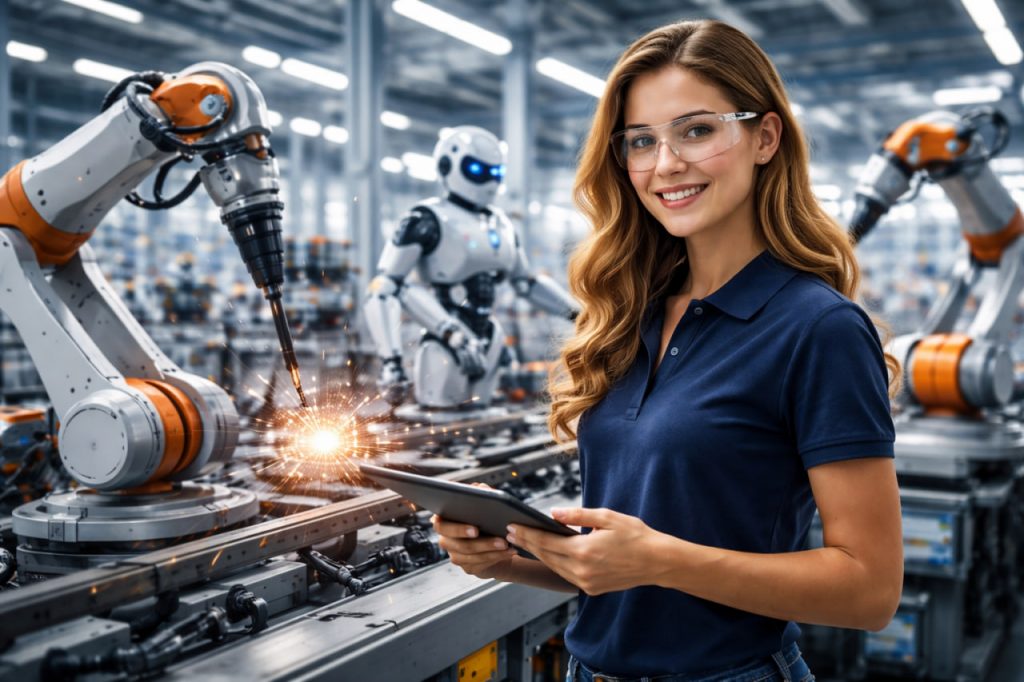
Modern factories increasingly deploy collaborative robots, or cobots, designed to work safely alongside human employees. Unlike traditional industrial robots that operate in isolated cages, cobots use sensors and AI to detect human presence and adjust their speed or movement accordingly. This enables safe collaboration in assembly lines and precision tasks.
Cobots enhance productivity without fully replacing human workers. Humans remain responsible for complex decision-making, creative problem-solving, and oversight. AI and robotics handle repetitive, physically demanding, or hazardous tasks, improving workplace safety and ergonomics.
Data-Driven Production and Smart Factories
AI enables the development of smart factories, where interconnected systems communicate through the Internet of Things (IoT). Sensors embedded in machinery collect continuous data streams, which AI analyzes to optimize workflows, inventory management, and supply chain coordination. These intelligent ecosystems allow manufacturers to respond quickly to demand fluctuations and supply disruptions.
Through advanced analytics, AI can forecast production bottlenecks and recommend process adjustments. This level of operational visibility enhances strategic planning and cost efficiency.
Economic Impact and Workforce Evolution
While robotics and AI increase efficiency, they also reshape workforce dynamics. Certain repetitive roles may decline, but new positions in robotics programming, data analytics, and AI system management are expanding. The shift requires reskilling initiatives and technical education programs to prepare workers for evolving industrial roles.
According to labor economics researcher Professor Daniel Brooks:
“Industrial AI does not eliminate work; it transforms skill requirements and productivity models.”
The long-term economic impact depends on balanced implementation, workforce training, and strategic policy support.
Ethical and Security Considerations
AI-driven manufacturing systems must address cybersecurity risks and operational transparency. Interconnected factories are vulnerable to digital threats, requiring robust protection measures. Additionally, ethical considerations include ensuring safe working environments and responsible automation deployment.
Clear governance frameworks and continuous monitoring are essential for maintaining system integrity and worker trust.
Conclusion
Robotics and artificial intelligence are redefining modern manufacturing by enabling adaptive automation, intelligent quality control, predictive maintenance, and collaborative human–machine workflows. While challenges related to workforce transformation and cybersecurity remain, AI-powered industrial systems significantly enhance productivity, precision, and safety. The future of manufacturing will not be purely automated, but intelligently integrated — where humans and machines work together in increasingly sophisticated environments.