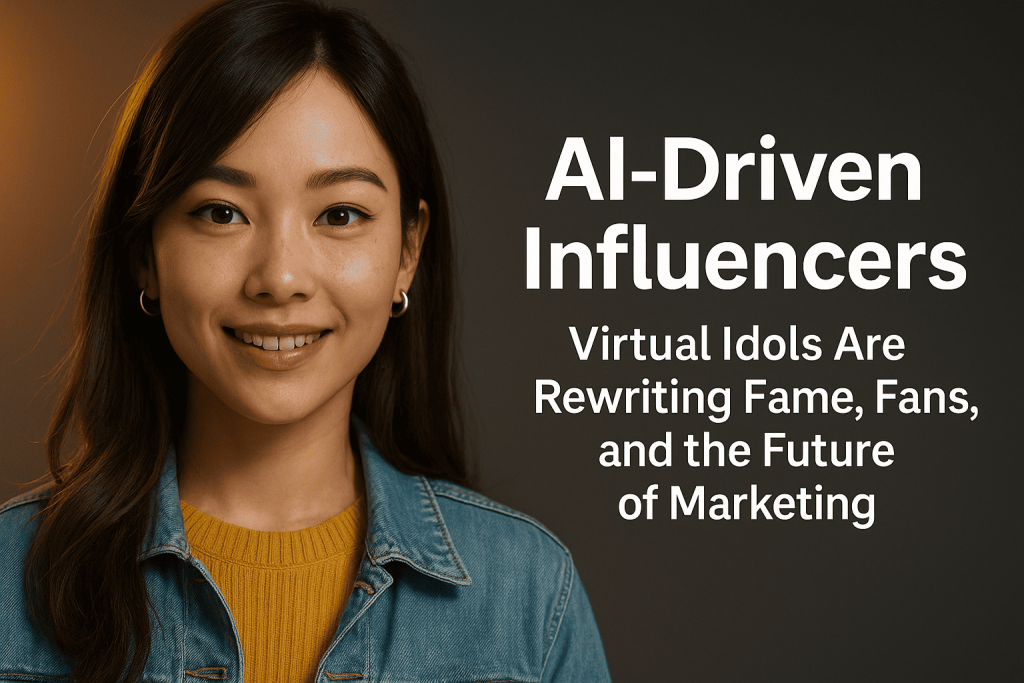
Virtual influencers—algorithmically animated personas who post, collab, and “live” online—have moved from novelty to strategy. They charm millions on Instagram, TikTok, YouTube, and Twitch; front campaigns for beauty, fashion, gaming, and fintech; and show up in music videos and livestreams as if they were human creators. Behind the glossy posts sits a stack of generative tech—LLMs like GPT for voice and personality, image/video generators for visuals, and orchestration tools that schedule, respond, and adapt in real time. This article explains how AI-driven idols are made, why brands love them, where the risks hide, and what a pragmatic playbook looks like if you’re building or partnering with digital celebrities.
Why virtual idols now?
Three trends collided: generative models that produce studio-grade assets on laptops; audiences already comfortable with VTubers, avatars, and game characters; and brands seeking creators who don’t sleep, age, or bring unpredictable headlines. Virtual influencers offer creative control, perfect on-brief visuals, global localization, and the ability to test narratives safely before scaling. They are not cheaper in absolute terms—good teams cost money—but they are infinitely adjustable and highly measurable.
The stack: from concept to character bible
Every compelling virtual idol starts with a persona document. This “character bible” defines backstory, values, goals, humor style, boundaries, and visual motifs. Include language and tone sliders (witty↔earnest, playful↔professional), hard red lines (no medical advice, no politics), and relationship arcs (how they treat fans, rivals, collaborators). GPT-class models can help draft this bible by sampling reference archetypes (fashion editor, cozy gamer, sci-fi explorer) and then remixing them into a distinctive voice that sustains months of content.
Visual pipelines: stills, motion, and live presence
For photos, teams often use diffusion models with consistent character checkpoints and a small “lookbook” of poses, angles, and lighting setups. For video, options range from motion-captured 3D avatars to 2D rigs and neural video synthesis. Lip-sync and dubbing tools enable multilingual posts. Real-time presence (Twitch, Spaces, live shopping) typically blends a motion-tracked avatar with an LLM-based dialog system plus a human safety pilot. The secret sauce is consistency: skin tone, hair physics, eye shape, wardrobe, and mannerisms must remain stable across posts to build parasocial trust.
Voice, dialog, and the “brain”
GPT-like models power scripts, captions, replies, and live banter. Best-in-class teams use retrieval-augmented generation (RAG) so the idol talks about brand facts and previous story beats without hallucinating. They add a memory layer (fan names, running jokes) and style prompts (signature phrases, pacing, emoji policy). A safety layer filters outputs for tone, claims, and legal exposure. The result: an idol who sounds like “herself,” remembers context, and stays inside brand-safe rails. ✨
Content engine: from one narrative to a week of assets
Think in arcs—mini seasons with a theme (moving to a new city, learning a skill, prepping a show). Each arc becomes a calendar: teaser photos, short skits, livestream Q&A, behind-the-scenes “studio day,” and collabs. Repurpose without repetition: a photo becomes a reel with VO; a livestream recap becomes a carousel; fan questions become a weekly advice column. GPT can break a single premise into hooks per platform while preserving voice.
Metrics that matter (beyond vanity counts)
Track not just follows and likes but conversation depth (multi-turn replies), save/share rates, repeat watchers, and comment quality (question vs. compliment). For commerce, attribute lift by cohort and creative variant: does the playful persona convert better than the aspirational one for skincare? Run A/B arcs: two micro-stories, one hypothesis about tone or timing. Virtual idols enable unusually clean experiments because you can control nearly every variable.
Fan relationships: parasocial, but with care
Fans know the idol isn’t “real,” yet they respond as if she were. Responsible teams set clear disclosures (“virtual character”), avoid exploiting loneliness, and establish boundaries (no DMs that simulate romance, no late-night “crisis” attention grabs). Healthy parasociality means empathy without deception: the character can be vulnerable about stage fright or learning a craft, but never pretend to have illnesses or traumas for engagement.
Commerce: shoppable stories and live selling
Virtual creators excel at shoppable formats—reels with tagged products, live demos with instant coupons, capsule drops with AR try-on. Because the idol is rendered, you can show product variants in seconds: colorways on skin tones, size fit overlays, ingredient animations. Use GPT to generate sizing guidance, ingredient explainers, and comparative tables tailored to the viewer’s locale and preferences.
Localization at scale
Digital idols can speak 10+ languages with consistent personality. Train glossaries and style sheets per market (honorifics, humor taboos, cultural holidays). Test joke density and reference points (anime vs. K-pop vs. Premier League). GPT handles first-pass localization; native editors do the final polish. A “local besties” strategy—co-creating with regional microcreators—builds authenticity while the idol stays canon.
Collabs: human × virtual
Hybrids win. Pair virtual idols with human creators, designers, or athletes. Let the idol interview a founder, duet a dancer, or tour a factory. These crossovers transfer trust and ground the character in real communities. Behind-the-scenes clips—rigging, voice sessions, bloopers—demystify the craft and soften “uncanny valley” vibes.
Ethics, disclosure, and brand safety
Always disclose synthetic media. Embed watermarks or provenance signals where possible. Do not deepfake real people or borrow their likeness. Avoid reinforcing narrow beauty standards—rotate body types, abilities, and ages across the roster. For sensitive categories (finance, health), keep claims tightly sourced and reviewed by experts. Build a refusal policy: topics the idol won’t touch, and graceful deflection lines.
Governance: guardrails you can show your lawyer
Ship with a compact policy stack: persona bible, style guide, risk register, and escalation paths. Log every AI-assisted claim with sources. Keep a block/allow list for brand mentions and industries. Run a red-team on prompts to test jailbreaks (e.g., coaxing medical or political advice). Maintain an audit trail of assets, tools, and approvals for compliance and postmortems.
Team models: who does what
Even “AI idols” are team sports. Typical crew: creative director (canon + arcs), LLM engineer (RAG, memory, safety), 3D/2D artist (look dev), motion specialist (rigging/mocap), community lead (moderation, sentiment), and brand strategist (partnerships, revenue). Small shops can start with a triad—writer/PM, artist, technologist—and outsource live ops until traction.
Cost realism
Upfront: model training/fine-tuning for visuals, look development, voice kit, tooling; ongoing: compute for generation, moderation, community management, and creative updates. Savings arrive in iteration speed: one day to reshoot a wardrobe, one hour to localize, five minutes to tweak VO. Consider token budgets and cache frequent lines (greetings, FAQs). Scale with a content library and snippets, not constant from-scratch generation.
Common pitfalls (and quick fixes)
Uncanny valley: Push toward stylized realism or fully stylized art; avoid near-but-not-quite-human. Calibrate eyes and micro-expressions; soften specular highlights on skin.
Tone drift: Include a one-page style fingerprint (cadence, sentence length, emoji policy) in every prompt; run a post-gen tone check.
Hallucinated facts: Use retrieval allow-lists; require citations for claims; empower the idol to say “let me check.”
Engagement farming: Invest in arcs and fan prompts; reward UGC; highlight creators who collaborate—not only giveaways.
Legal and IP: own your character
Register trademarks for names/logos, lock down model files and training data rights, and keep contracts that clarify ownership of voices and rigs. If freelancers contribute assets, ensure work-for-hire clauses or explicit assignments. Respect platform rules for synthetic media to avoid takedowns.
Measurement and learning loops
Review weekly: content performance by arc, audience shift by region, comment sentiment, and conversion by storyline. Let data reshape the canon—new hobbies, supporting characters, or a pet mascot—so the idol grows with the community. Keep a public roadmap or “season preview” to invite fans into co-creation.
Blueprint: launch your first AI-driven influencer in 30–60 days
Week 1–2: draft persona bible, visual look, and safety rails; set up RAG with product facts. Week 3–4: produce a 10-post pilot pack (3 photos, 2 shorts, 1 live test, 2 carousels, 2 collabs); prepare localization. Week 5–6: ship the arc, collect signals, iterate voice and visuals, add one mini-campaign with a clear CTA. If traction is real, expand the team and introduce a second character to build a small “virtual house.”
What’s next: multi-agent crews and true interactivity
Expect squads of virtual idols that banter, compete, and co-create with fans; live choose-your-own-adventure shows; and in-world commerce where items from a stream become AR filters and physical drops. Voice cloning will get safer with consent tech; provenance will get stronger; and the line between brand mascots and creator friends will blur. The winners will treat AI as a craft, not a gimmick—shipping characters that feel coherent, kind, and fun to be around.
Conclusion: avatars with values
AI-driven influencers aren’t just efficient; they’re expressive. Done well, they widen creative possibility, let brands tell long-running stories, and invite fans into worlds that evolve together. The key is ethics and craft: a clear persona, strong safety rails, and community-first storytelling. Build characters people want to root for—and your marketing becomes less like advertising and more like shared culture.


Virtual x human collabs are my fave — they make the characters feel less uncanny.
guess thats like the best compromise we got😥