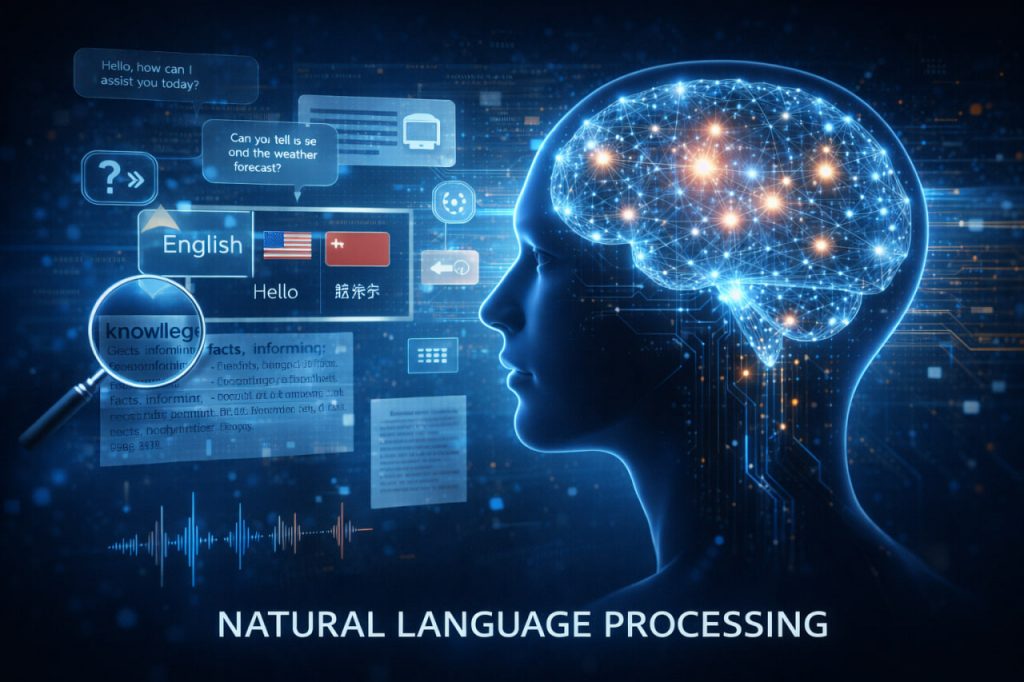
Natural language is messy, ambiguous, and deeply dependent on context, which is exactly why teaching machines to work with human language is one of the hardest problems in artificial intelligence. Natural Language Processing (NLP) is the field that enables computers to analyze, interpret, and generate human language in ways that feel useful in real life—whether that means translating text, answering questions, summarizing documents, or detecting sentiment. When people say “AI understands language,” they usually mean it can map words and sentences to patterns it has learned from data, then produce outputs that match those patterns. This is not the same as human understanding, because today’s AI does not experience meaning the way people do, but it can still perform remarkably well on many language tasks. To see why, you need to understand how modern NLP represents words, handles context, and learns from large-scale text.
From Words to Numbers: Why NLP Starts With Representation
Computers cannot work directly with language as humans do, so NLP begins by converting text into numerical formats that models can process. Historically, systems used bag-of-words and TF-IDF, which treat a document as a collection of words and measure importance based on frequency, but these methods struggle with context and word order. Modern NLP relies on embeddings, which are dense numerical vectors that place words (and sometimes sentences) in a geometric space where semantic similarity becomes measurable. In this space, words used in similar contexts appear closer together, allowing models to generalize beyond exact keyword matches. This is why an NLP system can often connect related ideas even when the same words are not repeated.
“The breakthrough in NLP came when we stopped treating language as discrete symbols and started representing meaning as geometry through embeddings,” — Dr. Emily Bender, computational linguist.
Context Is Everything: How Models Handle Meaning in Sentences
Human language depends heavily on context, because the same word can mean different things depending on surrounding words, the topic, or the speaker’s intent. Older NLP systems used n-grams or rule-based parsing to approximate context, but they tended to fail when sentences became complex or when meaning depended on long-range relationships. Modern approaches use contextual embeddings, where the representation of a word changes depending on its sentence, so “bank” in “river bank” is treated differently from “bank account.” This shift is critical because it lets models track meaning across a sentence rather than relying on a fixed dictionary definition. Context also includes things like reference resolution—understanding that “she” refers to the previously mentioned person—and handling negation, sarcasm, or implied meaning, which remain challenging in many real-world settings.
“Language is fundamentally contextual, and the goal of modern NLP is to model context efficiently rather than memorize static definitions,” — Professor Christopher Manning, NLP researcher.
Transformers and Attention: The Engine Behind Modern NLP
Most high-performing NLP systems today are built on transformers, a model architecture that became dominant because it captures relationships between words at scale. The key mechanism inside transformers is attention, which allows the model to weigh which words matter most when interpreting a particular token or producing the next one. Unlike older sequential models that struggled with long sentences, attention can connect distant words directly, which helps with tasks like summarization, translation, and question answering. Transformers are trained on massive text corpora to predict missing words or the next word, and through this objective they learn rich statistical patterns of language. These patterns allow models to generate coherent responses and to perform tasks with impressive fluency, even though the model is not “thinking” in a human way. Importantly, transformers can be adapted to specialized tasks through fine-tuning or instruction tuning, which aligns model outputs with specific goals and safety constraints.
“Attention let models scale language understanding because it provides a flexible way to link meaning across an entire sequence, not just nearby words,” — Dr. Ashish Vaswani, AI researcher.
Training, Tokens, and Why “Understanding” Is Not Human Understanding
When NLP models process text, they typically work with tokens, which are chunks of text such as words, subwords, or characters depending on the tokenizer. Training involves optimizing billions of parameters so that, given a context window, the model predicts likely continuations or fills in missing pieces. This learning process creates a powerful engine for pattern completion, which often looks like comprehension, but it can also produce confident errors when prompts fall outside the model’s learned distribution. This limitation is closely related to issues like hallucination, where a model generates plausible but incorrect information, and distribution shift, where real-world data differs from training examples. Another key constraint is that models do not have direct access to truth; they learn correlations from data, not verified facts, unless integrated with external retrieval systems or strict verification pipelines. For this reason, professional NLP deployments often combine language models with retrieval-augmented generation (RAG), which grounds responses in authoritative documents and reduces unsupported claims.
“Language models can be extraordinarily fluent because they learn statistical structure, but fluency is not the same as factual grounding or human-level understanding,” — Dr. Percy Liang, machine learning researcher.
Practical NLP Tasks: What AI Can Do Well Today
NLP is not a single capability; it is a toolkit that powers a wide range of applications, each with different levels of reliability. In text classification, models can label documents by topic, detect spam, or identify toxic language with strong accuracy when trained on representative datasets. In named entity recognition, models identify people, locations, organizations, and other entities, enabling information extraction from messy text. In machine translation, transformer-based systems can produce highly readable output, especially for high-resource language pairs, though nuance and cultural context can still be difficult. In summarization, NLP can compress long text into key points, but quality depends on whether the system is optimized for faithfulness rather than just readability. In dialogue systems, models can maintain conversation flow and follow instructions, but robust long-term consistency often requires additional memory, retrieval, or guardrails.
“Modern NLP excels when the task is well-defined and evaluation is clear, but open-ended dialogue is still one of the hardest settings to control,” — Dr. Diyi Yang, NLP researcher.
The Hard Parts: Ambiguity, Bias, and Safety in Language Systems
Language carries ambiguity, cultural norms, and social power, which means NLP systems can inherit and amplify biases present in training data. This is why bias mitigation and fairness evaluation have become central concerns in production NLP. Another challenge is that language can be used for harmful purposes, so systems need content moderation, policy constraints, and robust refusal behavior for unsafe requests. There is also the problem of interpretability, because transformer models are complex and it is often difficult to explain why a model produced a specific output. In regulated industries, these issues matter because decisions must be auditable and aligned with ethical standards, not just accurate on average. Strong NLP governance therefore includes dataset documentation, monitoring, red-teaming, and continuous evaluation under real-world conditions.
“When language systems scale, their social impact scales too, so safety, bias, and transparency are not optional features—they are core engineering requirements,” — Dr. Timnit Gebru, AI ethics researcher.
Conclusion
AI “understands” natural language by converting text into numerical representations, learning patterns from massive datasets, and using architectures like transformers and attention to model context across sequences. This produces highly capable language behavior, but it remains fundamentally different from human understanding because models learn statistical structure rather than grounded meaning. The most effective NLP systems combine strong representation learning with careful alignment, evaluation, and—when accuracy matters—grounding through retrieval or verification. When you know what NLP is doing under the hood, you can use it more effectively, trust it appropriately, and design safer, more reliable applications.