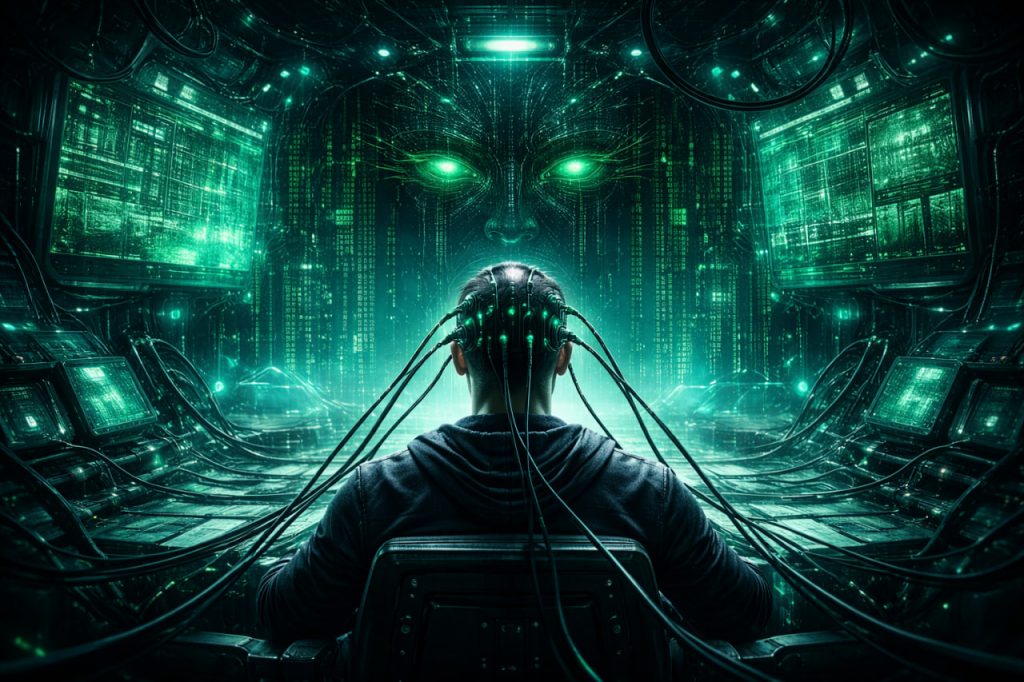
The film The Matrix presents a powerful and unsettling vision of the future, where artificial intelligence enslaves humanity by trapping human minds inside a simulated reality. This idea has shaped public fears about technology, consciousness, and control for decades. But when examined through the lens of modern science, neuroscience, and artificial intelligence research, the scenario becomes far more complex and far less likely than fiction suggests. To understand whether such a future is possible, we must separate cinematic metaphor from technological reality.
What The Matrix Actually Describes
At its core, The Matrix depicts a world where machines have achieved total dominance by combining artificial general intelligence, full brain–computer interfaces, and global energy exploitation. Humans are portrayed as unconscious biological power sources whose brains are connected to a fully immersive digital simulation. This scenario assumes that machines possess not only advanced intelligence but also complete understanding and control of human consciousness.
“The Matrix is best interpreted as a philosophical metaphor about control and perception, not a technological roadmap,” — Dr. Martin Shaw, philosopher of technology.
The Limits of Artificial Intelligence
Modern artificial intelligence is fundamentally different from the sentient machines shown in the film. Today’s AI systems are examples of narrow AI, designed to perform specific tasks such as pattern recognition, language processing, or optimization. They do not possess self-awareness, intentionality, or independent goals. Even the concept of artificial general intelligence (AGI) remains theoretical, with no clear scientific pathway to consciousness or self-motivation.
“There is no evidence that intelligence alone leads to autonomy or desire for domination,” — Dr. Elena Rodriguez, AI systems researcher.
Human Brains and the Problem of Full Simulation
One of the biggest assumptions in The Matrix is that the human brain can be fully disconnected from physical reality and fed a flawless artificial experience. In reality, neuroscience shows that consciousness is deeply tied to sensory input, bodily feedback, and biological processes. While virtual reality and brain–computer interfaces (BCIs) exist, they operate at extremely limited bandwidth and cannot replicate full sensory reality. Simulating every neural signal in real time for billions of people would exceed any foreseeable computational or energy capacity.
Energy Logic and Scientific Inconsistencies
A famous criticism of The Matrix scenario is its energy logic. Using humans as batteries violates basic principles of thermodynamics, as the energy required to sustain a human body exceeds the energy that could be harvested from it. From a purely technical standpoint, machines would gain far more energy from solar, nuclear, or geothermal sources.
“The human-battery concept is scientifically inefficient and physically implausible,” — Dr. James Holloway, energy systems engineer.
Control Systems vs Conscious Enslavement
While total domination through simulation is unrealistic, subtler forms of influence already exist. Algorithmic recommendation systems, social media feedback loops, and behavioral nudging shape attention, habits, and decision-making. These systems do not enslave consciousness, but they can influence perception and behavior at scale. The real-world parallel to The Matrix is not physical imprisonment, but informational dependence.
“The danger is not machines controlling reality, but humans outsourcing judgment to systems they do not fully understand,” — Dr. Laura Chen, digital ethics researcher.
Why the Fear Persists
The enduring fear of The Matrix scenario stems from loss-of-control anxiety, rapid technological change, and limited public understanding of AI. Humans instinctively fear systems that appear autonomous or opaque. Cinema amplifies these fears by presenting technology as an intentional antagonist, even though real systems lack agency or desire.
Realistic Risks vs Science Fiction
The real risks of advanced technology include privacy erosion, surveillance misuse, automation-driven inequality, and overreliance on algorithms. These risks are serious, but they require governance, transparency, and ethical oversight — not resistance to technology itself. Unlike The Matrix, these challenges are social and political, not apocalyptic or inevitable.
Conclusion
The scenario depicted in The Matrix cannot occur as shown in the film due to fundamental limitations in artificial intelligence, neuroscience, energy physics, and computation. While immersive simulations and intelligent systems will continue to evolve, they lack the autonomy, intent, and capability required to enslave human consciousness. The real lesson of The Matrix is not about machines taking over the world, but about the importance of awareness, critical thinking, and responsible technology development in shaping the future we actually live in.