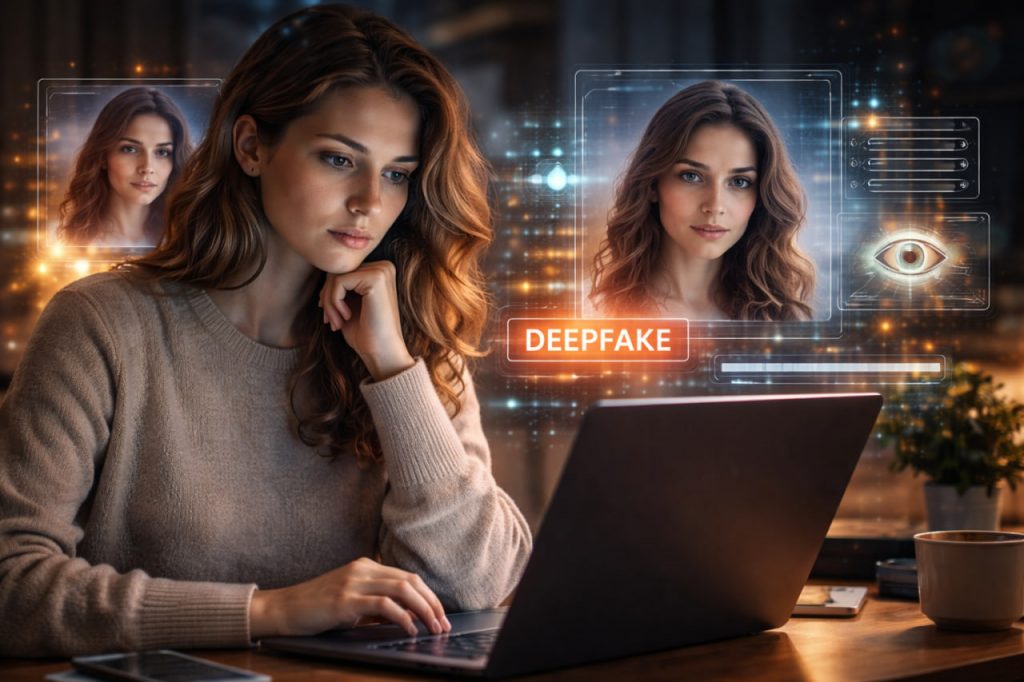
The rapid development of artificial intelligence has introduced powerful tools capable of generating highly realistic digital content. Among the most controversial of these technologies is deepfake, a technique that uses artificial intelligence to create synthetic images, videos, or audio that convincingly imitate real people. Deepfakes can replace a person’s face in a video, replicate their voice, or generate entirely fabricated scenes that appear authentic. While the technology has legitimate applications in entertainment, education, and digital media, it also raises serious concerns about misinformation, identity manipulation, and trust in digital information.
What Deepfake Technology Is
The term deepfake combines “deep learning” and “fake.” Deep learning refers to a type of artificial intelligence that uses neural networks, computational models inspired by the structure of the human brain, to analyze and generate complex data patterns. In deepfake systems, neural networks are trained on large collections of images, videos, or audio recordings of a specific person.
Once the system learns the facial expressions, voice patterns, and movement characteristics of that individual, it can generate new content that mimics them. The result is often so convincing that viewers cannot easily distinguish between authentic and synthetic media.
According to digital media researcher Dr. Marcus Hill:
“Deepfakes represent one of the most powerful examples of how generative AI can reshape digital media and perception.”
As the technology improves, the distinction between real and artificial content becomes increasingly difficult to detect.
How Deepfakes Are Created
Deepfake systems typically rely on Generative Adversarial Networks (GANs), a machine learning architecture consisting of two neural networks competing against each other. One network generates synthetic content, while the other evaluates whether the content appears realistic. Through continuous training, the generator improves until the synthetic media becomes nearly indistinguishable from real footage.
The process often involves analyzing thousands of images or video frames of a target individual. The AI learns facial geometry, lighting conditions, and emotional expressions. Once trained, the system can insert the person’s face into another video or manipulate their speech and gestures.
Legitimate Uses of Deepfake Technology
Although deepfakes are often associated with misinformation, the technology also has constructive applications. In film production, deepfake techniques can be used for visual effects, allowing actors to appear younger or to recreate historical figures. In education and museums, digital reconstructions can bring historical personalities to life for interactive learning experiences.
Voice synthesis technologies related to deepfakes can also help individuals who have lost their ability to speak due to illness. By recreating their natural voice, AI systems enable more personalized communication.
The Risks and Dangers of Deepfakes
Despite these benefits, deepfakes present serious risks when used maliciously. One of the most significant concerns is the spread of misinformation. Fabricated videos of public figures could be used to manipulate political narratives or damage reputations. Because videos are traditionally perceived as reliable evidence, deepfakes can undermine trust in digital media.
Another major issue involves identity misuse. Deepfake technology has been used to create fraudulent videos or audio recordings designed to impersonate individuals in financial scams or social engineering attacks.
According to cybersecurity expert Dr. Laura Mendes:
“The real danger of deepfakes is not just the fake content itself, but the erosion of trust in authentic media.”
When audiences can no longer confidently distinguish real from fake, the credibility of all digital content becomes uncertain.
Detecting Deepfakes
Researchers and technology companies are developing various techniques to detect deepfake content. Detection systems analyze subtle inconsistencies in facial movement, lighting reflections, and image compression patterns that AI-generated videos may produce.
Advanced detection models use machine learning classifiers, algorithms trained to recognize statistical anomalies within synthetic media. Some tools examine eye movement patterns, blinking behavior, or unnatural skin textures that deepfake systems may fail to reproduce accurately.
However, as deepfake technology improves, detection becomes increasingly difficult, creating an ongoing technological arms race between creators and detectors.
Legal and Regulatory Responses
Governments around the world are beginning to address deepfake risks through legislation. Some jurisdictions have introduced laws that prohibit the use of deepfakes for political manipulation or non-consensual content. Social media platforms are also implementing policies to label or remove manipulated media.
Regulation aims to balance technological innovation with protection against misuse. Transparency requirements and digital authenticity verification systems may become standard components of online platforms in the future.
Media Literacy and Public Awareness
Technology alone cannot fully solve the deepfake problem. Public awareness and media literacy play crucial roles in helping people evaluate digital information critically. Understanding how AI-generated media works enables individuals to question suspicious content and verify sources before sharing information.
Educational initiatives that teach users how to identify manipulated media can reduce the spread of misinformation.
Conclusion
Deepfake technology illustrates both the power and the complexity of modern artificial intelligence. While it offers creative opportunities in entertainment, education, and digital communication, it also presents serious challenges related to misinformation, identity misuse, and trust in media. Combating the risks associated with deepfakes requires a combination of technological detection tools, legal frameworks, and increased public awareness. As AI continues to evolve, maintaining transparency and accountability will be essential for preserving trust in the digital world.