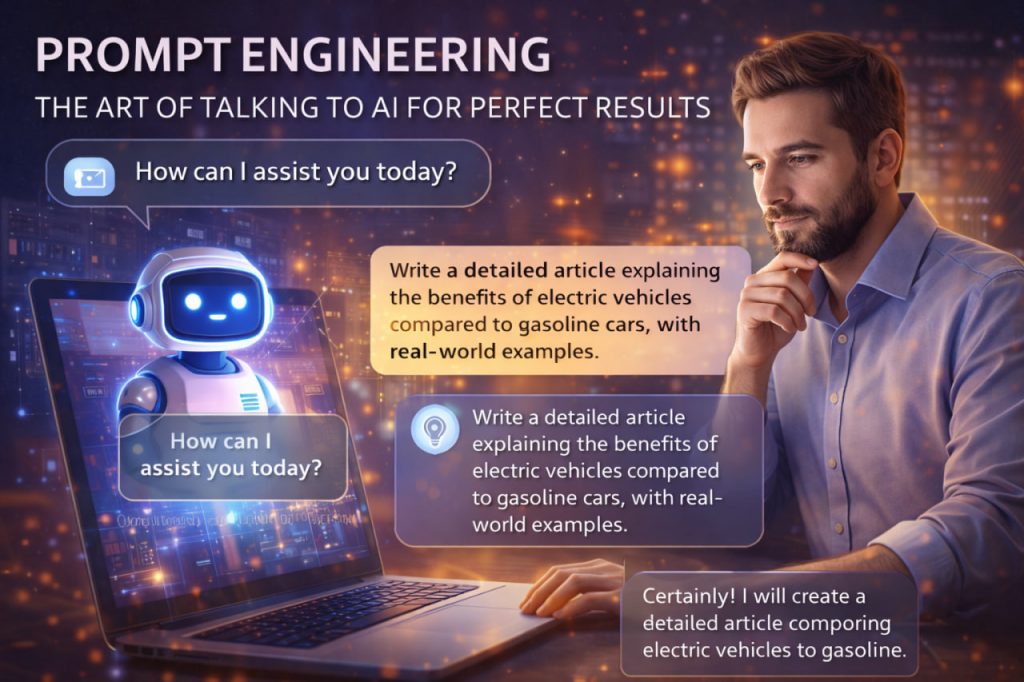
As artificial intelligence becomes more powerful, a new skill is emerging as essential: prompt engineering. It is the ability to communicate effectively with AI systems—especially large language models—to get accurate, useful, and high-quality results. While AI models are trained on massive datasets, the quality of the output often depends directly on how the request is formulated. In simple terms: better prompts lead to better answers.
What Is Prompt Engineering?
Prompt engineering is the practice of designing inputs (prompts) that guide AI systems to produce desired outputs. A prompt can be:
- a question
- an instruction
- a scenario
- a combination of context + task
Instead of simply asking “Write something about EVs,” a well-crafted prompt provides clarity and direction.
Example:
Weak prompt:
“Tell me about electric cars”
Strong prompt:
“Write a detailed 1000-word article explaining the cost advantages of electric vehicles compared to gasoline cars, including real-world examples and calculations.”
Why Prompting Matters
AI does not “understand” requests like a human—it interprets patterns. The more precise and structured your prompt is, the better the model can align with your intent.
Good prompting helps:
- reduce errors
- improve relevance
- control tone and format
- get consistent results
Core Principles of Effective Prompts
1. Be Specific
Vague prompts lead to vague answers.
Instead of:
“Explain AI”
Use:
“Explain reinforcement learning in simple terms with real-world examples.”
2. Provide Context
Context helps AI understand the goal.
Example:
“You are writing for beginners with no technical background…”
3. Define the Output Format
Tell the AI exactly what you want:
- article
- bullet points
- table
- step-by-step guide
4. Set Constraints
You can control:
- length
- tone (formal, casual)
- language
- structure
Example:
“Write in a professional tone, 1200 words, with clear headings.”
5. Use Iteration
Prompting is not one-shot. You refine step by step:
- ask
- review
- improve
Advanced Techniques
Few-Shot Prompting
Provide examples in your prompt:
“Here are examples of good headlines:
- …
- …
Now generate 5 similar headlines.”
Role-Based Prompting
Assign a role to the AI:
“You are an experienced automotive analyst…”
This improves depth and style.
Chain-of-Thought Prompting
Encourage step-by-step reasoning:
“Explain your reasoning step by step.”
Common Mistakes
- too vague requests
- no structure
- unrealistic expectations
- ignoring iteration
Real-World Applications
Prompt engineering is used in:
- content creation
- programming assistance
- data analysis
- marketing
- education
It is becoming a core digital skill, similar to using search engines effectively.
The Future of Prompt Engineering
As AI evolves, prompt engineering will become:
- more intuitive
- partially automated
- integrated into tools
However, the ability to clearly express intent will always remain valuable.
Key Insight
Prompt engineering is not about “tricking” AI—it’s about clear communication.
The better you define your goal, the better AI performs.
Conclusion
Prompt engineering is the bridge between human intent and machine output. By learning how to structure requests, provide context, and refine inputs, users can unlock the full potential of AI systems. In a world increasingly driven by intelligent tools, the ability to “talk to AI” effectively is becoming a powerful and practical skill.