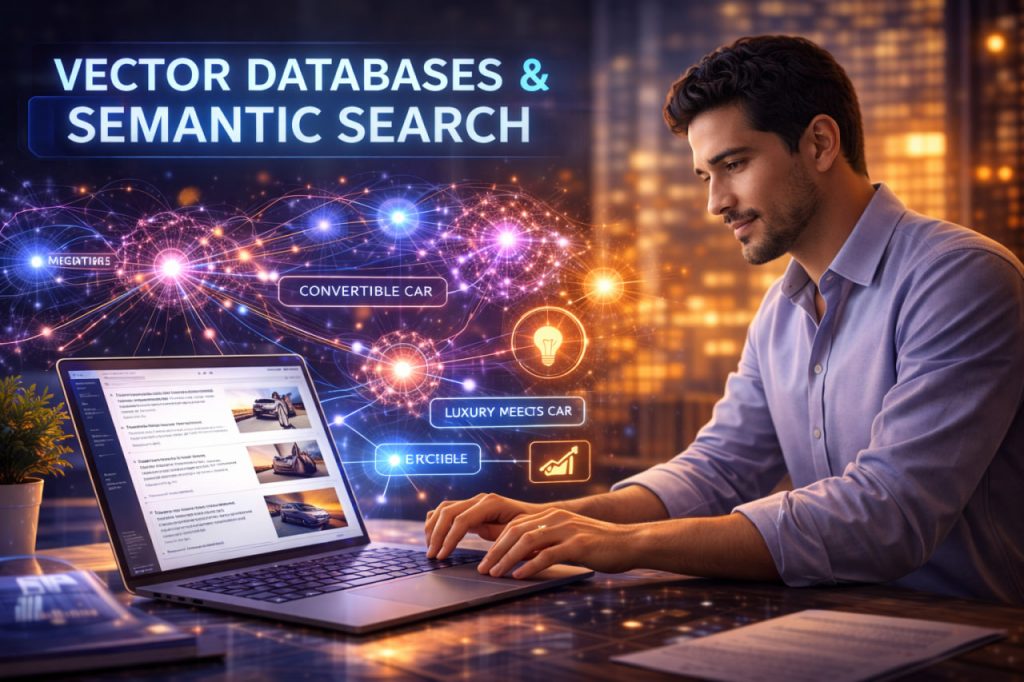
Traditional search systems are built on keyword matching — they look for exact words or phrases in text. However, human language is far more complex: the same idea can be expressed in many different ways. This limitation led to the development of semantic search, a technology that allows AI to understand the meaning behind queries rather than just matching words. At the core of this approach are vector databases, specialized systems designed to store and search high-dimensional data representations known as vectors. Together, they form the backbone of modern AI-powered search, recommendation systems, and intelligent assistants.
What Is a Vector?
In the context of AI, a vector is a numerical representation of data — such as text, images, or audio — in a multi-dimensional space. This process is called embedding, where information is transformed into a set of numbers that capture its meaning.
For example:
- the words “car” and “vehicle” will have similar vector representations
- the words “car” and “banana” will be far apart in vector space
This allows AI systems to measure semantic similarity, meaning how close two pieces of information are in meaning rather than wording.
According to AI researcher Dr. Tomas Mikolov:
“Word embeddings capture semantic relationships by placing similar concepts closer together in vector space.”
What Is a Vector Database?
A vector database is a specialized system designed to store, index, and search vectors efficiently. Unlike traditional databases, which rely on exact matches, vector databases perform similarity search — finding items that are closest in meaning.
Key features include:
- fast nearest-neighbor search
- high-dimensional indexing
- scalability for large datasets
These databases are optimized for operations such as:
- cosine similarity
- Euclidean distance
- dot product comparison
How Semantic Search Works
Semantic search uses vector representations to understand user intent. Instead of matching keywords, it compares the query vector to stored vectors and retrieves the most relevant results.
The process typically involves:
- Converting the query into a vector using an embedding model
- Searching the vector database for similar vectors
- Returning results ranked by semantic similarity
This approach allows systems to:
- understand synonyms
- interpret context
- handle vague or natural language queries
According to search technology expert Dr. Laura Mendes:
“Semantic search shifts the focus from matching words to understanding intent.”
Real-World Applications
Vector databases and semantic search are used in many modern systems:
1. AI Assistants and Chatbots
They retrieve relevant information based on meaning, improving response quality.
2. Recommendation Systems
Platforms suggest products, movies, or content based on user preferences and behavior.
3. Image and Multimedia Search
Users can search using images or descriptions instead of keywords.
4. Document Search and Knowledge Bases
Companies use semantic search to navigate large volumes of internal data.
5. Fraud Detection and Security
Similarity search helps identify unusual patterns and anomalies.
Popular Vector Database Technologies
Several platforms specialize in vector search:
- Pinecone
- Weaviate
- Milvus
- FAISS (Facebook AI Similarity Search)
These systems are designed to handle billions of vectors with high performance.
Challenges and Limitations
Despite their advantages, vector databases come with challenges:
- high computational requirements
- complexity of indexing large datasets
- need for high-quality embeddings
- difficulty in explaining results (black-box nature)
Additionally, performance depends heavily on the quality of the embedding model.
Hybrid Search: Combining Keywords and Semantics
Many modern systems use hybrid search, combining traditional keyword matching with semantic search. This approach provides both precision and contextual understanding, delivering more accurate results.
The Future of Search
Vector databases are becoming a fundamental component of AI infrastructure. As models improve, semantic search will become more accurate, faster, and more integrated into everyday applications.
Future developments include:
- real-time vector updates
- multimodal search (text + image + audio)
- deeper integration with large language models
Conclusion
Vector databases and semantic search represent a major evolution in how information is retrieved. By focusing on meaning rather than keywords, they enable more intelligent, flexible, and human-like interactions with data. As AI systems continue to advance, these technologies will play a central role in powering the next generation of search and knowledge discovery.