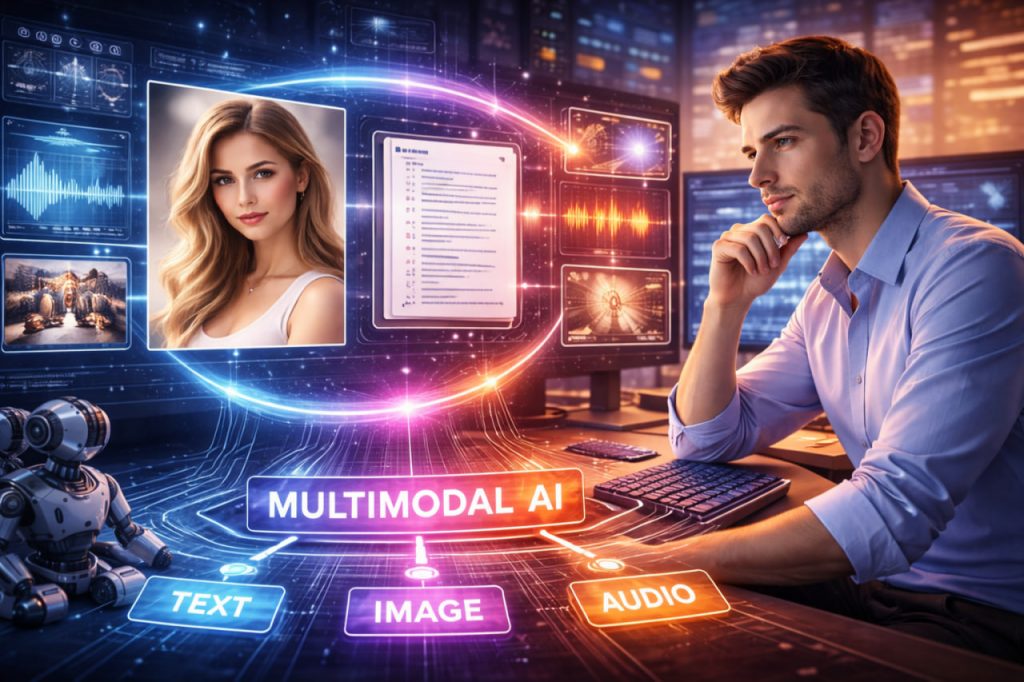
Artificial intelligence is evolving beyond systems that process a single type of data. Today, one of the most important breakthroughs is multimodal AI — models capable of understanding and generating information across multiple data types simultaneously, such as text, images, and audio. This shift represents a major step toward more human-like intelligence, as people naturally interpret the world through multiple senses at once. Multimodal systems enable richer interactions, deeper understanding, and more powerful applications across industries.
What Is Multimodal AI?
Multimodal AI refers to models that can process and integrate different types of input data (modalities) within a single system. These modalities typically include:
- Text — language, documents, conversations
- Images — photos, diagrams, video frames
- Audio — speech, music, environmental sounds
Instead of analyzing each type separately, multimodal models combine them into a unified representation, allowing more context-aware decision-making.
According to AI researcher Dr. Fei-Fei Li:
“Multimodal intelligence brings AI closer to how humans perceive and understand the world.”
Why Multimodal Learning Matters
Traditional AI models operate within narrow domains. For example, an NLP model processes text, while a computer vision model analyzes images. However, real-world scenarios rarely involve a single modality.
Consider examples:
- watching a video (image + sound + language)
- having a conversation (speech + context + visual cues)
- driving a car (visual data + sensor input + decision-making)
Multimodal AI bridges these domains, enabling systems to understand relationships between different types of information.
How Multimodal Models Work
Multimodal AI systems rely on advanced architectures that combine multiple neural networks or use unified models capable of handling diverse inputs. Key components include:
- Encoders — convert each modality into numerical representations
- Fusion mechanisms — combine these representations into a shared space
- Decoders — generate outputs based on combined information
A critical concept is cross-modal learning, where information from one modality enhances understanding of another. For example, an image can help clarify ambiguous text, and audio can provide emotional context.
According to machine learning expert Dr. Kevin Liu:
“The real power of multimodal AI lies in the interaction between modalities, not just their coexistence.”
Real-World Applications
Multimodal AI is already transforming multiple industries:
1. Virtual Assistants and Conversational AI
Systems can understand spoken language, interpret images, and respond with text or voice, enabling more natural interactions.
2. Healthcare
Doctors can combine medical images, patient records, and voice notes to improve diagnosis and decision-making.
3. Autonomous Vehicles
Self-driving systems process camera data, sensor input, and contextual signals simultaneously to navigate safely.
4. Content Creation
AI can generate images from text, create videos from scripts, or produce audio narratives, enabling new creative workflows.
5. Search and Recommendation Systems
Users can search using images, voice, or text, with AI understanding intent across all formats.
Multimodal Models and Foundation AI
Modern multimodal systems are often part of foundation models, large-scale AI systems trained on diverse datasets. These models can perform multiple tasks without retraining, thanks to their generalized understanding.
Examples of capabilities include:
- describing images in natural language
- generating visuals from text prompts
- answering questions about videos
- translating speech into text with contextual understanding
Challenges in Multimodal AI
Despite its potential, multimodal AI faces several challenges:
- Data alignment — ensuring different modalities correspond correctly
- Computational complexity
- training data requirements
- bias across modalities
Additionally, combining modalities increases system complexity, requiring more sophisticated architectures and training strategies.
Ethical Considerations
Multimodal AI raises important ethical issues, especially in areas such as surveillance, deepfakes, and misinformation. Systems that can generate realistic images, voices, and text simultaneously have powerful capabilities that must be used responsibly.
According to AI ethics specialist Dr. Laura Mendes:
“Multimodal AI amplifies both the benefits and risks of artificial intelligence.”
The Future of Multimodal Intelligence
The future of AI is increasingly multimodal. Researchers are working toward systems that integrate even more data types, including sensor data, biological signals, and real-world interactions.
Emerging directions include:
- real-time multimodal interaction
- embodied AI systems (robots that perceive and act)
- unified models for all data types
These developments bring AI closer to general intelligence, where systems can understand the world in a holistic way.
Conclusion
Multimodal AI represents a significant leap forward in artificial intelligence. By combining text, images, and audio into unified systems, it enables richer understanding and more powerful applications. While challenges remain, the ability to process multiple forms of information simultaneously is key to building more intelligent, flexible, and human-like AI systems. As technology advances, multimodal AI will become a central pillar of the next generation of intelligent applications.