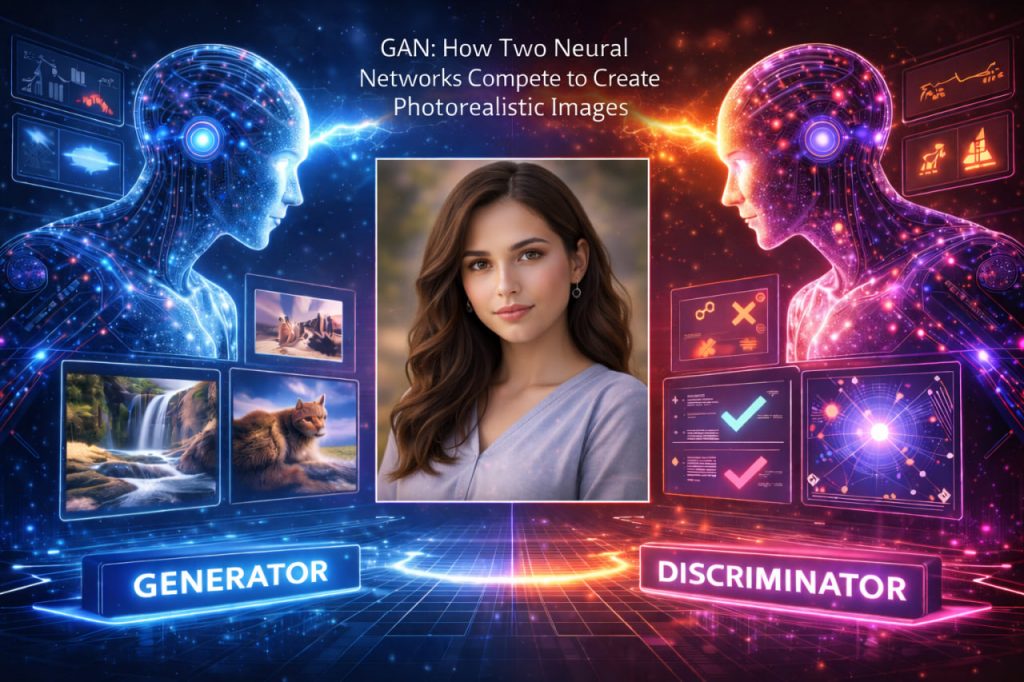
Artificial intelligence has reached a point where machines can generate images that are nearly indistinguishable from real photographs. One of the key technologies behind this breakthrough is Generative Adversarial Networks (GANs) — a powerful framework in machine learning where two neural networks compete against each other to improve results. This adversarial process allows AI to learn how to generate highly realistic images, videos, and even synthetic human faces. GANs have revolutionized fields such as digital art, media production, gaming, and data simulation.
What Is a GAN?
A Generative Adversarial Network (GAN) consists of two main components:
- Generator — creates fake data (images, videos, etc.)
- Discriminator — evaluates whether the data is real or fake
These two networks are trained simultaneously in a competitive process. The generator tries to produce realistic outputs, while the discriminator attempts to detect whether those outputs are artificial.
According to AI researcher Dr. Ian Goodfellow (the creator of GANs):
“The generator and discriminator are locked in a game where both improve through competition.”
This setup creates a feedback loop where both networks continuously learn and evolve.
The Core Idea: Learning Through Competition
The key innovation of GANs is the idea of adversarial learning. Instead of learning from labeled data alone, the system improves through competition between two models.
The process works as follows:
- The generator creates an image
- The discriminator evaluates it
- Feedback is sent back to the generator
- The generator improves its output
Over time, the generator becomes better at fooling the discriminator, while the discriminator becomes better at detecting fakes. This dynamic pushes both networks toward higher performance.
Why GANs Produce Realistic Images
GANs excel at generating realistic images because they learn data distributions — the underlying patterns that define how real images look. Instead of memorizing examples, the generator learns how to create entirely new data that follows the same statistical structure.
This allows GANs to produce:
- realistic human faces
- high-quality textures
- detailed environments
- synthetic training data
According to computer vision expert Dr. Laura Mendes:
“GANs don’t just copy reality — they learn how reality is structured and recreate it.”
Training Challenges and Instability
Despite their power, GANs are notoriously difficult to train. One of the main challenges is training instability, where the balance between generator and discriminator breaks down.
Common issues include:
- Mode collapse — generator produces limited variety
- Vanishing gradients — learning slows down
- imbalance between networks
Achieving stable training requires careful tuning of hyperparameters and architecture design.
Variants and Improvements of GANs
Since their introduction, many variations of GANs have been developed to improve stability and performance:
- DCGAN (Deep Convolutional GAN) — improved image generation using convolutional layers
- StyleGAN — enables high-resolution, controllable image synthesis
- CycleGAN — translates images between domains (e.g., summer to winter scenes)
These advancements have significantly expanded the practical applications of GANs.
Real-World Applications
GANs are used in a wide range of industries:
- Entertainment — visual effects, game design
- Fashion — virtual clothing and design
- Healthcare — medical image augmentation
- Marketing — content generation
- Security — simulation and testing
They are also behind technologies such as deepfakes, which raise both creative opportunities and ethical concerns.
Ethical Considerations
The ability of GANs to generate realistic content raises serious questions about authenticity, misinformation, and digital trust. Synthetic media can be used for both beneficial and harmful purposes, making regulation and awareness increasingly important.
According to AI ethics researcher Dr. Helen Brooks:
“The realism of GAN-generated content challenges our ability to distinguish truth from fabrication.”
The Future of GAN Technology
GANs continue to evolve, with research focusing on:
- better training stability
- higher resolution outputs
- integration with other AI models
- real-time generation
They are also becoming part of multimodal systems, combining text, image, and video generation.
Conclusion
Generative Adversarial Networks represent one of the most innovative approaches in artificial intelligence. By using competition between two neural networks, GANs achieve remarkable realism in generated content. While challenges remain in training and ethical use, GANs have fundamentally changed how machines create visual data. As the technology advances, it will continue to shape industries ranging from entertainment to science, redefining the boundaries between real and artificial.