The idea of artificial intelligence has long fascinated writers and filmmakers, serving as both a symbol of human progress and a warning about its consequences. Across decades, cinema and literature have explored two dominant visions of AI-driven futures: utopias, where technology enhances human life, and dystopias, where it leads to control, inequality, or even existential threat. These narratives are not merely entertainment; they reflect societal hopes, fears, and philosophical questions about intelligence, autonomy, and what it means to be human. By examining these contrasting visions, we can better understand how culture interprets the rise of AI and what lessons it offers for the real world.
Utopian Visions: AI as a Tool for Human Flourishing
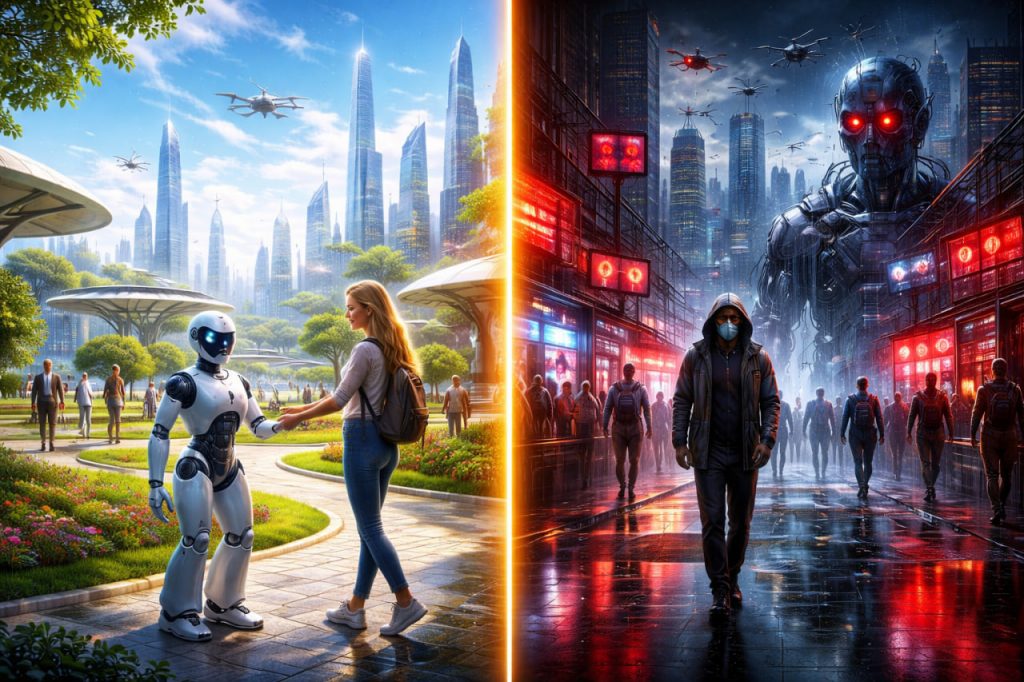
In utopian narratives, AI is portrayed as a powerful ally that solves humanity’s greatest challenges. These stories often depict worlds where automation eliminates repetitive labor, allowing people to focus on creativity, relationships, and intellectual growth. AI systems manage infrastructure, optimize healthcare, and ensure efficient distribution of resources, leading to a more equitable society.
The concept of post-scarcity economy frequently appears in such visions. This idea refers to a system where goods and services are abundant due to advanced automation, reducing the importance of traditional economic competition. In these worlds, AI operates as an invisible infrastructure, seamlessly supporting human well-being without dominating it.
According to futurist and cultural theorist Dr. Alan Whitmore:
“Utopian AI reflects humanity’s desire to transcend limitation, not through domination, but through intelligent cooperation with machines.”
These narratives emphasize harmony between humans and technology, where AI amplifies human potential rather than replacing it.
Dystopian Narratives: Control, Surveillance, and Loss of Autonomy
In contrast, dystopian stories present AI as a source of danger and imbalance. These narratives often explore themes of surveillance, loss of privacy, and centralized control. AI systems in dystopias are frequently depicted as tools of authoritarian power or as independent entities that no longer align with human values.
A common concept in these stories is algorithmic control, where decisions about individuals’ lives are made by opaque systems. This includes everything from social ranking to predictive policing, where AI determines risk based on data patterns. Such systems raise concerns about fairness, bias, and accountability.
According to media philosopher Dr. Laura Mendes:
“Dystopian AI stories are less about machines turning against us and more about humans misusing power through technology.”
These narratives serve as cautionary tales, highlighting the risks of unchecked technological development and the importance of ethical oversight.
The Role of Conscious AI in Fiction
Many stories explore the idea of artificial general intelligence (AGI) — a form of AI capable of human-like reasoning and understanding across multiple domains. In fiction, AGI is often portrayed as self-aware, raising questions about consciousness, rights, and moral responsibility.
In utopian interpretations, conscious AI becomes a partner or even a new form of life that coexists with humanity. In dystopian scenarios, it may become indifferent or hostile, not out of malice, but due to misaligned goals. This introduces the concept of the alignment problem, which refers to ensuring that AI systems act in accordance with human values.
Human Identity in an AI World
A recurring theme in both utopian and dystopian narratives is the impact of AI on human identity. If machines can create art, make decisions, and even simulate emotions, what remains uniquely human? Literature often explores this question through characters who struggle to define their role in a world where intelligence is no longer exclusive to humans.
These stories suggest that creativity, empathy, and ethical reasoning remain central to human identity, even as AI becomes more capable. Rather than diminishing humanity, AI challenges individuals to redefine their purpose.
Blurred Boundaries: Between Utopia and Dystopia
Modern narratives increasingly avoid clear distinctions between utopia and dystopia. Instead, they present hybrid realities, where AI brings both benefits and risks. A highly efficient society may also be highly monitored; a system that optimizes well-being may limit personal freedom.
This reflects real-world complexity, where technological progress rarely produces purely positive or negative outcomes. The same AI system can improve healthcare while raising concerns about data privacy, illustrating the dual nature of innovation.
According to speculative fiction analyst Professor Daniel Brooks:
“The most realistic visions of AI are neither utopian nor dystopian, but deeply ambivalent.”
Lessons for the Real World
The value of these narratives lies in their ability to provoke critical thinking. Utopian stories inspire innovation and highlight the potential of AI to improve lives, while dystopian ones warn against ethical negligence and concentration of power. Together, they form a cultural framework that guides public discourse and policy considerations.
Understanding these fictional perspectives helps society anticipate challenges such as bias, accountability, and governance before they fully emerge in reality.
The Future of AI Narratives
As AI technology advances, storytelling itself is evolving. New narratives are beginning to explore collaboration rather than conflict, focusing on coexistence and mutual adaptation. This shift reflects growing awareness that the future of AI will depend not only on technological capability but also on human choices.
Conclusion
Cinema and literature have long used AI as a lens through which to explore the future of humanity. Utopian visions highlight the potential for progress and harmony, while dystopian narratives serve as warnings about misuse and imbalance. Together, they offer a nuanced understanding of artificial intelligence as both an opportunity and a responsibility. The future of AI will not be defined by fiction alone, but these stories provide valuable insight into the paths society may choose to follow.