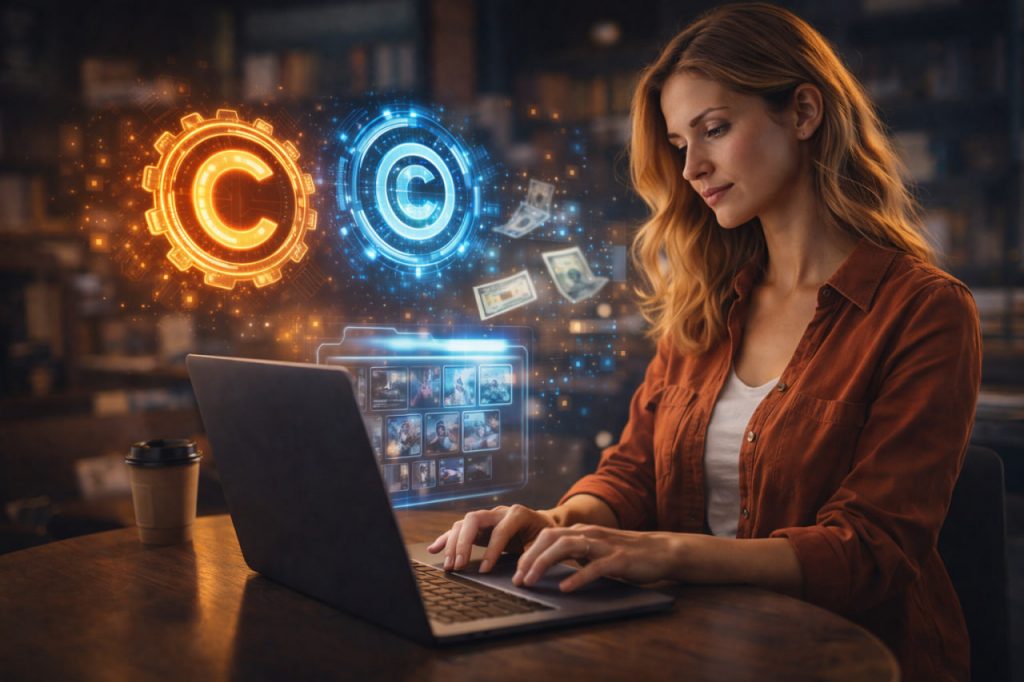
Artificial intelligence is increasingly capable of producing text, images, music, and video that closely resemble human-created works. As these technologies become more widely used in creative industries, an important legal question arises: who owns the rights to content generated by artificial intelligence? Traditional copyright law was designed around human authorship, where a person creates an original work and receives legal protection for it. AI systems complicate this framework because the creative output is generated by algorithms rather than a single identifiable human author. As a result, lawmakers, courts, and technology experts around the world are debating how intellectual property rules should apply to AI-generated works.
What Copyright Protection Means
Copyright is a legal framework that protects original creative works such as books, music, films, photographs, and software. The purpose of copyright is to give creators exclusive rights to reproduce, distribute, and profit from their work for a limited period of time. To qualify for copyright protection in most jurisdictions, a work must meet two key criteria: originality and human authorship.
Artificial intelligence challenges the second requirement. When an AI system generates an image, article, or piece of music, the algorithm performs the creative process. However, the system itself is not a legal entity and cannot hold rights. This creates uncertainty about whether the rights belong to the user, the developer of the AI system, or no one at all.
According to intellectual property researcher Dr. Laura Mendes:
“Copyright law was built around the concept of human creativity, which makes AI-generated works legally complex.”
This complexity is forcing regulators to reconsider how authorship should be defined in the age of generative technology.
The Role of the Human User
In many current legal interpretations, the human user who directs the AI system may be considered the author of the final output. If a person provides prompts, selects outputs, edits the results, or integrates them into a larger project, their creative contribution may qualify for copyright protection. In this scenario, the AI functions as a tool rather than an independent creator.
For example, a designer using AI to generate visual concepts may refine and modify the output before publishing it. The final product may be protected because of the designer’s creative input during the process.
However, purely automated outputs with minimal human involvement may not qualify for copyright in some legal systems.
The Developer’s Perspective
Another perspective focuses on the developers who build the AI systems. Developers create the algorithms, train the models on large datasets, and design the architecture that enables content generation. Some argue that this technical contribution could justify ownership or partial rights to AI-generated works.
However, most legal systems currently separate software ownership from the creative outputs generated by that software. Owning the AI model does not necessarily grant ownership of every piece of content it produces.
Global Differences in Legal Approaches
Copyright rules for AI-generated content vary significantly across countries. In the United States, copyright law generally requires human authorship, meaning fully automated AI outputs may not be protected. The U.S. Copyright Office has stated that works created entirely by machines without human creative input cannot receive copyright protection.
In the European Union, discussions focus on balancing innovation with intellectual property protection. Some policymakers propose recognizing human direction or “creative control” as the basis for ownership.
In China, courts have shown more openness to recognizing certain AI-generated works if sufficient human involvement can be demonstrated.
According to technology law expert Professor Daniel Brooks:
“Global copyright frameworks are evolving as governments attempt to reconcile human creativity with machine-generated outputs.”
These legal differences mean that the status of AI-generated content may vary depending on jurisdiction.
Training Data and Ownership Concerns
Another important issue involves the training data used to build AI models. Generative AI systems learn from massive datasets that may include copyrighted works such as images, books, and music. This raises questions about whether training AI models on protected content violates intellectual property rights.
Content creators have expressed concerns that their work may be used to train AI systems without permission or compensation. Several lawsuits and policy discussions are currently addressing this issue.
Ethical and Economic Implications
Beyond legal ownership, AI-generated content raises broader ethical and economic questions. If machines can produce large volumes of creative material quickly, traditional creative industries may experience significant disruption. Writers, artists, musicians, and designers are increasingly exploring how AI can be used as a collaborative tool rather than a replacement for human creativity.
Clear legal frameworks will be essential to ensure fair compensation, protect intellectual property, and encourage innovation.
The Future of Copyright in the AI Era
As AI technology continues to evolve, copyright law will likely adapt to address new forms of digital creativity. Future frameworks may introduce hybrid models where rights are shared between human creators and technology platforms, or where new legal categories are established specifically for AI-generated works.
International cooperation will also be necessary to prevent conflicting regulations across different countries.
Conclusion
The question of who owns AI-generated content remains one of the most complex legal challenges in modern technology. Traditional copyright systems rely on human authorship, while artificial intelligence introduces automated creative processes that blur these boundaries. Current legal interpretations often recognize the human user as the rights holder when meaningful creative input is involved. However, ongoing debates about training data, developer rights, and global legal differences suggest that copyright law will continue evolving as AI becomes more deeply integrated into creative industries.