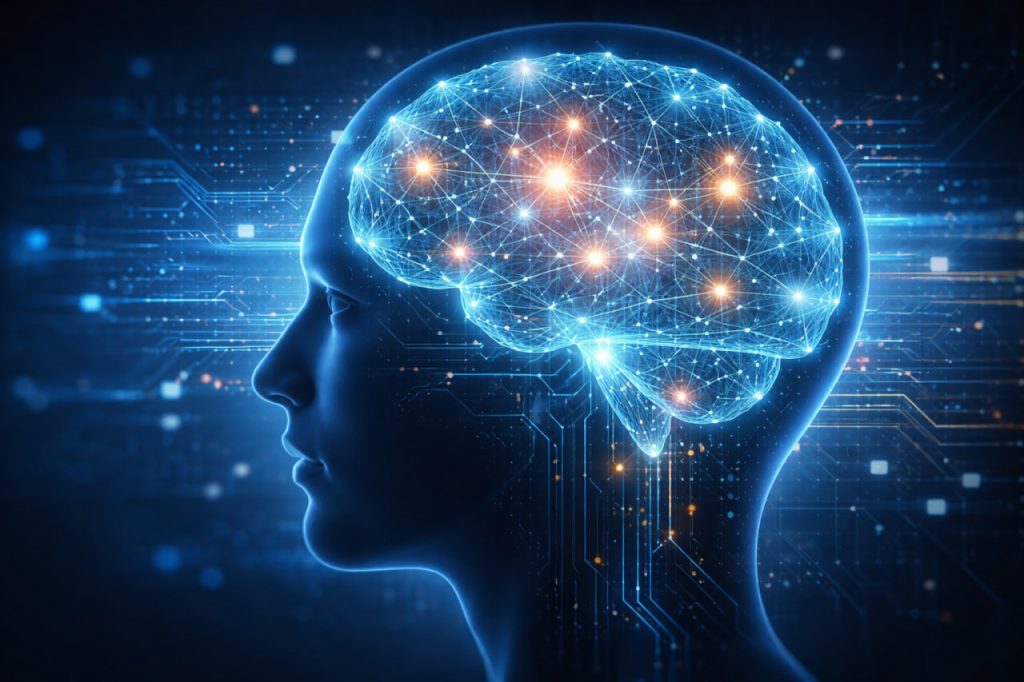
Neural networks are one of the most influential technologies behind modern artificial intelligence, often described as a digital brain because of how they process information. While this comparison is metaphorical rather than literal, it helps explain why neural networks are so effective at recognizing patterns, learning from experience, and making predictions. From image recognition and speech processing to recommendation systems and autonomous vehicles, neural networks form the backbone of many AI applications. Understanding how they work demystifies AI and reveals why data, computation, and structure matter so much.
What a Neural Network Actually Is
A neural network is a computational model inspired by the structure of the human brain, but it operates purely through mathematics. It consists of interconnected units called artificial neurons, which receive inputs, process them, and pass results forward. Each connection has a weight, a numerical value that determines how strongly one neuron influences another. Unlike human neurons, artificial neurons do not think or feel; they calculate.
“Neural networks are best understood as layered mathematical functions optimized to transform data into useful representations,” — Dr. Ethan Moore, machine learning researcher.
Neurons, Weights, and Activation Functions
Each artificial neuron performs a simple operation: it multiplies inputs by weights, sums them, and applies an activation function. The activation function determines whether the neuron “fires” and how strong its output is. Common activation functions include ReLU, sigmoid, and tanh, each shaping how information flows through the network. These functions allow neural networks to model non-linear relationships, which is essential for handling complex real-world data like images or language. Without activation functions, neural networks would be no more powerful than basic linear models.
Layers: From Input to Understanding
Neural networks are organized into layers: an input layer, one or more hidden layers, and an output layer. The input layer receives raw data, such as pixel values or sound waves. Hidden layers gradually extract higher-level features, transforming raw inputs into meaningful patterns. The output layer produces the final prediction or classification.
“Each hidden layer builds a more abstract understanding of the data, similar to how perception evolves from sensation to recognition,” — Dr. Laura Chen, neural computation specialist.
Learning Through Training and Backpropagation
Neural networks learn through a process called training, where they are exposed to large amounts of data. During training, the network makes predictions, compares them to correct answers, and calculates an error. This error is then propagated backward through the network using a method known as backpropagation, which adjusts weights to reduce future errors. Over time, repeated adjustments lead to improved accuracy. This process requires significant computing power, especially for deep networks with millions of parameters.
Deep Neural Networks and Representation Learning
When a neural network has many hidden layers, it becomes a deep neural network, forming the basis of deep learning. Deep networks excel at representation learning, meaning they automatically discover which features matter most without human-designed rules. For example, in image analysis, early layers detect edges, middle layers recognize shapes, and deeper layers identify objects. This hierarchical learning is what enables high performance in vision, speech, and language tasks.
Strengths and Limitations of the Digital Brain
Neural networks are powerful because they scale well with data and improve as more examples become available. However, they also have limitations. They require large datasets, significant energy consumption, and are often difficult to interpret. Their decision-making process can appear opaque, leading to concerns about transparency and trust.
“Neural networks trade interpretability for performance, which is both their strength and their biggest challenge,” — Dr. Michael Grant, AI ethics and systems analyst.
How Neural Networks Differ from the Human Brain
Despite the “digital brain” analogy, neural networks differ fundamentally from biological brains. Human brains are energy-efficient, adaptive, and capable of reasoning across contexts with limited data. Neural networks, by contrast, are task-specific and rely on vast amounts of training data. The analogy helps explain structure, not consciousness or intelligence. Understanding this distinction prevents unrealistic expectations and science-fiction fears.
Conclusion
Neural networks function as a digital brain by processing information through interconnected layers of artificial neurons that learn from data. They excel at pattern recognition and complex transformations but remain mathematical tools rather than thinking entities. By understanding how neural networks work, we gain a clearer view of what modern AI can achieve—and where its real limits lie.