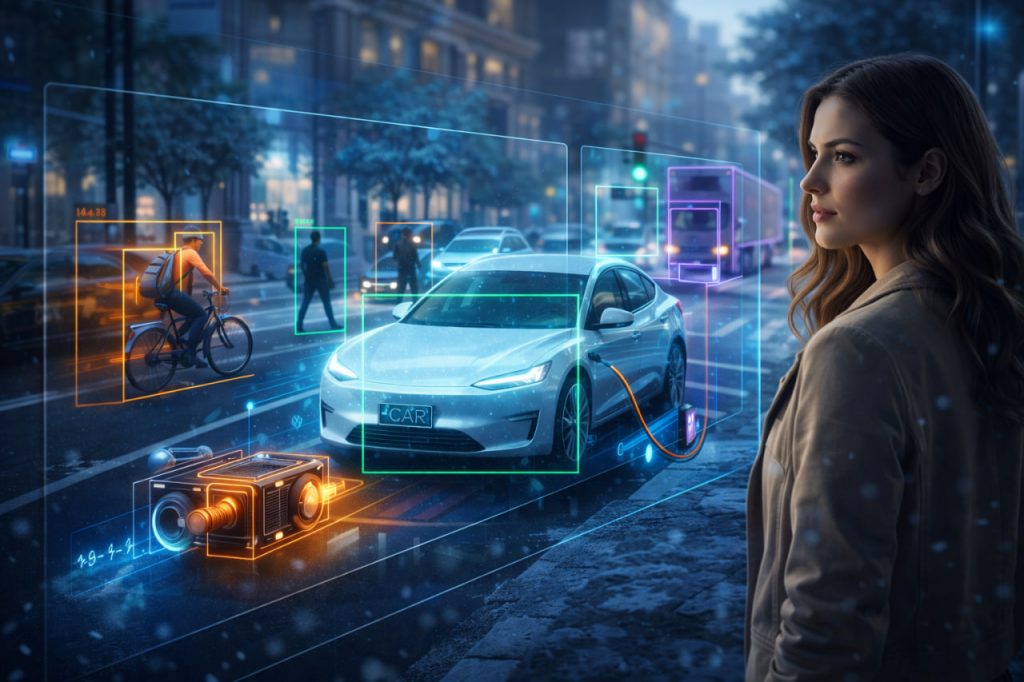
Computer vision is one of the most powerful and fast-evolving branches of artificial intelligence, enabling machines to extract meaning from images and video. At its core, computer vision allows AI systems to transform raw pixels into structured information that can be interpreted, classified, and acted upon. This capability underpins technologies such as facial recognition, medical imaging, autonomous driving, quality control in manufacturing, and visual search. While humans perceive images almost instantly, AI must learn to see through layers of mathematical abstraction, data representation, and probabilistic reasoning.
From Pixels to Data: How Images Become Information
Digital images are composed of pixels, each represented as numerical values corresponding to color intensity. For a computer, an image is not a scene or an object but a grid of numbers. The first challenge of computer vision is converting this raw data into representations that highlight meaningful patterns. Early systems relied on handcrafted features such as edges, corners, and textures, extracted using mathematical filters. These approaches worked in controlled environments but failed when lighting, perspective, or background changed.
“The key challenge in computer vision has always been bridging the gap between raw pixel data and semantic understanding,” — Dr. Andrew Zisserman, computer vision researcher.
Feature Learning and the Rise of Convolutional Neural Networks
Modern computer vision systems rely heavily on convolutional neural networks (CNNs), a class of deep learning models specifically designed for image data. CNNs automatically learn features from images through stacked layers of convolution, pooling, and nonlinear activation. Early layers detect simple patterns like edges and gradients, while deeper layers learn complex structures such as shapes, objects, and spatial relationships. This hierarchical learning mirrors how visual information becomes more abstract as it moves through the human visual cortex, though the mechanisms are purely mathematical.
Training Vision Models: Data, Labels, and Learning
To “understand” images, AI systems must be trained on massive datasets containing millions of labeled examples. In supervised learning, images are paired with labels such as object names, bounding boxes, or segmentation masks. The model learns by minimizing prediction errors across this dataset, gradually improving accuracy. Training requires substantial computational resources, often using GPUs or specialized accelerators.
“In computer vision, scale matters—more diverse data usually leads to more robust visual understanding,” — Dr. Fei-Fei Li, AI and vision pioneer.
Object Detection, Segmentation, and Scene Understanding
Computer vision is not limited to recognizing what is in an image; it also determines where things are and how they relate to one another. Object detection identifies and localizes multiple objects within a scene, while image segmentation classifies every pixel into categories such as road, pedestrian, or vehicle. More advanced systems perform scene understanding, combining visual cues with contextual reasoning to infer actions, depth, and intent. These capabilities are essential for applications like autonomous vehicles and robotics, where understanding spatial relationships is critical for safety.
Vision Beyond Static Images: Video and Motion Analysis
When extended to video, computer vision must also handle temporal information. Models track objects across frames, estimate motion, and recognize activities over time. This introduces additional complexity, as the system must remain consistent while adapting to changing viewpoints and occlusions. Video-based vision enables applications such as surveillance analytics, gesture recognition, and real-time driver assistance systems.
Limitations, Bias, and Reliability Challenges
Despite impressive performance, computer vision systems are not infallible. They can struggle with unusual lighting, rare scenarios, or data distributions not seen during training. Bias in training datasets can lead to unequal accuracy across demographics or environments. Interpretability is also limited, making it difficult to explain why a model made a specific decision.
“High accuracy does not guarantee reliability in the real world—robustness and fairness remain major challenges,” — Dr. Timnit Gebru, AI ethics researcher.
Why Computer Vision Matters for the Future
Computer vision is becoming a foundational layer of digital infrastructure, enabling machines to interact with the physical world. As models improve and integrate with other AI systems such as natural language processing and decision-making engines, visual understanding will become more contextual and adaptive. This convergence is driving progress in fields ranging from healthcare and transportation to energy and smart cities.
Conclusion
Computer vision allows AI to analyze images by converting pixels into hierarchical representations learned from data. Through deep neural networks, especially convolutional architectures, machines can recognize objects, understand scenes, and interpret visual patterns at scale. While limitations remain, computer vision continues to reshape how technology perceives and interacts with the world, making it one of the most impactful domains of modern artificial intelligence.