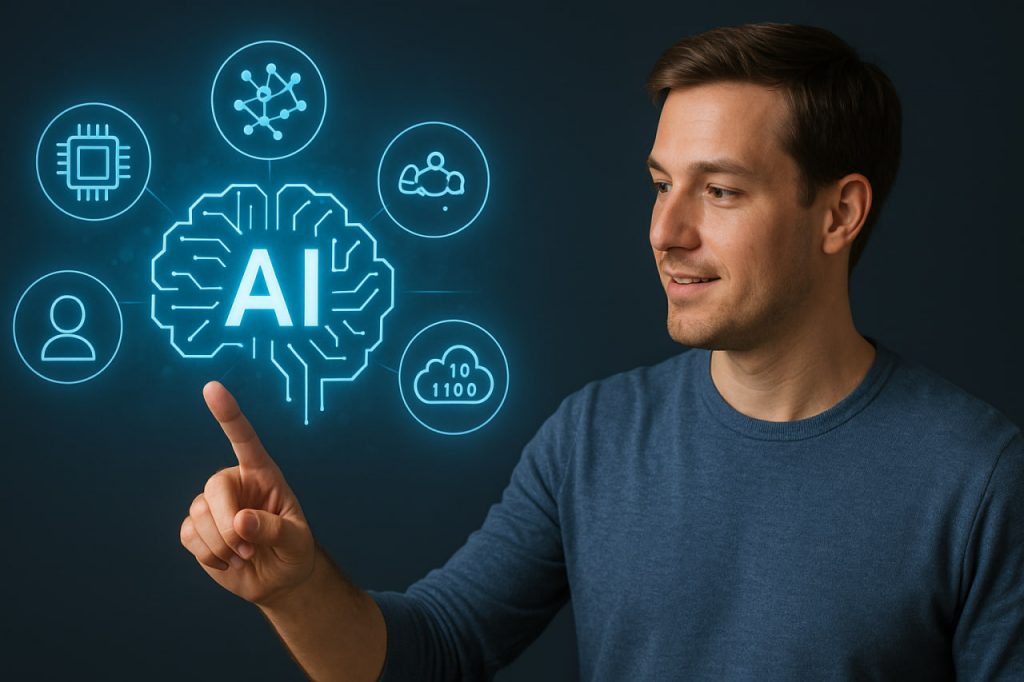
Artificial Intelligence, often called AI, may sound complex and intimidating, but at its core it is simply a set of technologies designed to help machines perform tasks that normally require human intelligence. AI systems are already part of everyday life, even if people do not always notice them. From smartphone assistants and navigation apps to online recommendations and spam filters, AI works quietly in the background to analyze information and make decisions. Understanding AI at a basic level helps reduce fear and builds awareness of how modern technology actually functions.
What Artificial Intelligence Really Means
Artificial Intelligence (AI) refers to computer systems that can analyze data, recognize patterns, and make decisions based on learned information. Unlike traditional software, which follows fixed instructions, AI adapts its behavior using data. Most modern AI belongs to a category called narrow AI, meaning it performs one specific task very well, such as recognizing faces or translating text. It is important to note that AI does not think or feel like a human; it operates using mathematics, statistics, and logic.
“AI is best understood as advanced data processing, not as a digital mind,” — Dr. Andrew Collins, computer science educator.
How AI Learns: A Simple Breakdown
AI systems learn through a process known as machine learning, where algorithms analyze large amounts of data to find patterns. For example, an AI trained to recognize images studies thousands of labeled pictures to learn what objects look like. Over time, it improves accuracy by adjusting internal parameters, a process similar to learning from experience. A more advanced method called deep learning uses layered structures known as neural networks, inspired by the human brain but functioning very differently.
“Machine learning allows systems to improve performance without being explicitly programmed for every situation,” — Dr. Melissa Grant, data science researcher.
Where You Already Use AI Every Day
Many people interact with AI daily without realizing it. Recommendation systems suggest movies, music, and products based on previous behavior. Voice assistants understand spoken commands and respond using language models. Navigation apps use AI to predict traffic and suggest faster routes. These systems do not understand meaning in a human sense, but they are very effective at processing massive amounts of information quickly.
What AI Can and Cannot Do
AI is powerful, but it has clear limitations. It cannot feel emotions, make moral judgments, or understand context beyond its training data. AI also depends heavily on data quality, meaning biased or incorrect data can lead to flawed outcomes. This is why human oversight remains essential in all AI applications.
“AI amplifies human decisions—it does not replace human responsibility,” — Dr. Jonathan Hayes, technology ethics specialist.
Common Myths About AI
One of the most common myths is that AI will suddenly become self-aware and replace humans. In reality, artificial general intelligence (AGI)—a system that can think like a human—does not currently exist. Another misconception is that AI always makes perfect decisions, while in truth it can make mistakes if trained poorly. Understanding these myths helps separate science fiction from real technology.
Why Learning About AI Matters
Basic AI literacy helps people make informed decisions about technology, privacy, and work. As AI becomes more common in healthcare, transportation, and education, understanding how it works builds confidence and critical thinking. Learning AI fundamentals is not about becoming a programmer, but about understanding the tools shaping modern life.
Conclusion
AI is not magic, consciousness, or science fiction—it is a practical technology designed to analyze data and assist humans. For beginners, understanding AI means recognizing its capabilities, limitations, and role in everyday life. When viewed realistically, AI becomes less intimidating and more understandable as a helpful tool created and controlled by people.


AI is only a step, for general public to accept it, in their lives. It is soft, it is a bended down version of what we will see 10 to 20 years. Look at the current AI, which ever you look at it, they are just like (if you happen to live during 2000’s MSN/Myspace era) facebook when it launched. Daily Motion, Myspace. They are sterile, people are having fun with it, helps people solve things on their own. Easy, accessible, no annoying futures or agendas. How long did it take for us to come from that era of social media, to Brain Rot Tiktok, Instagram Reels that makes people addicted, sells only specific agendas and only works for ad revenues? It will happen again, much faster, and much harder as well. We are in the step of being addicted to it. More and more corporations and companies are joining just like they did to social medias back in the day, they will make movies with GenAI, games with it. There will be security issues, some countries will ban, there will be restrictions, people will use VPN to access their ChatGPT’s or idk artifical girlfriends. They will be manipulated, and targeted for political agendas. AI will now who you are so well, that it will tell you everything in a language that only you want to hear. It will sell you things that you did not know you needed, it will alter your mind, slowly, to purchase or support ideologies. Most people, like I am right now, will go against it will be left behind, just like when the elderly first was against social media, then they too became addicted to it through farming games, through connecting with their relatives, one by one we shall join too. Time, is not a lineer thing you know. These things work, these steps. Nothing on this scale can be accidental nor be called ”new” technology.