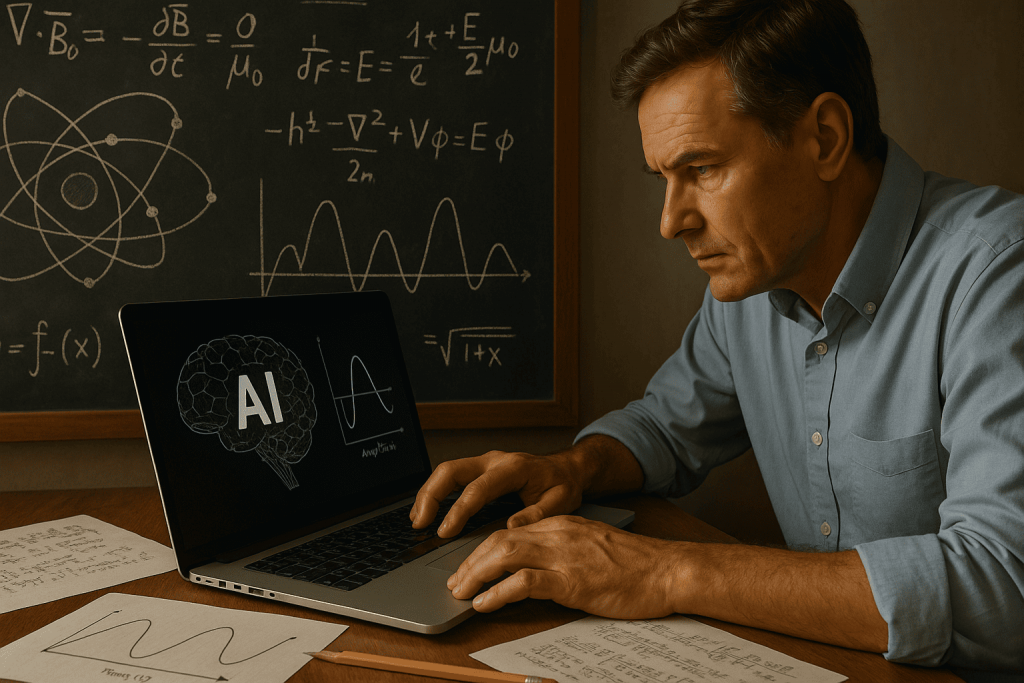
Science advances when patterns become principles—when messy observations crystallize into equations, models, and mechanisms. GPT-class systems are astonishing at finding and articulating patterns across oceans of text and data. But can a language model really help uncover new laws of nature? This article explores where GPT meaningfully accelerates discovery, where it hits hard limits, and how human curiosity and judgment remain indispensable—even in an age of smart machines.
What GPT actually brings to the lab
GPT is a universal interface over knowledge. It reads papers at scale, translates jargon between disciplines, drafts code for analysis, summarizes debates, and proposes candidate hypotheses conditioned on prior evidence. It can align datasets, suggest experimental controls, design ablation studies, and generate interpretable “first-pass” models that scientists refine. In short, GPT compresses the overhead of science—the meta-work of reading, coding, and coordinating—so humans can spend more time on insight.
From literature firehose to living map
One of GPT’s superpowers is turning the literature deluge into a navigable landscape. It can cluster papers by method and result, extract effect sizes and caveats, and surface contradictions that warrant replication. It drafts related-work sections, but more importantly, it highlights gaps—unmeasured variables, missing controls, unexplored regimes—where novel experiments could pay off. With retrieval-augmented generation, it cites sources and flags uncertainty, making the map auditable rather than mystical.
Hypothesis generation that’s grounded, not hand-wavy
Given structured data summaries and constraints, GPT can propose families of hypotheses that specialize across regimes: “If X holds only at low Reynolds number, test Y in the transitional regime; if not, instrument Z to separate confounders.” Prompted well, it outputs testable predictions, suggested measurements, and pre-registered decision rules. It’s not an oracle; it’s a catalyst for more disciplined curiosity.
Equation discovery and symbolic regression
Beyond prose, GPT can assist symbolic tools that search for governing equations (e.g., sparse regression, genetic programming). It helps prune the search space with dimensional analysis, invariance hints, and physically sane priors, then explains candidate forms in plain language. The loop is pragmatic: numerical methods propose forms; GPT critiques them for units, boundary behavior, and interpretability; humans decide what survives.
Closed-loop science: design → run → learn → refine
In automated labs and simulations, GPT can act as an orchestration layer: drafting protocols, writing control scripts, proposing active-learning batches, and updating a “lab memory” of what worked and why. It can formalize stopping criteria (“halt when improvement < δ for 5 rounds”), switch models when drift is detected, and produce end-of-day briefs that keep human oversight tight. Think of it as a careful chief of staff for your experimental pipeline.
Case sketches across fields
In materials science, GPT helps connect synthesis recipes, phase diagrams, and property tables, suggesting compositional tweaks that balance stability and performance. In biology, it harmonizes heterogeneous omics datasets, proposes causal graphs to test (with explicit “unknown” edges), and drafts CRISPR screening libraries with controls. In astronomy, it prioritizes anomalies for follow-up by cross-referencing survey catalogs with instrument quirks and weather logs. In climate and earth science, it distills ensemble models, identifies regions of model disagreement, and frames field campaigns to reduce uncertainty where it matters. 🚀
Causality is the cliff
GPT infers patterns from correlations it sees across text and data, but causality requires interventions or strong identification strategies. A fluent model can sound causal while remaining purely associative. The remedy is procedural: pre-register hypotheses, encode identification assumptions explicitly (instruments, natural experiments, randomization), and make the model state when evidence is insufficient to claim causality. GPT should propose how to test, not declare what is true.
Uncertainty first, always
Scientific outputs must carry uncertainty. GPT can be required to attach confidence notes, bounds, and sensitivity checks (“if measurement error doubles, the effect estimate collapses”). It can generate simulation-based calibration tasks so you understand failure modes before touching real data. Models that refuse to say “I don’t know” are dangerous; teach yours to abstain.
Reproducibility as a feature, not an afterthought
Ask GPT to emit every analysis step as code + manifest: versions, seeds, data lineage, and environment specs. Have it auto-generate unit tests for key transforms, and an executable report with figures rebuilt from raw inputs. When a result changes, the model should highlight exactly which data, parameter, or dependency shifted—and draft a changelog your future self can trust.
How GPT fails (predictably) in scientific work
It can hallucinate citations or interpolate beyond the valid regime of a model. It may “average out” conflicting findings into a safe but useless summary. It can mirror prevailing biases in the literature, overlooking negative results or underrepresented perspectives. It might design experiments that are elegant on paper but impossible under real constraints (budget, instrument limits, biosafety). Each failure mode has a countermeasure: citation validation, regime checks, bias audits, and feasibility reviews with domain experts.
Human intuition: the irreplaceable compass
Discovery often hinges on taste for the right question, skepticism toward convenient stories, and the courage to pursue an odd signal. GPT can model styles of reasoning but doesn’t feel the risk of being wrong, the pressure of limited lab time, or the aesthetic sense that a theory “hangs together.” Human intuition chooses which anomalies are meaningful, which simplifications are dishonest, and which detours are worth a week of work.
Ethics, credit, and the political economy of discovery
As AI accelerates science, questions of attribution, consent, and access sharpen. Data often contain people’s lives; methods embed labor from technicians to community observers. Use consented datasets, document provenance, and share credit generously. If a model helped shape a discovery, say how—not to glorify the tool, but to make the process legible and reproducible.
Design patterns for “AI-native” scientific workflows
Successful teams treat prompts like protocols: versioned, reviewed, and tied to acceptance criteria. They separate exploration (fast, messy) from confirmation (slow, rigorous). They keep retrieval allow-lists for trusted corpora, bind outputs to schemas, and enforce guardrails that block unsafe lab actions. They run regular red-team sessions: try to make the system suggest a flawed inference, then harden it.
Collaboration: translation layers between disciplines
GPT shines as an interpreter: turning a physicist’s abstraction into a biologist’s experiment, summarizing a statistician’s identification argument for an engineer, or rephrasing a chemist’s reaction mechanism for a materials team. This lowers the friction of interdisciplinary work, where breakthroughs often hide.
Education: raising a new kind of scientist
Tomorrow’s scientists need fluency in prompting, evaluation, and guardrails—not to chase “prompt magic,” but to encode scientific norms into the machine. Lab courses can include closed-loop experiments with AI proposing next steps, while students learn to reject seductive but ungrounded suggestions. The goal is judgment amplified by tools, not judgment outsourced to them.
Will GPT discover laws of nature?
In some domains, yes—indirectly. By compressing literature, proposing candidate invariants, and steering symbolic search, GPT can help humans articulate governing relations faster. In other domains where new observations or instruments are the bottleneck, GPT accelerates the path to the critical experiment rather than the law itself. Either way, the “discovery moment” remains a human act of endorsement: we accept a principle not because a model said it, but because evidence, argument, and replication converge.
Practical safety rails you can adopt this week
Bind GPT to verified sources and require citations; mark unverified claims. Force structured outputs for hypotheses: assumptions, predicted direction and magnitude, tests, and potential falsifiers. For code, require runnable notebooks with unit tests. For conclusions, demand an “alternatives considered” section. And practice saying “unknown”—you’ll trust the model more when it admits it.
A glimpse ahead
As models become more grounded—reading instruments directly, training on simulation-to-real loops, reasoning with constraints—AI will partner more deeply in theory formation. Expect tools that suggest symmetries, conservation laws, or hidden variables because those forms best compress diverse datasets. Expect debates to shift from “can AI discover?” to “which discoveries count, and how do we verify them across labs and contexts?”
Conclusion: patterns need principles, and principles need people
GPT is already a capable research assistant and a promising hypothesis engine. It will not replace the scientist’s eye for a clean experiment, the skeptic’s refusal of pretty stories, or the community’s demand for reproducibility and care. Treat the model as a force multiplier for disciplined curiosity: let it map the terrain, draft the code, and propose the next step—while humans decide which paths are worthy, which results are real, and what they mean for our shared understanding of nature.