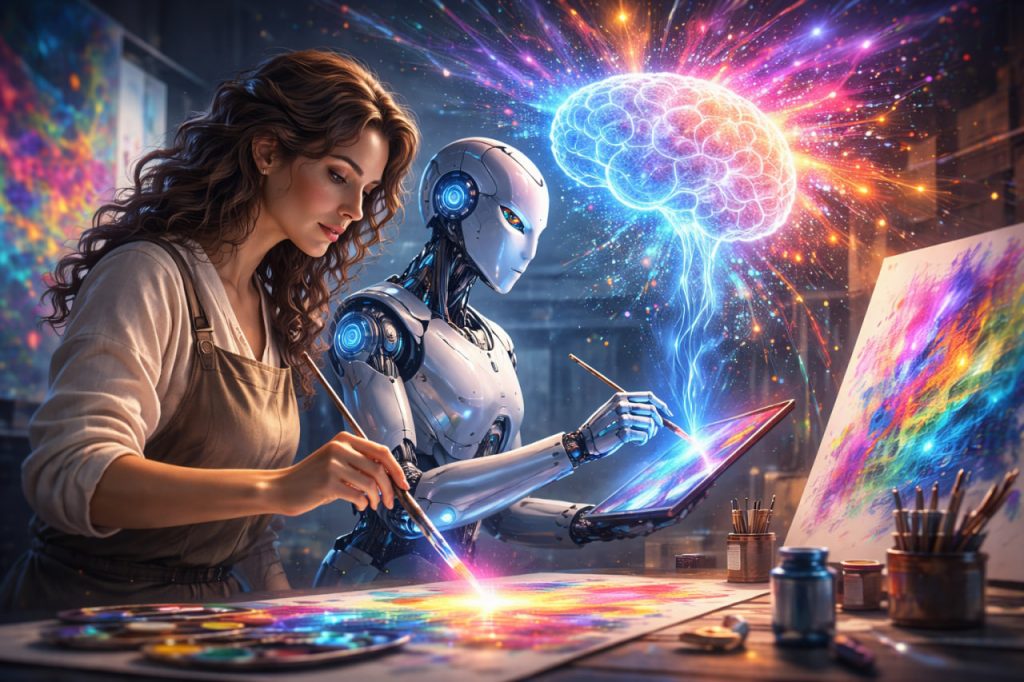
The question of whether artificial intelligence can truly be creative lies at the intersection of technology, philosophy, and human identity. As AI systems begin to generate art, music, writing, and even scientific ideas, they challenge long-standing assumptions about creativity being an exclusively human trait. At first glance, the outputs of AI can appear original and expressive, raising a fundamental question: is creativity defined by the process, the result, or the intention behind it? Exploring this issue requires a deeper understanding of what creativity actually means and how AI operates in comparison to the human mind.
What Is Creativity in Philosophical Terms
In philosophy, creativity is often defined as the ability to produce something both novel and valuable. Human creativity is closely tied to consciousness, emotion, and intentionality, meaning that ideas are not only new but also driven by purpose and subjective experience. This raises a key distinction: humans create with meaning, while AI generates outputs based on patterns.
According to philosopher Dr. Eleanor Hayes:
“Creativity is not just the production of novelty—it is the expression of intention shaped by experience.”
How AI Generates “Creative” Content
Artificial intelligence relies on machine learning, neural networks, and large datasets to produce outputs that resemble human creativity. Systems analyze existing works, identify patterns, and recombine elements in new ways. This process is often referred to as generative modeling, where AI predicts what a plausible new output should look like based on prior data. While the results can be impressive, they are fundamentally rooted in statistical relationships rather than independent thought.
According to AI researcher Dr. Kevin Liu:
“AI does not imagine; it calculates probabilities of what might come next based on learned patterns.”
Creativity Without Consciousness: Is It Possible?
One of the central philosophical debates is whether consciousness is necessary for creativity. If creativity requires awareness, intention, and subjective experience, then current AI cannot be considered truly creative. However, if creativity is judged solely by the output—novel and useful results—then AI may qualify as a creative tool or system. This leads to the concept of functional creativity, where value is measured by results rather than internal experience.
Human-AI Collaboration as a New Form of Creativity
Rather than replacing human creativity, AI is increasingly seen as an amplifier of it. Artists, writers, and designers use AI tools to explore new ideas, accelerate workflows, and expand creative boundaries. This creates a hybrid model where human intuition and AI pattern generation work together. In this context, AI becomes part of the creative process rather than an independent creator.
According to digital artist Sophia Reynolds:
“The most powerful creativity emerges when humans and AI collaborate, combining emotion with computational exploration.”
The Illusion of Originality
Another important concept is the illusion of originality. AI outputs may appear new, but they are always derived from existing data. Humans also build on past knowledge, but they reinterpret it through personal experience and context. AI lacks this subjective layer, which raises doubts about whether its outputs can truly be called original in the philosophical sense.
The Future of Creativity in the Age of AI
As AI systems become more advanced, the boundary between human and machine creativity may continue to blur. Future developments could introduce more sophisticated forms of context awareness and adaptive learning, making AI outputs even more convincing. However, unless AI develops consciousness—something currently unsupported by science—it will remain fundamentally different from human creativity.
Conclusion
Artificial intelligence can generate content that appears creative, but from a philosophical perspective, it lacks the intention, consciousness, and subjective experience that define true creativity. Rather than being a replacement for human imagination, AI should be understood as a powerful tool that expands creative possibilities while leaving the essence of creativity rooted in human experience.