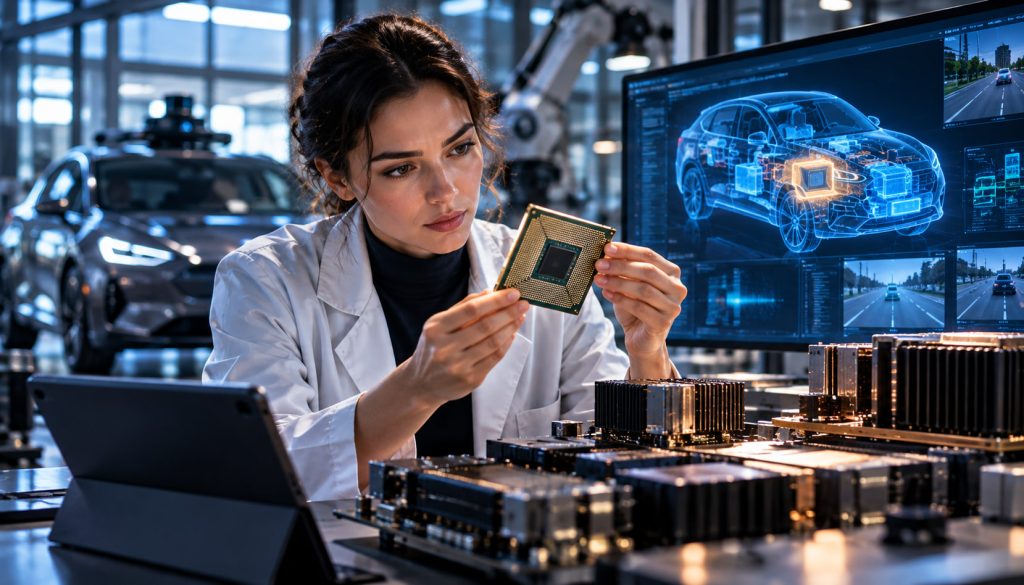
Artificial intelligence may feel like software, but every AI answer ultimately comes from hardware. Behind a chatbot response, an autonomous-driving decision, an image generator, or a scientific AI model sits an enormous amount of numerical computation performed by specialized processors.
Over the past several years, these chips have become some of the most strategically important components in the technology industry. The reason is simple: modern neural networks require a type of computing that conventional processors were never designed to perform efficiently.
A useful automotive comparison is the difference between a general-purpose engine and a powertrain engineered specifically for racing. A conventional processor can perform almost any computing task, but an AI accelerator is designed to perform a much narrower set of mathematical operations at extraordinary speed and efficiency.
Today, the term AI processor can describe graphics processing units, tensor processors, neural processing units, custom accelerators, and specialized automotive systems-on-chip. Increasingly, however, the processor itself is only one part of the story. Memory, networking, packaging, cooling, and software have become equally important.
Why Artificial Intelligence Needs Special Processors
Traditional central processing units, or CPUs, are designed for flexibility.
A modern CPU can operate an operating system, open applications, manage storage, run spreadsheets, control peripherals, execute game logic, and handle countless other tasks.
AI workloads behave differently.
Neural networks repeatedly perform huge numbers of relatively similar mathematical calculations, particularly matrix and vector operations. Instead of asking a handful of powerful CPU cores to process those calculations sequentially, AI hardware attempts to execute enormous numbers of operations in parallel.
That is why graphics processors became central to the AI revolution.
GPUs were originally designed to calculate millions of pixels and geometric operations simultaneously. Researchers realized that the same parallel architecture was extremely effective for neural-network calculations.
The rise of modern AI was therefore not driven by software alone. It depended heavily on processors capable of performing parallel mathematics at enormous scale.
CPU, GPU, NPU and TPU: What Is the Difference?
The terminology surrounding AI processors can become confusing because different architectures often overlap.
A CPU remains the general-purpose controller. It handles operating systems, data preparation, application logic, storage access, and many tasks that do not benefit from massive parallelization.
A GPU contains many processing units optimized for highly parallel workloads. GPUs remain among the most important processors for both AI training and inference.
An NPU, or neural processing unit, is generally a specialized accelerator designed primarily for neural-network inference. NPUs are increasingly built into smartphones, laptops, cameras, industrial devices, and vehicles because they can perform AI calculations with relatively low power consumption.
A TPU, or tensor processing unit, is Google’s name for its family of custom AI accelerators. Instead of adapting a graphics architecture, Google designed TPUs specifically around machine-learning workloads.
There are also numerous custom AI ASICs, or application-specific integrated circuits, developed by cloud providers, semiconductor companies, automakers, and technology firms.
The distinction is becoming less rigid. Modern processors frequently combine CPU cores, GPU-style accelerators, matrix engines, video processors, security modules, and dedicated AI blocks in one package.
Training and Inference Require Different Priorities
AI computing is normally divided into two major stages: training and inference.
Training is where a model learns.
Large datasets are processed repeatedly while billions or even trillions of internal parameters are adjusted. Training frontier AI models can require thousands of accelerators operating together for extended periods.
Training therefore emphasizes enormous computational throughput, memory bandwidth, networking performance, and scalability.
Inference happens after the model has been trained.
When a user sends a question to an AI assistant, asks a vehicle to recognize an object, or requests an image, the model performs inference.
Inference has different requirements. Latency becomes critical because users expect immediate responses. Energy efficiency and operating cost become especially important because a popular service may handle millions of requests every day.
Training builds the intelligence; inference is where that intelligence is repeatedly used.
Modern AI processor designs increasingly specialize around one of these roles or provide separate configurations optimized for each.
Why GPUs Became the Dominant AI Engine
GPUs became the standard hardware for much of modern AI because their architecture matched neural-network mathematics unusually well.
A CPU may contain a relatively small number of sophisticated cores. A GPU contains many more simpler computational units capable of processing thousands of operations simultaneously.
The advantage becomes enormous when multiplying large matrices, which is fundamental to deep learning.
NVIDIA built a particularly strong position by combining powerful GPU hardware with CUDA, its mature software platform for accelerated computing. Developers gained access not merely to processors, but to libraries, compilers, development tools, networking technologies, and optimized machine-learning frameworks.
That software ecosystem matters because raw silicon performance means little if developers cannot efficiently use it.
NVIDIA’s 2026 Vera Rubin platform demonstrates how far the concept has evolved. The company describes Rubin not merely as a GPU generation but as a rack- and data-center-scale platform integrating processors, memory, networking, and systems designed for increasingly demanding agentic AI workloads.
AMD and the Growing Competition for AI Compute
NVIDIA is not the only company pursuing high-performance AI accelerators.
AMD’s Instinct family has become an important alternative, particularly for large-scale data centers and high-performance computing.
The 2026 Instinct MI400 family includes the MI455X for frontier AI and the MI430X for AI and high-performance computing. AMD is also promoting rack-scale systems containing dozens of accelerators connected as an integrated computing platform.
AMD’s software strategy centers on ROCm, an open software platform designed to support machine learning and accelerated computing.
This competition is important because AI hardware buyers increasingly care about more than peak benchmark numbers. They consider software compatibility, model support, networking, memory capacity, availability, power consumption, and total system cost.
The AI processor market is increasingly becoming a competition between complete computing ecosystems rather than isolated chips.
Google’s TPU Shows Why Specialized Architecture Matters
Google took a different approach.
Rather than relying exclusively on general-purpose GPUs, the company developed its own Tensor Processing Units specifically for machine learning.
Google’s eighth-generation TPU systems, announced in 2026, include separate designs for different AI workloads. TPU 8t is focused heavily on training, while TPU 8i targets inference and reinforcement-learning workloads where latency and memory behavior are particularly important. Google says TPU 8t systems can be assembled into superpods containing thousands of processors.
The basic idea behind TPUs illustrates a broader semiconductor trend.
David Patterson, a Turing Award-winning computer architect and professor emeritus at the University of California, Berkeley, has long argued that as conventional processor scaling becomes harder, domain-specific architectures can deliver major gains in performance and energy efficiency. His research on Google’s early TPU showed dramatic advantages for specialized machine-learning hardware compared with conventional processors of the time.
That principle now influences almost every major AI chip developer.
Memory Is Becoming as Important as Computing Power
One of the most misunderstood aspects of AI processors is that arithmetic performance alone does not determine speed.
Modern AI models contain enormous numbers of parameters. Those parameters must be moved continuously between memory and processing units.
If a processor can perform calculations faster than memory can supply data, the expensive compute units sit partially idle.
This is known as the memory bandwidth problem.
High-bandwidth memory, or HBM, has therefore become fundamental to modern AI accelerators.
HBM packages stack memory vertically and place it close to the processor, allowing enormous amounts of data to move with much greater bandwidth than traditional memory systems.
As models become larger, memory capacity matters as well.
A processor that cannot hold enough of a model locally must constantly transfer data between devices, increasing latency and power consumption.
For modern AI hardware, memory bandwidth can be just as important as raw processor speed.
Advanced Packaging Is Changing What a “Chip” Means
There was a time when improving processor performance primarily meant placing more transistors on a single silicon die.
That approach is becoming increasingly difficult and expensive.
Modern AI processors increasingly use multiple chiplets and memory stacks connected inside one advanced package.
TSMC’s CoWoS technology is one example. It enables logic chips and multiple high-bandwidth memory stacks to be integrated using advanced interconnect technology. TSMC says demand for this type of packaging increased sharply following the generative AI boom.
In 2026, TSMC said it was already producing larger CoWoS packages and planning substantially larger generations to accommodate more computing dies and HBM stacks.
This trend changes the meaning of the word processor.
A cutting-edge AI accelerator may effectively be a miniature computing system containing multiple silicon components, memory stacks, high-speed interfaces, and power-delivery structures.
Networking Turns Thousands of Chips into One Machine
A single AI processor, no matter how powerful, cannot train the largest models alone.
Thousands of accelerators must work together.
The challenge is keeping them synchronized.
Every processor must exchange enormous quantities of data with others. If communication is too slow, much of the theoretical compute performance is wasted waiting for information to arrive.
This is why technologies such as high-speed Ethernet, proprietary accelerator interconnects, optical networking, and specialized switching have become essential components of AI infrastructure.
NVIDIA’s latest systems, Google’s TPU superpods, and AMD’s rack-scale platforms all reflect the same trend: the unit of AI computing is moving from the individual chip toward the rack, cluster, and entire data center.
In practical terms, designing a modern AI system increasingly resembles designing a distributed supercomputer.
Lower Precision Makes AI Faster
AI processors also achieve performance gains by reducing numerical precision.
Traditional scientific computing often uses 32-bit or 64-bit floating-point numbers.
Many neural-network calculations do not require that level of precision.
AI accelerators increasingly support formats such as FP16, BF16, FP8, and even 4-bit formats for certain workloads.
Using smaller numbers provides several benefits.
More calculations can be performed using the same silicon area. Less memory is required. Data moves faster. Energy consumption per operation decreases.
The challenge is maintaining model quality.
Training may require relatively high precision in some stages, while inference can often use more aggressive quantization.
This is one reason headline performance figures can be misleading. A processor may advertise enormous performance at FP4 while delivering very different performance at FP16.
Why TOPS and FLOPS Do Not Tell the Whole Story
AI processors are frequently marketed using enormous numbers measured in TOPS or FLOPS.
TOPS means trillions of operations per second. FLOPS refers to floating-point operations per second.
These figures can be useful, but comparisons require caution.
Performance depends on:
- Numerical precision
- Model architecture
- Memory bandwidth
- Memory capacity
- Software optimization
- Batch size
- Networking
- Power limits
- Latency requirements
Two processors advertising similar TOPS may perform very differently in a real application.
Automotive buyers already understand a comparable problem: maximum horsepower does not tell you fuel economy, acceleration under every condition, thermal performance, reliability, or how well the transmission uses that power.
AI processor specifications require the same skepticism.
AI Processors Are Moving Into Cars
Some of the most interesting AI processors do not live in giant data centers.
Modern vehicles increasingly require powerful local AI computing for perception, driver assistance, voice interfaces, driver monitoring, and autonomous-driving functions.
Cars create a very different engineering challenge.
A data-center accelerator can consume enormous amounts of electricity and rely on industrial cooling. An automotive processor must operate within strict power, temperature, reliability, and safety limits.
It must also respond immediately.
A vehicle cannot wait for a distant cloud data center before deciding whether an object ahead is a pedestrian.
NVIDIA’s DRIVE AGX Thor automotive computer uses the company’s Blackwell architecture and is designed for advanced driver assistance and autonomous-driving workloads. NVIDIA lists more than 1,000 INT8 TOPS for the platform and positions it for systems ranging from advanced assistance to highly automated driving.
Qualcomm is pursuing a similar direction with Snapdragon Ride. Its newer automotive systems combine CPU processing, neural acceleration, perception, cockpit functionality, and safety-related computing. Qualcomm says Snapdragon Ride Flex has already entered mass-produced vehicle programs and is designed to combine cockpit and driver-assistance workloads on centralized vehicle computers.
The software-defined vehicle is becoming an AI computer on wheels.
Energy Is Becoming the Next Major Constraint
The faster AI processors become, the more electricity large-scale AI infrastructure can consume.
This creates an unusual situation.
A new chip may be considerably more efficient per calculation while the total system still consumes more energy because companies deploy vastly more processors and run much larger models.
Power delivery and cooling are therefore becoming central design problems.
Large AI data centers require sophisticated liquid cooling, high-capacity electrical infrastructure, efficient power conversion, and careful thermal engineering.
Performance per watt may ultimately become more important than peak compute performance.
The same is true in vehicles, smartphones, laptops, and robots, where battery capacity and heat dissipation create even stricter limits.
The Future of AI Processors
The next generation of AI chips will probably not be defined by one revolutionary invention.
Progress is coming from many technologies simultaneously:
- Smaller semiconductor manufacturing processes
- Larger advanced packages
- More chiplets
- Faster HBM
- Optical communication
- Improved interconnects
- Lower-precision mathematics
- Specialized inference hardware
- Better compilers
- More efficient models
- Tighter hardware-software integration
The industry is also moving toward increasingly specialized systems.
Massive data-center processors will train frontier models. Inference accelerators will serve billions of requests. Automotive processors will make real-time decisions inside vehicles. Small NPUs will run private AI applications directly on consumer devices.
The result will not be one universal AI processor.
It will be an ecosystem of architectures optimized for different combinations of speed, cost, energy consumption, memory, latency, and safety.
Conclusion
AI processors have become the physical foundation of the artificial intelligence revolution.
GPUs remain central because their parallel architecture and mature software ecosystems are ideally suited to neural networks. Google’s TPUs demonstrate the advantages of specialized hardware. AMD is increasing competition in data-center accelerators, while automotive platforms from NVIDIA, Qualcomm, and others are bringing increasingly powerful AI directly into vehicles.
But the modern AI processor is no longer just a piece of silicon.
Its real performance depends on memory, advanced packaging, networking, cooling, software, and the ability to connect thousands of computing elements into a coordinated system.
That is why the AI hardware race increasingly resembles the development of an entire vehicle rather than a competition between individual engines. A powerful processor matters, but only when every surrounding component can deliver data, power, cooling, and software fast enough to use it.
As AI models continue to grow more capable, processors will become faster and more specialized—but efficiency may ultimately be the most important metric of all.